What Is HVAC and Why Does It Matter?
Walk into almost any hospital, school, office building, grocery store, hotel, or airport, and you’ll experience something you probably don’t even think about.
Comfort.
The room is cool during the summer.
Warm during the winter.
The air feels fresh.
Humidity is controlled.
The temperature remains stable whether it’s 115°F in Arizona or below freezing in the northern states.
None of that happens by accident.
It’s made possible by HVAC.
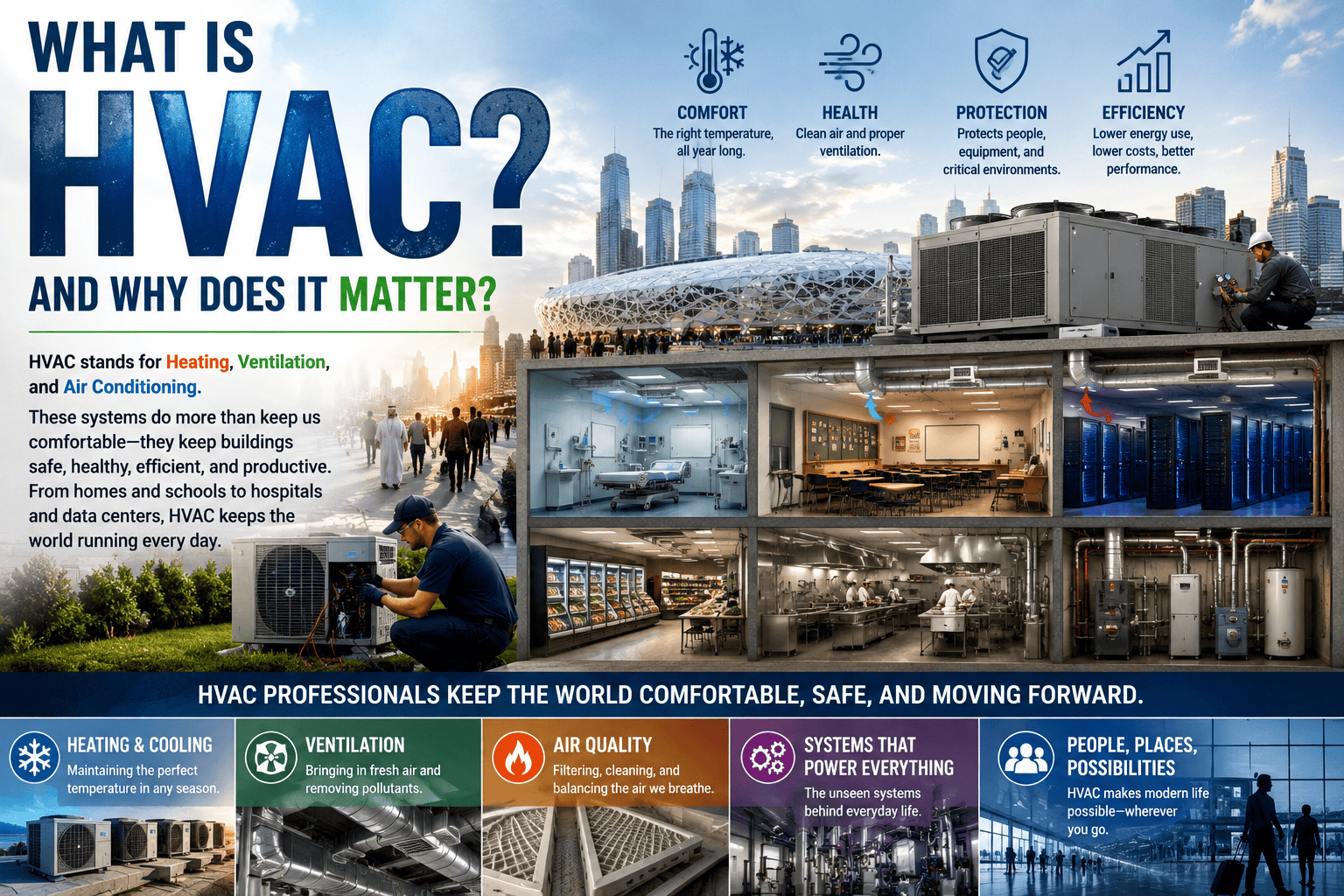
HVAC stands for Heating, Ventilation, and Air Conditioning, but it represents much more than a collection of equipment. It is one of the most important systems supporting modern life.
Without it, many of the places we depend on every day simply couldn’t operate the way they do.
The History of HVAC
People have tried to control indoor temperatures for thousands of years.
- Ancient Romans using aquaducts and circulating water.
- Persians using wind towers for passive cooling.
- Ice houses.
- Coal and wood furnaces.
And of course the Industrial Revolution that created the demand for better ventilation.
Spearheaded by past Presidents;
- Franklin D. Roosevelt helped push for massive public buildings, schools, hospitals, and government infrastructure which increased the demand.
- Dwight Eisenhower pushed for the Interstate Highway System which resulted in hotels, motels, restaurants and truck stops all needing HVAC.
- Jimmy Carter fought the energy crisis which pushed for more efficient equipment, insulation and building codes to help regulate the industry.
- George H.W. Bush signed amendments to strengthen ozone protection under the Clean Air Act, leading to the phaseout of many ozone depleting refrigerants.
More Than Just Comfort
Most people think HVAC is about making homes comfortable.
Comfort is certainly part of the job, but HVAC has a much bigger purpose.
Willis Carrier is probably the single most important person in HVAC as he designed modern air conditioning in 1902, and he built it for humidity control, not comfort, as printing companies needed stable humidity.
HVAC protects:
- Hospitals where patients require precise temperatures to hinder the spread of bacteria and viruses.
- Data centers that power the internet need it to stay cool.
- Grocery stores that preserve food.
- Pharmaceutical facilities producing medicine.
- Schools where climate control is critical to students learning.
- Manufacturing plants with temperature-sensitive equipment.
- Office buildings that keep thousands of people productive.
The systems behind these buildings quietly operate every day, often without anyone noticing, until something stops working.
Without it, would Phoenix exist as it does today? Probably not.
Las vegas? Dubai? Huge office towers? Data centers? Indoor sports arenas?
HVAC eventually changed where people can comfortably live and work.
A Growing Need Around the World
For decades, many parts of the world relied on natural ventilation, ceiling fans, or simply adapted to warmer indoor temperatures.
Today, that is changing.
As global travel increases, cities become more densely populated, and heat waves become more frequent, more people are experiencing modern air conditioning for the first time.
Major international events such as the FIFA World Cup and the Olympics bring visitors from every climate into highly conditioned stadiums, hotels, airports, and transportation systems. Travelers often return home with different expectations about indoor comfort, while many countries are seeing increased demand for residential air conditioning as summers become hotter.
The result is simple:
Demand for HVAC professionals continues to grow around the world.
Every Building Depends on HVAC
Think about the places you visit every week.
Your workplace.
The grocery store.
The movie theater.
The doctor’s office.
Your child’s school.
The restaurant where you celebrate birthdays.
Every one of those buildings depends on heating, cooling, ventilation, or refrigeration systems operating correctly.
When they fail, people notice immediately.
HVAC Is Problem Solving
Many people imagine HVAC technicians simply replacing parts or installing air conditioners.
In reality, HVAC is about solving problems.
A technician may be asked questions like:
- Why won’t the compressor start?
- Why is the building too hot?
- Why is the airflow weak?
- Why does one room stay cold while another overheats?
- Why does the breaker keep tripping?
- Why is energy consumption increasing?
Finding the answer requires observation, testing, and logical thinking.
Good technicians don’t guess.
They diagnose.
HVAC Is Bigger Than Air Conditioning
Heating and cooling are only part of the industry.
HVAC professionals work with:
- Residential homes
- Commercial buildings
- Schools
- Hospitals
- Industrial facilities
- Restaurants
- Data centers
- Warehouses
- Manufacturing plants
- Cold storage facilities
Some technicians specialize in comfort cooling.
Others maintain massive chillers serving entire campuses.
Some work with refrigeration systems that preserve food and medicine.
Others focus on building automation systems controlling thousands of devices from a single computer.
HVAC is one industry with many career paths.
The Four Foundations of HVAC
Although HVAC equipment can appear complicated, nearly everything in the trade can be understood through four core areas.
Refrigerants
Learning how heat is transferred, how refrigerants move through a system, and how to handle them safely and legally.
Mechanical
Understanding compressors, coils, fans, belts, bearings, airflow, and the physical movement of heat.
Electrical
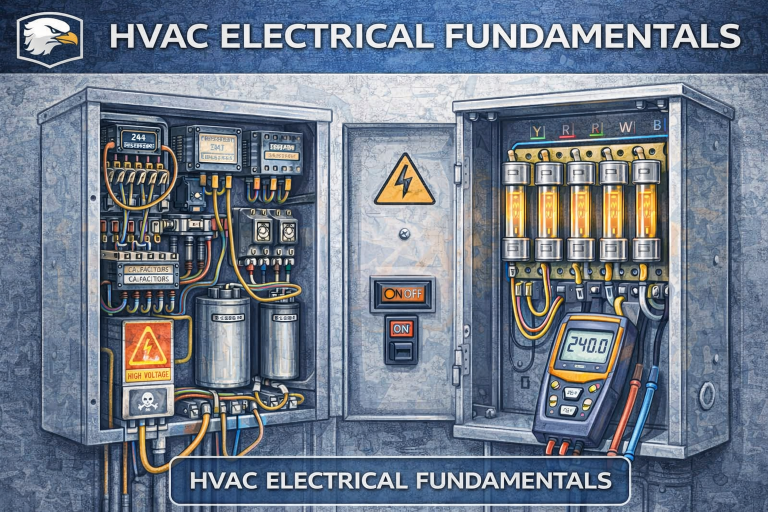
Learning how power moves through equipment, how motors start, and how to safely diagnose electrical problems.
Controls
Understanding thermostats, sensors, pressure switches, relays, timers, and control boards that tell equipment when and how to operate.
Together, these four pillars form the foundation of nearly every HVAC system you’ll encounter.
Why HVAC Matters to You
Whether you’re considering a new career, preparing for certification, or simply curious about how buildings stay comfortable, learning HVAC means learning how modern buildings function.
It is a trade that combines:
- Science
- Mechanical systems
- Electricity
- Critical thinking
- Hands-on skills
- Technology
Every service call is a puzzle waiting to be solved.
Every successful repair keeps homes comfortable, businesses running, food preserved, patients protected, and people productive.
Your Journey Starts Here
At Eagleye Forum, we believe understanding why HVAC matters is just as important as learning how it works.
Before diving into compressors, electrical circuits, and troubleshooting techniques, it’s important to understand the purpose of the systems you’ll be working on and the role HVAC professionals play in everyday life.
From here, we’ll explore the four foundations of the trade:
- EPA 608 & Refrigerants – Why environmental regulations exist and how refrigerants are handled safely.
- Mechanical Systems – The components that move heat and air.
- Electrical Systems – The circuits and motors that power HVAC equipment.
- Controls – The devices that monitor conditions and tell the system what to do.
Master these four areas, and you’ll have the foundation needed to grow into a confident HVAC technician, whether your path leads to residential service, commercial maintenance, industrial facilities, refrigeration, or building automation.
L
Want to take the free practice test to see where you stand?
Or if looking to go further join our quiz hub premium membership and enjoy a variety of quizzes, cancel anytime.
- $9.99 monthly
- $79.99 annually (Best Value)