HVAC Career Paths: Finding Your Place in the Industry
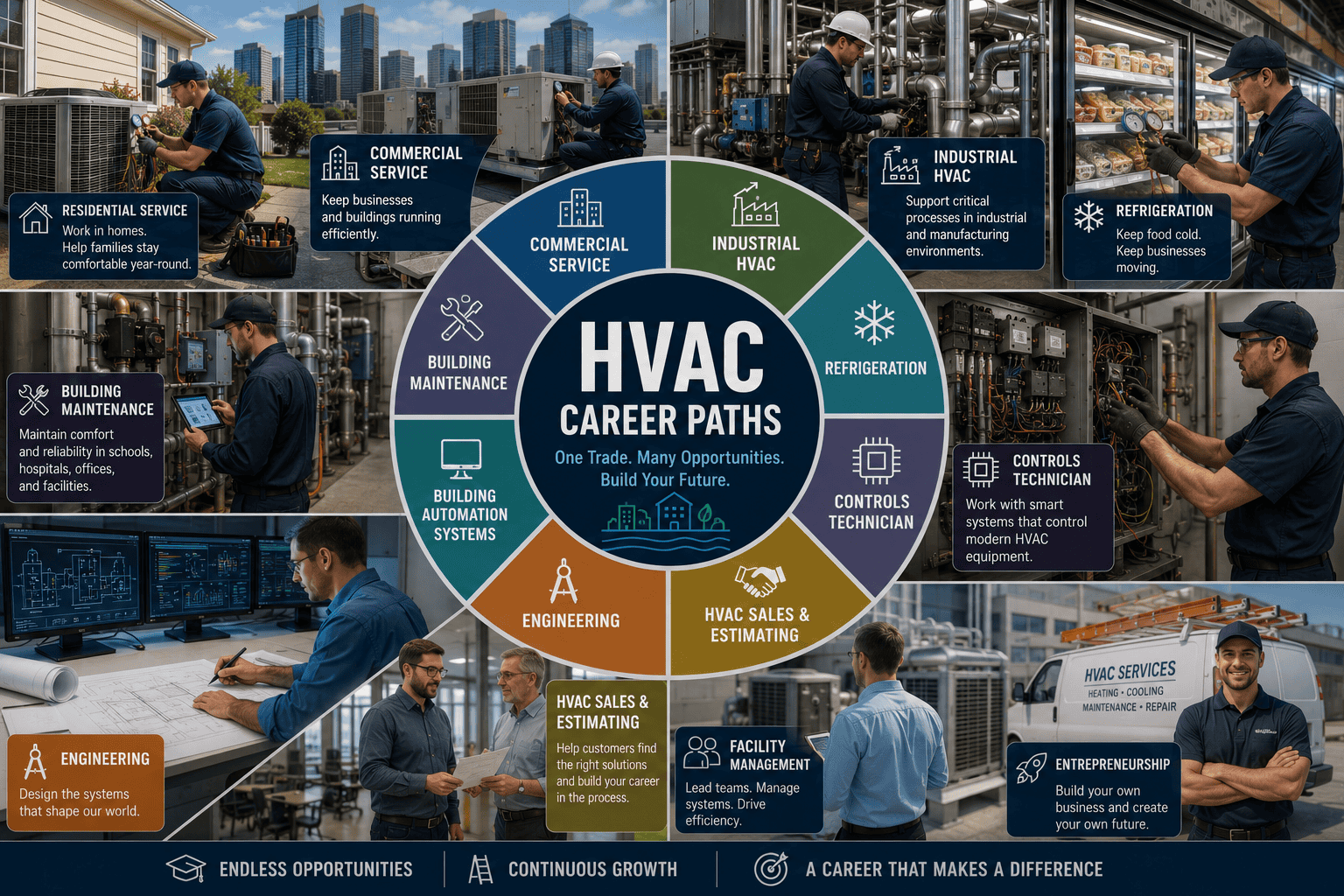
One of the greatest things about HVAC is that there isn’t just one career path.
When most people think of HVAC, they picture a technician repairing an air conditioner at someone’s home. While residential service is certainly a major part of the industry, HVAC professionals work in hospitals, schools, factories, office buildings, data centers, supermarkets, sports arenas, pharmaceutical facilities, and even aboard ships.
Whether you enjoy troubleshooting electrical problems, maintaining equipment, working with computers, or installing new systems, there is likely an HVAC career path that matches your interests.
The skills you develop today can open doors to many different career paths.
Residential Service
Residential service will always be a high demand career path for technicians that want to work on homes and small residential systems .
Typical equipment includes:
- Split systems
- Heat pumps
- Furnaces
- Mini-splits
- Package units
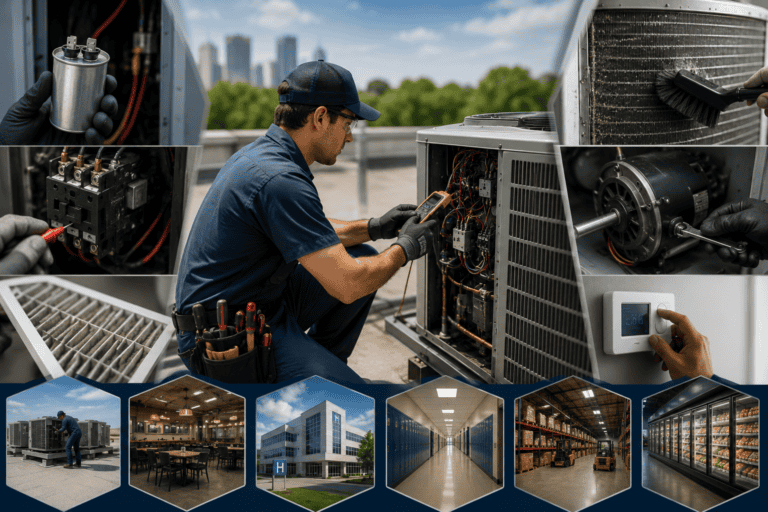
A residential technician’s day often includes:
- Diagnosing no-cooling calls
- Replacing capacitors
- Replacing contactors
- Cleaning condenser coils
- Replacing blower motors
- Thermostat replacement
- Preventive maintenance
- New equipment installation
This path is excellent for technicians who enjoy working directly with homeowners and solving a variety of problems every day.
Commercial Service
Commercial HVAC career path tend to lead to systems that are larger, more complex, and often serve entire buildings.
Examples include:
- Rooftop Units (RTUs)
- Chillers
- Cooling towers
- Large air handlers
- Variable Air Volume (VAV) systems
- Boilers
Commercial technicians spend more time troubleshooting sophisticated equipment and less time interacting with individual homeowners.
Many technicians enjoy commercial work because every building presents a new challenge.
Building Maintenance
Many people don’t realize this career path exists.
Schools, hospitals, universities, office buildings, casinos, hotels, manufacturing facilities, and city governments often employ in-house maintenance technicians.
Rather than driving from customer to customer, these technicians maintain equipment for one organization.
Typical responsibilities include:
- Filter replacements
- Capacitor testing
- Contactor replacement
- Motor replacement
- Thermostat calibration
- Preventive maintenance
- Airflow inspections
- Belt replacement
- Coil cleaning
Many maintenance technicians rarely need to open refrigeration circuits, making this an excellent career for people who enjoy troubleshooting and keeping equipment reliable.
Industrial HVAC
Industrial career paths offer systems that support manufacturing plants, warehouses, power plants, and processing facilities.
Equipment is often much larger than residential systems and may include:
- Large chillers
- Industrial refrigeration
- Process cooling
- Heat recovery systems
- Ventilation systems
- Specialized controls
Industrial technicians often work alongside electricians, mechanics, instrumentation technicians, and engineers.
Refrigeration
Refrigeration is its own specialty.
Instead of focusing primarily on comfort cooling, refrigeration technicians keep products cold.
Typical customers include:
- Grocery stores
- Restaurants
- Convenience stores
- Cold storage warehouses
- Food processing facilities
- Ice rinks
Equipment may include:
- Walk-in coolers
- Walk-in freezers
- Display cases
- Ice machines
- Reach-in refrigerators
Refrigeration often involves more work with refrigerant systems than other HVAC specialties.
Building Automation Systems (BAS)
Modern buildings are becoming increasingly intelligent.
Instead of individual thermostats controlling every unit, entire buildings may be managed through a central computer.
Building Automation technicians work with:
- Johnson Controls
- Siemens
- Honeywell
- Schneider Electric
- Tridium Niagara
- Automated Logic
Responsibilities include:
- Programming controllers
- Networking HVAC equipment
- Scheduling building operation
- Energy management
- Troubleshooting sensors
- Monitoring alarms
This career combines HVAC knowledge with computers, networking, and software.
Controls Technician
Controls technicians focus on the devices that tell HVAC equipment what to do.
They troubleshoot:
- Thermostats
- Pressure switches
- Relays
- Sensors
- Variable Frequency Drives (VFDs)
- Control boards
- Timers
Many experienced technicians consider controls one of the most rewarding specialties because every system is a logical puzzle.
HVAC Sales and Estimating
Not every HVAC professional works with tools every day.
Some move into:
- System design
- Equipment sales
- Project estimating
- Energy consulting
- Customer education
Strong technical knowledge often leads to success in these positions.
HVAC Engineering
Some technicians eventually pursue engineering careers.
Mechanical engineers may design:
- Hospitals
- Schools
- Stadiums
- Airports
- Office towers
- Manufacturing plants
They calculate:
- Heating loads
- Cooling loads
- Airflow requirements
- Ventilation rates
- Equipment sizing
Engineering combines mathematics, physics, and HVAC principles.
Facility Management
Many experienced HVAC technicians eventually become facility managers.
Rather than repairing equipment themselves, they oversee entire buildings.
Responsibilities include:
- Maintenance planning
- Contractor management
- Budgeting
- Capital improvements
- Energy efficiency
- Preventive maintenance programs
- Regulatory compliance
This career rewards strong leadership and organizational skills.
Owning Your Own Business
Many HVAC professionals eventually start their own companies.
Business owners may focus on:
- Residential service
- Commercial service
- Maintenance contracts
- Installation
- Controls
- Refrigeration
- Energy management
Running a successful business requires technical expertise along with customer service, accounting, marketing, and leadership.
Which Career Is Right for You?
There is no single “best” HVAC career.
Some people enjoy working outdoors on rooftop units.
Others prefer maintaining equipment in one facility.
Some love electrical troubleshooting.
Others enjoy refrigeration or programming building automation systems.
The beauty of HVAC is that the fundamentals remain the same while your career can evolve in many different directions.
As your experience grows, so do your opportunities.
Build Your Foundation First
Regardless of which career path you choose, every successful HVAC professional benefits from understanding the four pillars of the trade:
- Refrigerants – Learn how heat is transferred, how refrigerants work, and the regulations surrounding their safe handling.
- Mechanical Systems – Understand compressors, coils, fans, belts, bearings, and airflow.
- Electrical Systems – Master motors, capacitors, contactors, relays, transformers, and wiring diagrams.
- Controls – Learn how thermostats, sensors, pressure switches, control boards, and automation systems keep equipment operating correctly.
A strong foundation in these areas prepares you for virtually every specialty within the HVAC industry.
Continue Your HVAC Journey
Whether your goal is to service residential systems, maintain commercial buildings, work with industrial equipment, or eventually lead a maintenance department, HVAC offers a career with continuous learning and countless opportunities.
Explore the articles below to strengthen your understanding of the trade before testing your knowledge in the Skilled Trades Quiz Hub.
Whether you enjoy troubleshooting electrical problems, maintaining equipment, working with computers, or installing new systems, there is likely an HVAC career path that matches your interests.
Want to take the free practice test to see where you stand?
Or if looking to go further join our quiz hub premium membership and enjoy a variety of quizzes, cancel anytime.
- $9.99 monthly
- $79.99 annually (Best Value)