#41 George H. W. Bush- Gulf War President
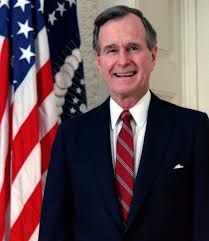
6/12/1924 – 11/13/2018
Party: Republican
Timeline; 1989-1993
#41 George H. W. Bush- Gulf War President
Following the attack on Pearl Harbor, Bush joined the Navy (1942-1945) during World War II. Based on U.S.S. San Jacinto, he was part of one of the largest air battles of WWII; Battle of the Phillipine Sea followed by piloting the Grumman TBM Avenger aircraft from VT-51 during the attack on Chichijima.
After his military career he went into the oil industry before getting into politics where he served as a U.S. representative for Texas (1967-1971), an ambassador to the U.N. (1971-1973), chairperson of the RNC (1973-1974), Chief liaison to the People’s Republic of China (1974-1975), Director of the C.I.A. (1976-1977), and Ronald Reagan’s V.P. (1981-1989)
1989;
- Bush becomes the 41st President of the Unites States, at the age of 64. Dan Quayle is his VP.
- Bush introduces his bail-out plan for troubled savings and loans banks.
- The Bush administration announces a temporary ban on the importation of semi-automatic rifle
- In the worst oil spill on American territory, the Exxon Valdez supertanker runs aground in southeastern Alaska.
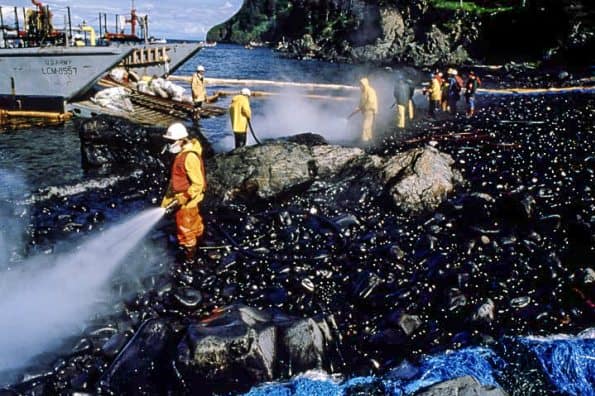
CREWS TRY TO CLEAN UP THE OIL ON THE SHORE
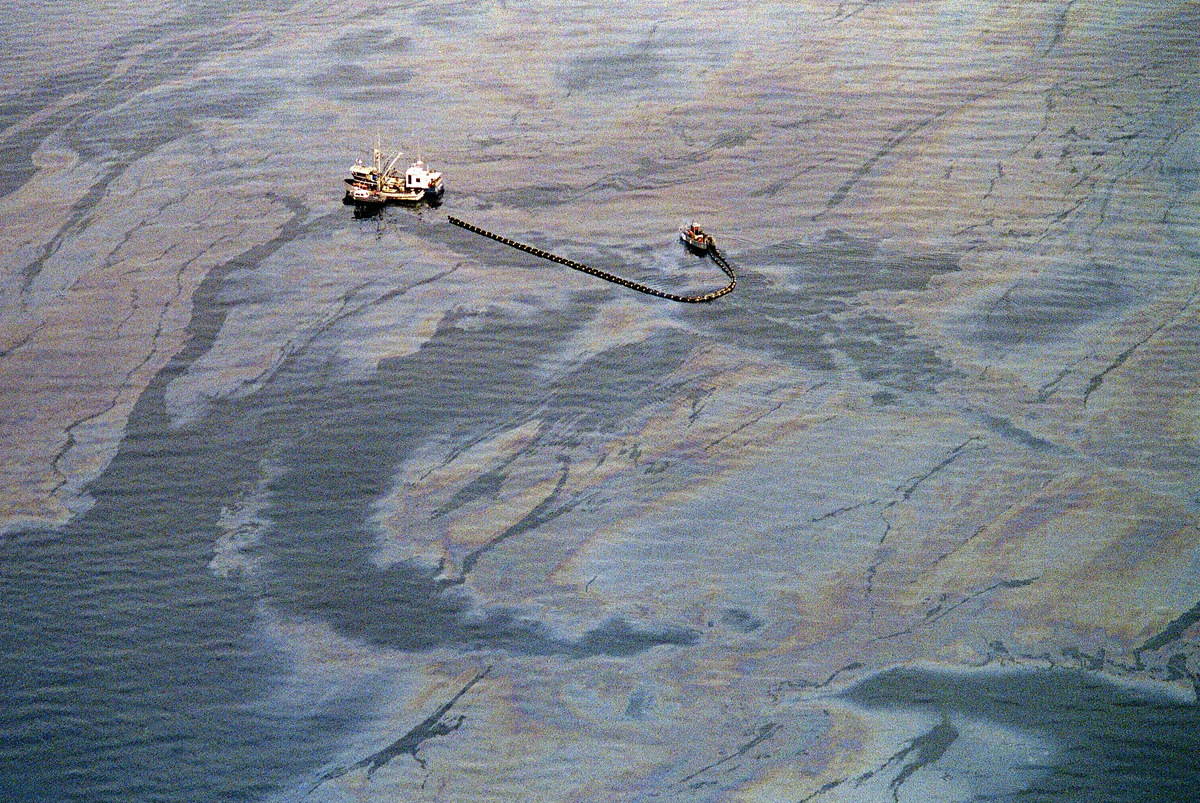
AERIAL VIEW OF THE EXXON OIL SPILL
- Bush offers a program of special assistance for Poland
- The People’s Liberation Army, the military arm of the Chinese government, uses tanks and armored cars to suppress a pro-democracy movement that had encamped in Beijing’s Tiananmen Square.
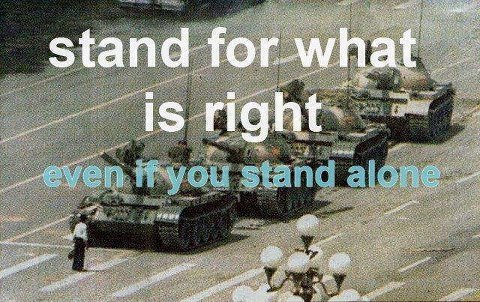
ONE PROTESTER STANDS IN FRONT OF TANKS AT TIANANMEN SQUARE
- Bush announces a number of condemnatory actions, including the suspension of the sale of American weapons to China for the Tiananmen Square Incident.
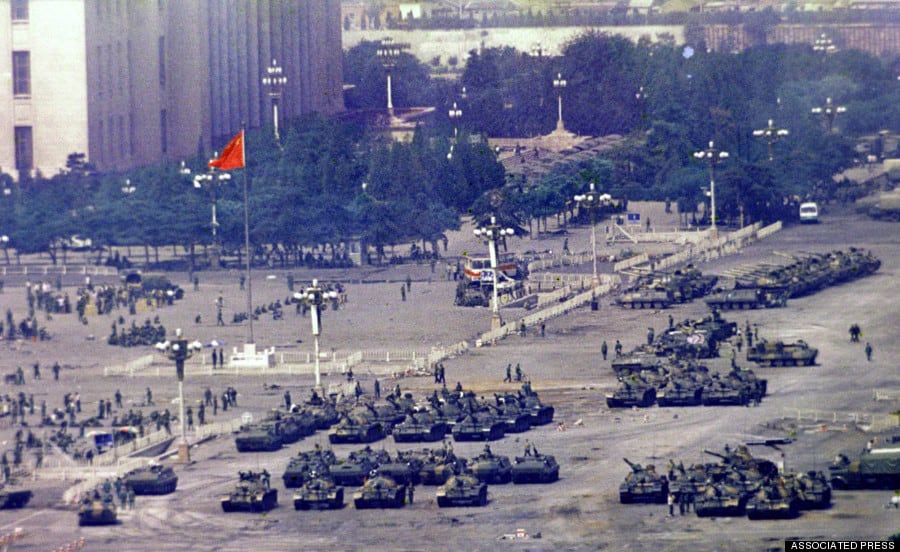
CHINESE TROOPS AND TANKS AT TIANANMEN SQUARE
- Bush the Financial Institutions Reform, Recovery, and Enforcement Act of 1989, a compromise with Congress on the bail-out of savings and loans.
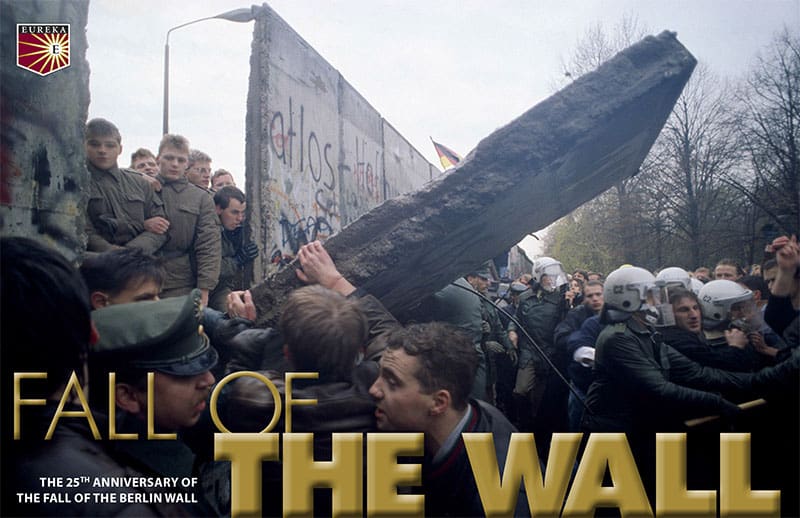
- The Berlin Wall falls, marking the symbolic end of Communist rule in Eastern Europe.
- Bush signs the Fair Labor Standards Amendments of 1989, which will raise the minimum wage to $4.25 an hour.
- Bush signs a new anti-drug law that provides more than $3 billion for expanded programs like treatment facilities, federal prison expansion, education, and law enforcement.
- Bush and Soviet President Mikhail Gorbachev meet to discuss nuclear disarmament and the strengthening of Soviet-American trade relations. Both leaders announce that the Cold War is effectively over.
- American armed forces invade Panama to capture Manuel Antonio Noriega, the country’s military dictator.
1990;
- Bush and Gorbachev sign the broadest arms reduction agreement in two decades, stipulating that the United States and the Soviet Union scrap 25 percent and 40 percent of their respective nuclear stockpiles.
- Bush reneges on his “no new taxes” pledge from the 1988 presidential campaign by stating that in order to solve the deficit problem, tax increases might be necessary
- Bush signs the Americans with Disabilities Act
- Iraq invades Kuwait. Bush strongly condemns Iraq’s actions
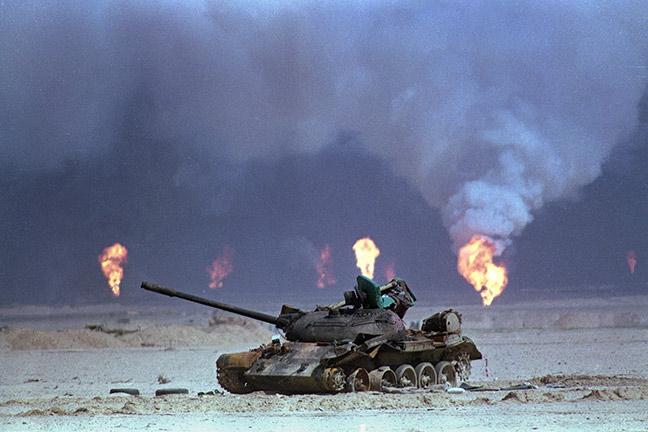
IRAQI TANK IN KUWAIT
- After East Germans approve reunification, East and West Germany are formally reunited
- Bush vetoes the Civil Rights Act of 1990, stating that the bill would “introduce the destructive force of quotas into our nation’s employment system.”
- Bush signs a budget law intended to reduce the federal budget by almost $500 billion over the next five years. The law includes $140 billion dollars in new taxes.
- Bush increases the number of American troops in Saudi Arabia to 400,000.
- Bush signs the Clean Air Act of 1990
- The United States, Canada, and twenty other European nations sign the Conventional Forces in Europe Treaty.
- Bush signs the Immigration Act of 1990, allowing for the admission of 700,000 aliens each year.
1991;
- The Persian Gulf War, code-named Operation Desert Storm, begins with a massive, American-led air attack on Iraq.

AIR RAID ON IRAQ
- Ground troops, including a large contingent of American soldiers, begin operations in Operation Desert Storm.
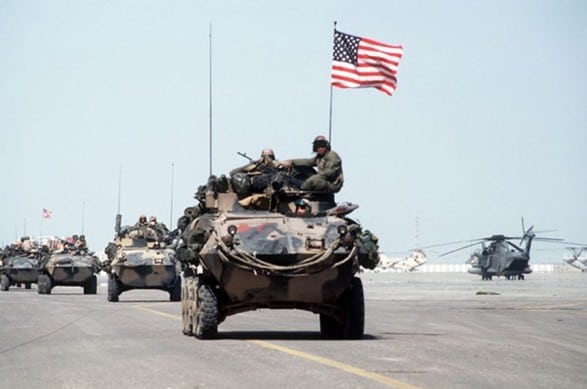
U.S. TROOPS STROLLING THROUGH KUWAIT
- After liberating Kuwait, coalition troops advance rapidly into Iraqi territory, encountering no resistance. Bush calls off the ground offensive.

- Bush lifts most American sanctions against the Republic of South Africa
- Bush and Gorbachev meet in Moscow to sign a nuclear arms reduction treaty (START-I) which calls for both nations to make significant reductions in the number of nuclear warheads in their respective arsenals.
- Bush signs the Civil Rights Act of 1991, making it easier for employees to sue employers on grounds of discrimination.
- The constituent republics of the Soviet Union dissolve the Union of Soviet Socialist Republics.
1992;
- At the presidential retreat at Camp David, Bush and Russian president Boris Yeltsin meet to discuss U.S.-Russian relations and officially declare the end of the Cold War.
- President Bush announces an aid plan of $24 billion to spur democratic and a free market reforms in the former Soviet Union.
- The United States signs agreements with Russia, Belarus, Ukraine, and Kazakhstan, ensuring the continued participation of these nations in the nuclear arms reduction treaties signed by the U.S.S.R. before its collapse in late 1991.
- The United States signs the Framework Convention on Climate Change aimed at preventing further global warming.
- Bush and Yeltsin announce an agreement by which the United States and Russia reduce their nuclear warheads to between 3,000 and 3,500 by the year 2003.
- Bush signs a supplemental appropriations act that provides aid to inner cities, specifically Los Angeles, which is trying to recover from the Rodney King riots.
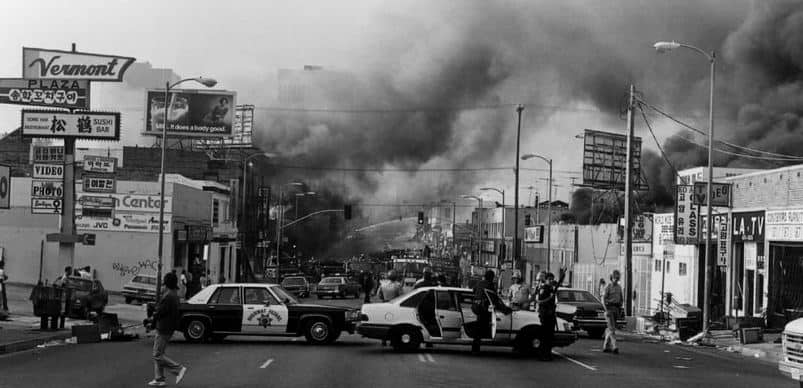
L.A. RIOTS
- Bush signs the Unemployment Compensation Amendments of 1992, extending coverage to the unemployed for 26 weeks, following their initial 26 weeks of benefits.
- American troops land in Somalia as part of the UN-sponsored “Operation Restore Hope.”
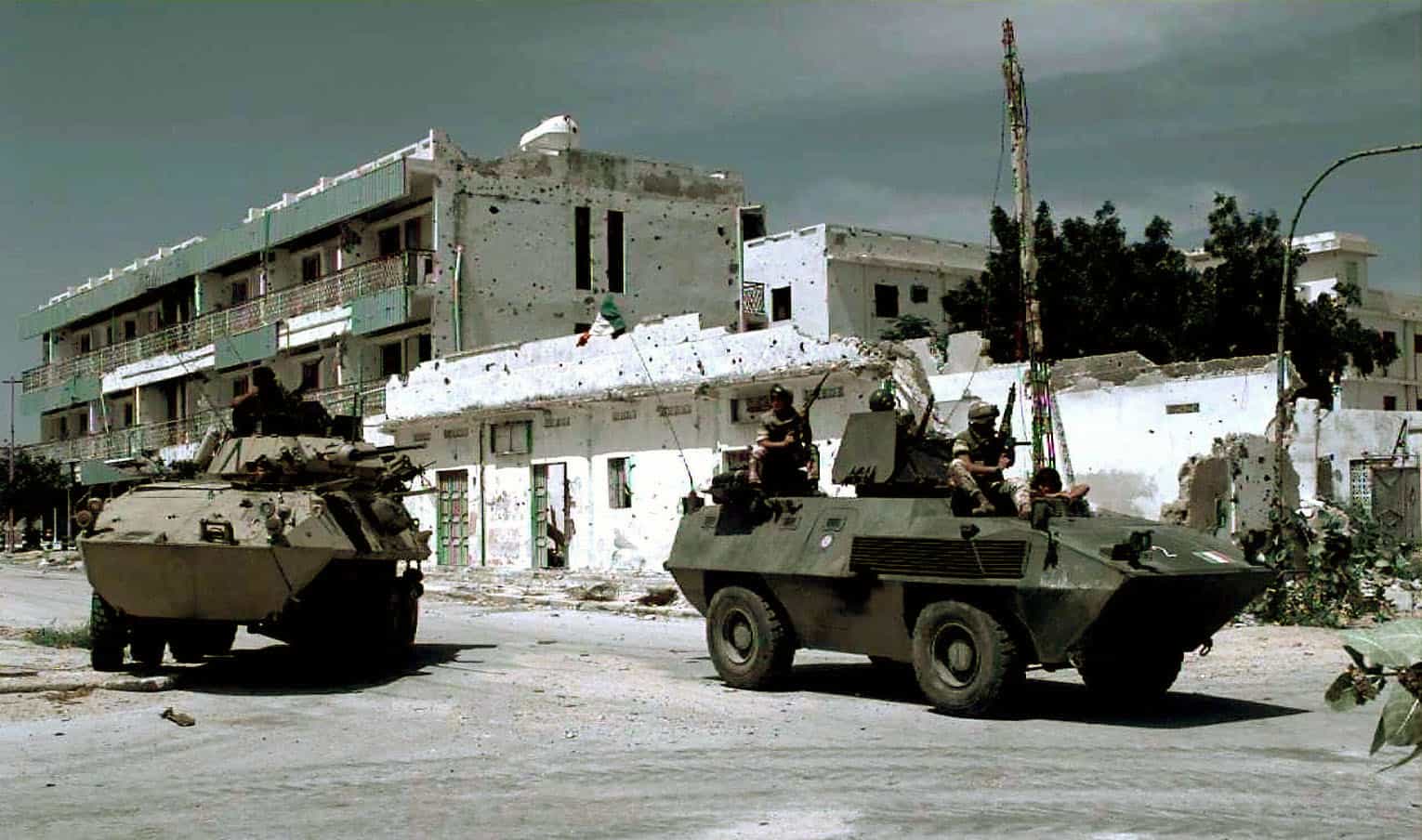
U.S. TROOPS IN SOMALIA
Bush was the first sitting Vice President to be elected President since Martin Van Buren. During his term, the Soviet Union collapsed and the Cold War ended. He also led the U.S. in the Gulf War against Iraq, but economic troubles at home cost him re-election. Since then he has been active in various humanitarian activities and living out his retirement making occasional political appearances.
Famous quotes;
“I have opinions of my own, strong opinions, but I don’t always agree with them.”
“We must act on what we know. I take as my guide the hope of a saint: In crucial things, unity; in important things, diversity; in all things, generosity.”
“Don’t confuse being ‘soft’ with seeing the other guy’s point of view.“