HVAC Electrical Fundamentals: Capacitors, Contactors, Transformers, Fuses & 24V Controls
HVAC Electrical Fundamentals
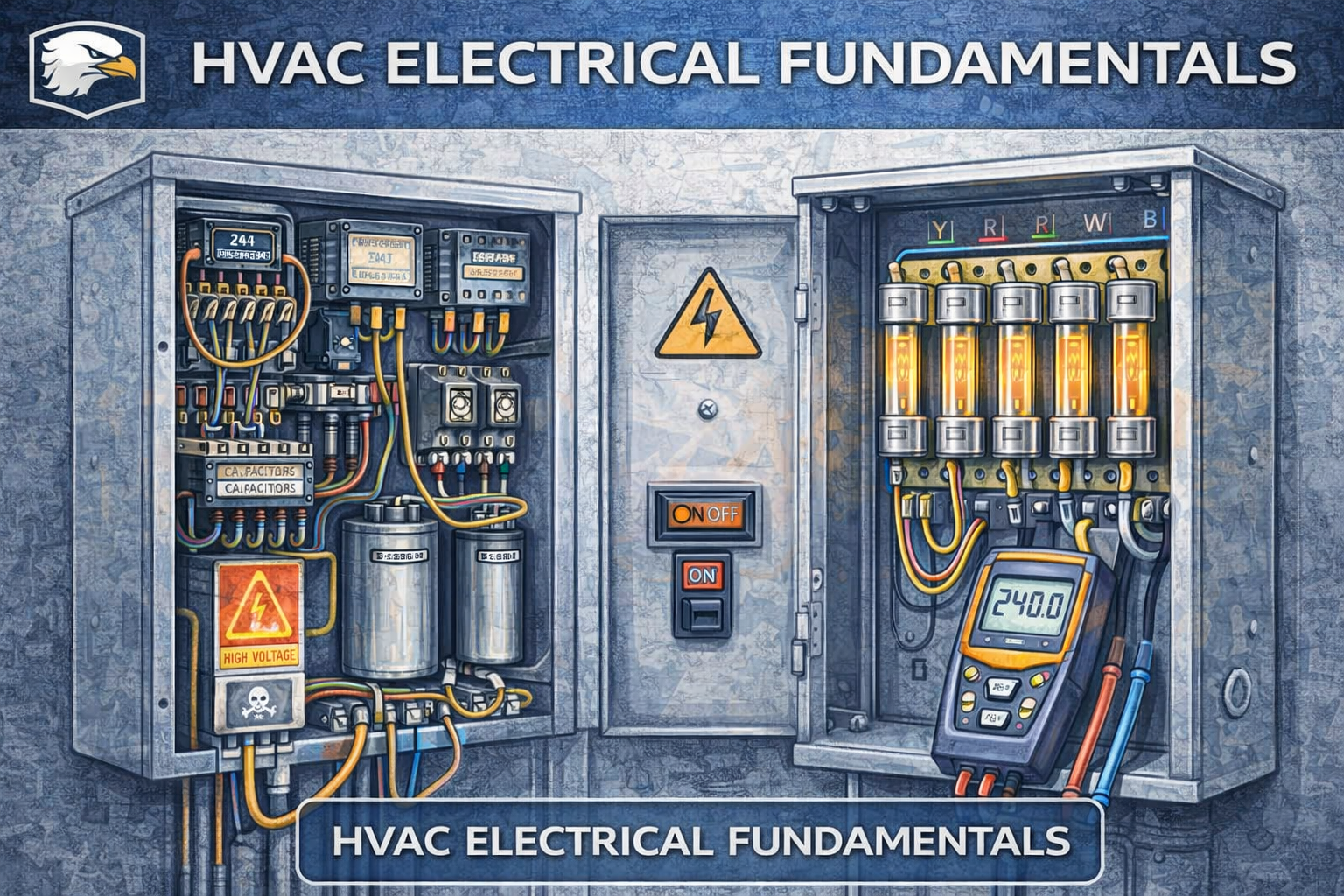
Understanding HVAC electrical fundamentals is one of the most important steps in learning how heating and cooling systems actually start, stop, and protect themselves. Refrigeration may do the cooling, and airflow may move the air, but electrical components are what allow the system to operate in the first place.
Start with a free 5 question practice test;
You need to be registered and logged in to take this quiz. Log in or Register
If you are new to HVAC, electrical topics can seem intimidating at first. Terms like voltage, amperage, continuity, resistance, capacitors, contactors, relays, and transformers often get thrown around quickly. The good news is that once you understand the purpose of each component and how they work together, the system becomes much easier to follow.
This page is designed to help someone taking either a short free quiz or a deeper paid test build a solid foundation in HVAC electrical basics.
Why HVAC Electrical Fundamentals Matter
Every modern HVAC system depends on electrical power and control circuits. The system needs a way to start motors, energize coils, switch higher voltage loads, protect against faults, and respond to thermostat demand.
A basic understanding of HVAC electrical fundamentals helps you:
- Understand what voltage and amperage actually mean
- Recognize the job of capacitors, contactors, transformers, fuses, and relays
- Follow a simple 24V control circuit
- Spot common failures
- Troubleshoot more logically instead of guessing
Electrical problems are common in HVAC service because so many components rely on proper voltage, intact wiring, and healthy motors and controls.
Voltage and Amperage Basics
What is voltage?
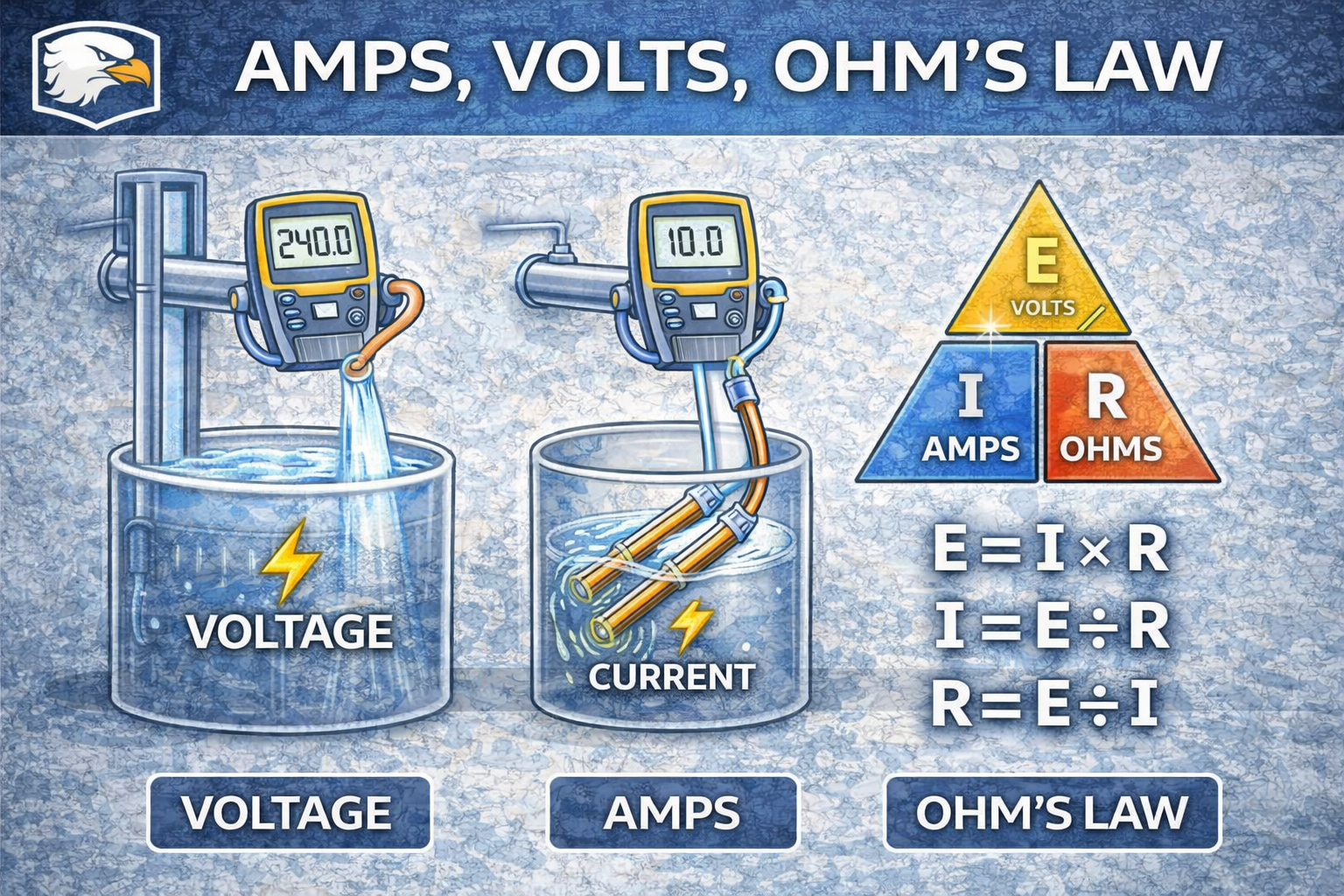
Voltage is electrical pressure.
It is the force that pushes electricity through a circuit. In HVAC, voltage is what allows components to energize and operate. Without the correct voltage present, even a healthy component will not do its job.
A simple way to think about it is this: voltage is the push.
What is amperage?
Amperage is the flow of electrons, or current.
If voltage is the push, amperage is the actual movement of electricity through the circuit. HVAC motors, contactor coils, relays, and other components all depend on proper current flow.
A simple way to think about it is this: amperage is the flow.

Continuity and Resistance Basics
What is continuity?
Continuity means there is a complete electrical path through a circuit or component.
If a wire, switch, fuse, or winding has continuity, electricity has a path to move through it. If there is no continuity, the path is broken.
What does infinite resistance mean?
Infinite resistance usually indicates an open circuit.
That means the electrical path is broken somewhere. A broken wire, open fuse, failed switch, or open winding can all produce this kind of reading.
What does zero resistance in a motor winding mean?
If a motor winding shows zero resistance, it commonly indicates a shorted winding.
That means the winding is no longer resisting current the way it should. This is not normal and usually points to a failed motor or compressor winding condition.
HVAC Capacitor Basics
What does a capacitor do?
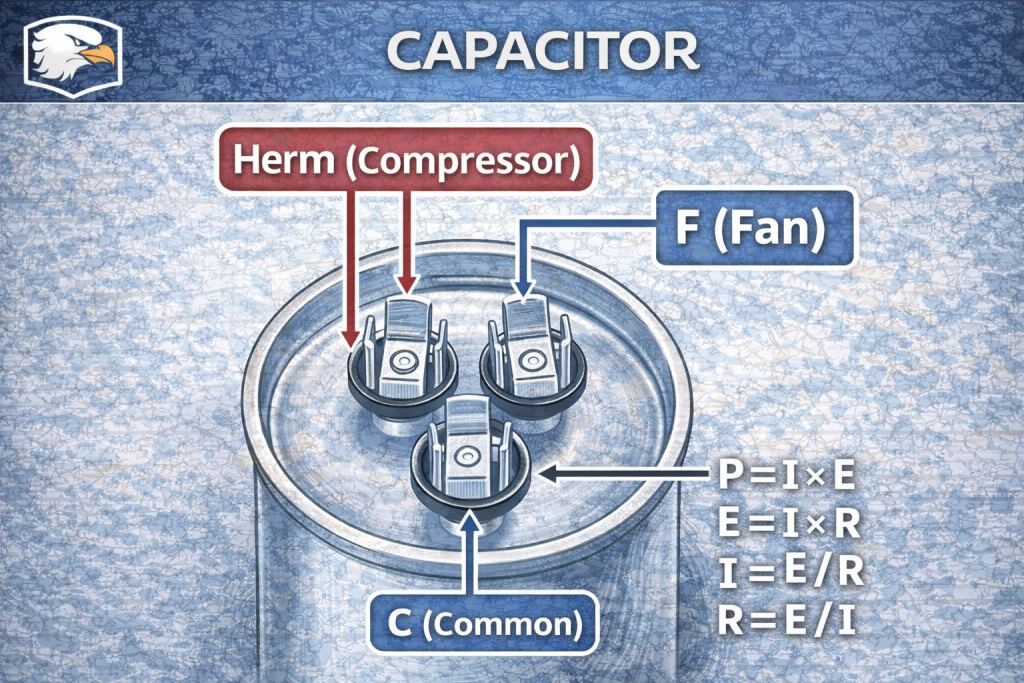
A run capacitor helps motors start and run properly by supporting the electrical phase shift needed for efficient motor operation. In HVAC systems, capacitors are commonly used with compressors and fan motors.
What does a 40/5 µF capacitor mean?
A capacitor rated 40/5 µF is a dual run capacitor.
That means it contains:
- 40 µF for the compressor
- 5 µF for the fan motor
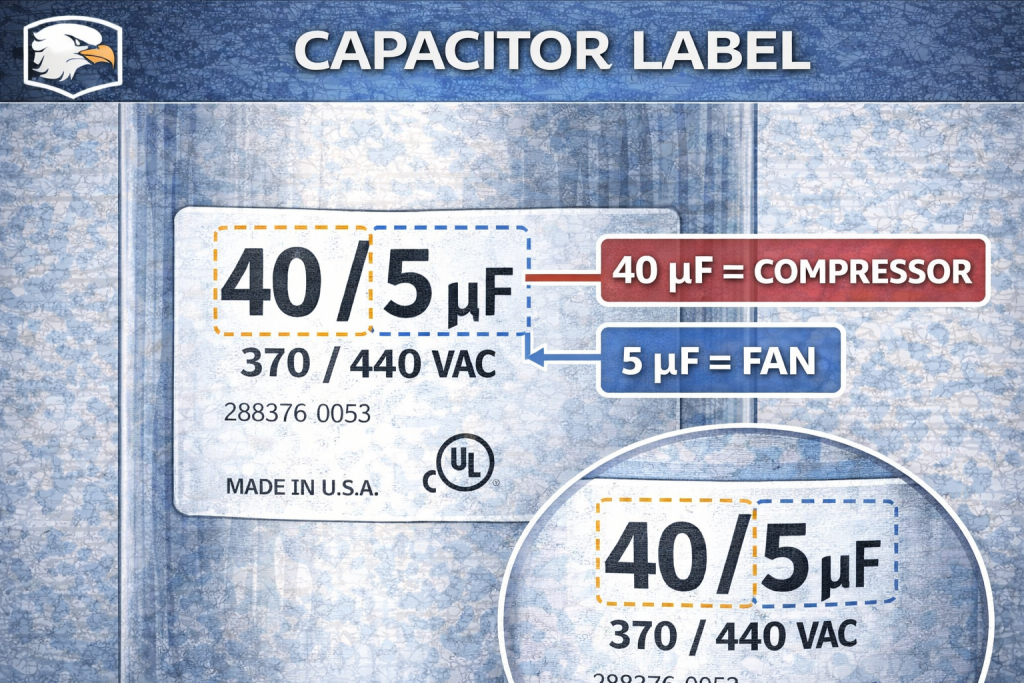
It is not saying 45 total capacitance. It is showing two separate capacitance ratings inside one component.
What is the typical tolerance for a capacitor?
A common acceptable tolerance is ±6%.
That means a capacitor can vary slightly from its rated value and still be considered usable. Once it falls outside that range, it should be replaced.
Example: 32 µF on a 40 µF capacitor
If a 40 µF capacitor tests at 32 µF, it is out of tolerance and should be replaced.
This is a common test question because a weak capacitor often causes hard starts, humming motors, overheating, or a motor that will not start at all.
Compressor hums but does not start
If a compressor hums but does not start, one of the most likely causes is a failed capacitor.
The compressor may be trying to start, but without proper capacitor support, it cannot overcome the starting load.
Contactors and Load Voltage
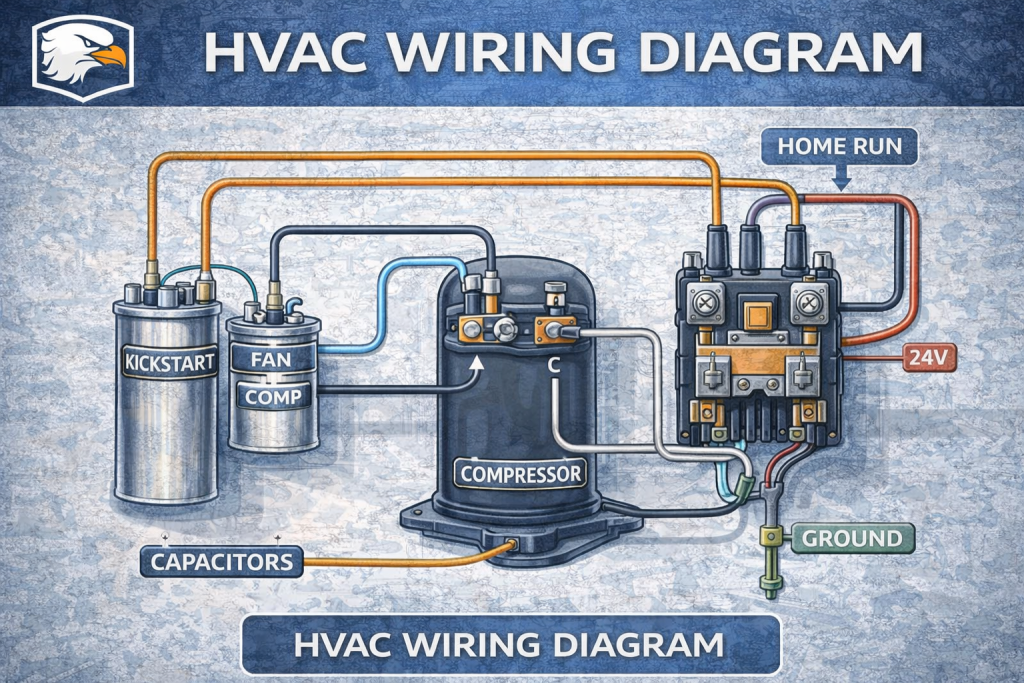
What does a contactor do?
A contactor is an electrically controlled switch that allows a low-voltage control signal to switch a higher-voltage load, such as a compressor or condenser fan motor.
When the thermostat calls for cooling, the contactor coil energizes and pulls in the contacts, allowing line voltage to pass through to the load.
Contactor pulls in, but compressor does not run
If the contactor is pulled in but the compressor is not running, the first thing to check is the voltage across the contactor load side.
Why? Because you need to know whether the compressor is actually receiving voltage. If the contactor is pulled in but not passing voltage through its contacts, the problem may be the contactor itself.
240V on line side, 0V on load side
If you measure 240V on the line side of an energized contactor but 0V on the load side, the most likely issue is failed contactor contacts.
That means the contactor is being told to close, but the internal contacts are not carrying voltage through to the load.
LRA and Motor Starting
What does LRA stand for?
LRA stands for Locked Rotor Amps.
This refers to the amount of current a motor draws when the rotor is not turning but the motor is energized. This typically happens during startup or when the motor is mechanically or electrically unable to turn.
What does it mean when a motor draws LRA?
When a motor draws LRA, it usually means startup condition or locked rotor.
A brief LRA condition during startup is normal. A sustained LRA condition is not. If the motor stays locked and continues pulling high current, it can overheat and damage components.
Transformers in HVAC
What does a transformer do?
A transformer in an HVAC system converts voltage levels.
A very common example is stepping 240V down to 24V for the control circuit. This lower voltage is used for thermostats, relays, contactor coils, and other control devices.
Power on primary, nothing on secondary
If a 240V to 24V transformer has power on the primary side but nothing on the secondary side, the most likely issue is a failed transformer.
In that case, the transformer is receiving input voltage but not producing the lower output voltage needed for control operation.
Fuses and Electrical Protection
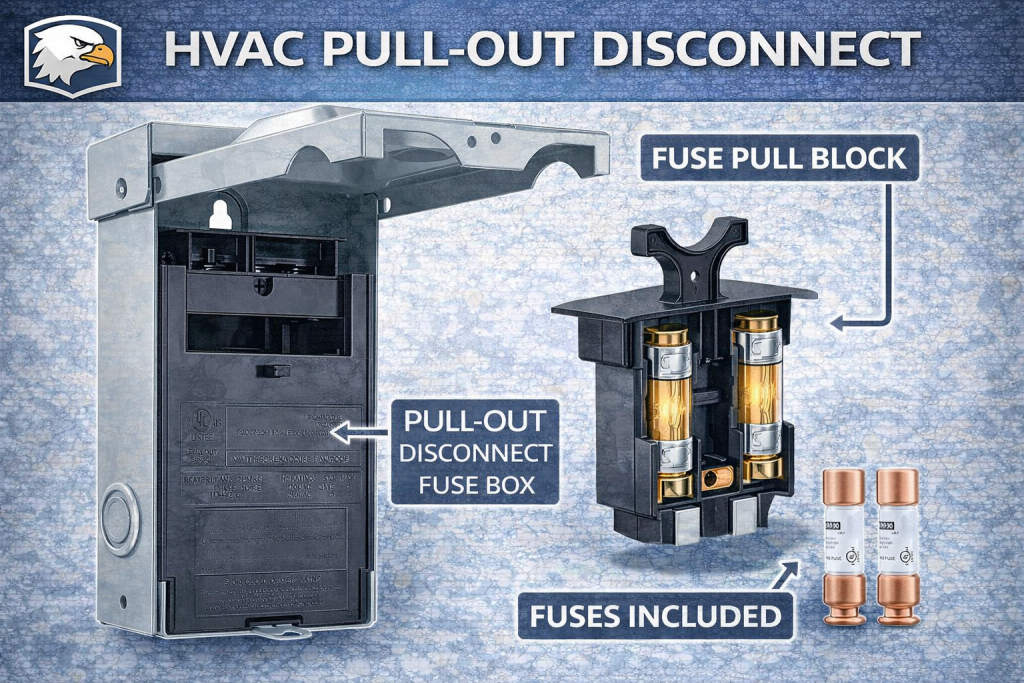
What is the purpose of a fuse?
A fuse is used to protect against overcurrent.
If current rises above a safe level, the fuse opens the circuit to protect wires and components from further damage.
What if a fuse blows repeatedly?
If a fuse keeps blowing, the system does not have a normal condition. It usually means there is an underlying electrical fault.
Possible causes include:
- Shorted wiring
- Grounded components
- Failed contactor coil
- Shorted motor winding
- Incorrect fuse size
- Damaged insulation
Replacing the fuse without finding the reason it blew is not real troubleshooting.
Relays and Low-Voltage Switching
What is the purpose of a relay?
A relay is used to switch circuits using low-voltage control.
Relays are similar in concept to contactors, but they are often used for smaller loads or control functions inside the HVAC system. They allow one circuit to control another without directly carrying the full load through the control switch.
24V Control Circuit Basics
Why the 24V circuit matters
In many HVAC systems, the thermostat does not directly power the compressor with high voltage. Instead, it sends a 24V control signal through the control circuit. That signal tells other components, like relays and contactors, when to energize.
This is why many troubleshooting steps begin at the 24V side.
Thermostat calls, but nothing happens
If a thermostat calls for cooling but nothing happens, the first place to check is the 24V control circuit.
That means verifying whether the control voltage is present and whether it is making its way through the circuit correctly.
24V at thermostat, but contactor does not pull in
If you measure 24V at the thermostat but the contactor does not pull in, the likely problem is an open control wire or failed contactor coil.
That means the control signal exists, but it is not successfully energizing the contactor.
How These Electrical Parts Work Together
A simple HVAC electrical sequence often looks like this:
- The thermostat calls for cooling
- The 24V control circuit is energized
- A relay or contactor coil receives the control signal
- The contactor closes and passes high voltage to the load
- The compressor and fan motors use capacitors to start and run
- Fuses protect the circuit if excessive current occurs
- The transformer keeps the control side supplied with usable low voltage
When you start looking at the system this way, it becomes easier to understand what component to test next when something fails.
Quick Review of HVAC Electrical Fundamentals
Here is a simple recap of the major points:
- Voltage is electrical pressure
- Amperage is the flow of electrons
- Continuity means a complete electrical path
- Infinite resistance usually means an open circuit
- Zero resistance in a winding often means a short
- A 40/5 µF capacitor is a dual capacitor for compressor and fan
- Capacitors are commonly rated with a tolerance around ±6%
- A weak capacitor outside tolerance should be replaced
- A failed capacitor can cause a compressor to hum but not start
- A contactor uses low-voltage control to switch high-voltage loads
- If a contactor pulls in but no voltage leaves the load side, the contacts may be bad
- LRA means Locked Rotor Amps
- A transformer converts voltage levels, often from 240V to 24V
- A fuse protects against overcurrent
- A repeatedly blown fuse usually means a deeper fault
- A relay switches circuits using low-voltage control
- If a thermostat calls and nothing happens, start with the 24V control circuit
HVAC Quiz Preparation: What to Focus On
If you are studying for a short free quiz or a larger paid HVAC electrical test, focus on understanding what each component does before trying to memorize every answer.
Make sure you understand:
- The difference between voltage and amperage
- The meaning of continuity, open circuits, and shorted windings
- What a capacitor rating means
- When a capacitor is out of tolerance
- What a contactor is supposed to do
- Why LRA matters at startup
- What a transformer does for the control circuit
- Why repeated fuse failure points to a deeper issue
- Why 24V controls are often the first troubleshooting step
Once those relationships make sense, the quiz becomes much easier because the answers stop looking random.
Final Thoughts
HVAC electrical fundamentals are not just about memorizing definitions. They are about understanding how power is delivered, controlled, and protected throughout the system.
When you understand capacitors, contactors, transformers, fuses, relays, voltage, amperage, continuity, and 24V controls, you build a foundation that supports nearly all future HVAC troubleshooting.
That foundation helps you move from guessing to logical diagnosis, which is exactly what separates a parts changer from someone who actually understands the system.
FAQ Section
What does a 40/5 capacitor mean in HVAC?
It means the capacitor contains two ratings in one unit: 40 µF for the compressor and 5 µF for the fan motor.
What is the normal tolerance for an HVAC capacitor?
A common tolerance is ±6%.
What does LRA stand for?
LRA stands for Locked Rotor Amps.
What does a transformer do in HVAC?
A transformer converts voltage levels, often stepping 240V down to 24V for the control circuit.
What is continuity in an electrical circuit?
Continuity means there is a complete path for electricity to flow.
What does infinite resistance mean?
Infinite resistance usually means the circuit is open.
Why would a compressor hum and not start?
A failed capacitor is one of the most common causes.
What should you check first if the thermostat calls but nothing happens?
Start by checking the 24V control circuit.
Want to take the free practice test to see where you stand?
Or if looking to go further join our quiz hub premium membership and enjoy a variety of quizzes, cancel anytime.
- $9.99 monthly
- $79.99 annually (Best Value)