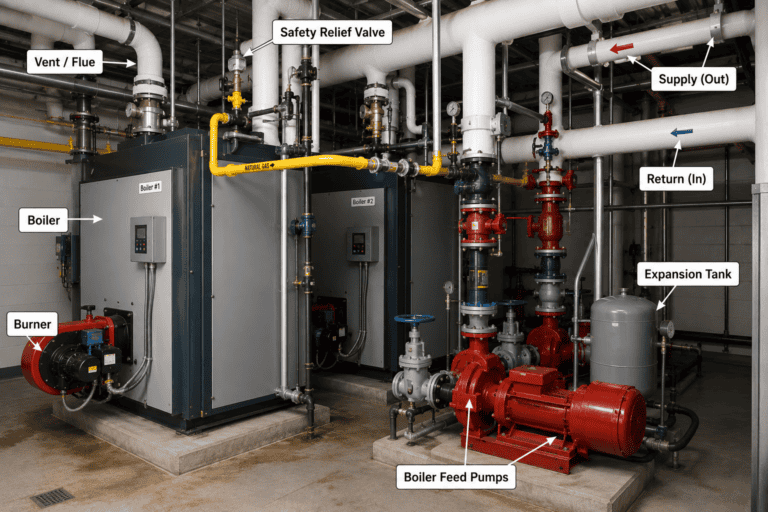
Steam Boiler Systems: Operation, Inspections, Water Chemistry, and Safety
Steam has powered industry for more than two centuries, and even today it remains one of the most efficient ways to transport large amounts of thermal energy throughout hospitals, universities, manufacturing facilities, military installations, and industrial campuses.
Unlike heating hot water systems, steam systems operate under pressure. That pressure allows steam to carry tremendous amounts of energy, but it also means the equipment must be maintained with exceptional care.
A properly operated steam plant can run safely for decades. A neglected one can become one of the most dangerous pieces of equipment in a facility.
Understanding daily inspections, water chemistry, blowdowns, and routine maintenance is essential for anyone working around these systems.
What Is a Steam Boiler?
A steam boiler heats water until it changes from a liquid into steam.
Then it is distributed through piping to:
- Building heating systems
- Heat exchangers
- Sterilizers
- Laundry equipment
- Industrial process equipment
- Humidification systems
After releasing its heat, it condenses back into water (condensate) and returns to the boiler where the cycle begins again.
This closed-loop system allows large amounts of energy to be transported efficiently across an entire campus.
Why Steam Is Different
Steam contains significantly more stored energy than hot water.
As pressure increases, so does the amount of energy stored inside the boiler.
That is why they include numerous safety devices designed to prevent excessive pressure or unsafe operating conditions.
These include:
- Safety relief valves
- Low-water cutoffs
- Pressure controls
- Flame safeguard controls
- Water level controls
- Pressure gauges
- Temperature monitoring
- Automatic burner shutdown systems
Each of these devices serves a critical purpose.
Daily Operator Inspections
One of the most important responsibilities of a steam plant operator is simply looking and listening.
Daily inspections often reveal developing problems long before alarms occur.
Typical inspections include:
Boiler
- Water level
- Steam pressure
- Operating temperature
- Burner flame quality
- Fuel pressure
- Combustion air
- Stack temperature
Pumps
Operators inspect for:
- Seal leaks
- Bearing noise
- Vibration
- Coupling condition
- Motor temperature
- Proper pressure
Steam Distribution
Operators look for:
- Steam leaks
- Condensate leaks
- Damaged insulation
- Valve packing leaks
- Steam trap failures
- Pipe movement
General Mechanical Room
Good operators constantly observe:
- Unusual odors
- Water on floors
- Rust streaks
- Condensation
- Corrosion
- Unusual sounds
- Excessive vibration
Many serious failures begin with subtle warning signs.
Blowdowns
Blowdowns remove accumulated sediment and dissolved solids from the boiler.
Without blowdowns, impurities continue building inside the pressure vessel.
This leads to:
- Scale buildup
- Reduced heat transfer
- Overheating
- Tube failures
- Corrosion
- Reduced efficiency
Two common types of blowdowns are performed.
Bottom Blowdown
Removes sludge and heavy sediment that settles at the bottom of the boiler.
Typically performed according to plant procedures.
Surface Blowdown
Removes dissolved solids floating near the water surface.
Helps maintain proper water chemistry.
Proper blowdown frequency depends on:
- Boiler design
- Water quality
- Chemical treatment program
- Steam demand
Too little blowdown allows contamination to build.
Too much wastes heat, water, chemicals, and energy.
Water Chemistry
Water chemistry is one of the most important aspects of these operations.
Untreated water can quickly destroy expensive equipment.
Most facilities routinely monitor:
- pH
- Conductivity
- Total Dissolved Solids (TDS)
- Alkalinity
- Sulfite
- Phosphate
- Hardness
- Chlorides
Many facilities perform these tests daily using titration kits or digital analyzers.
Results determine:
- Chemical feed rates
- Blowdown requirements
- Boiler efficiency
- Corrosion protection
Proper chemistry prevents:
- Corrosion
- Scale formation
- Oxygen pitting
- Tube failures
- Reduced efficiency
Titration Testing
Many plants still rely on manual titration testing to verify boiler water quality.
Operators collect water samples and perform chemical tests that measure important treatment parameters.
Common titrations include:
- Sulfite residual
- Phosphate residual
- Alkalinity
- Hardness
- Chloride concentration
These tests help confirm that the chemical treatment program is protecting the boiler from corrosion and mineral deposits.
Accurate recordkeeping is equally important, allowing operators to identify long-term trends before they become major problems.
Steam Traps
These traps automatically remove condensate while preventing live steam from escaping.
A failed steam trap can:
- Waste energy
- Reduce heating performance
- Cause water hammer
- Damage equipment
Routine inspections are a critical part of preventive maintenance.
Common Steam System Problems
Poor maintenance can result in:
- Scale buildup
- Corrosion
- Oxygen pitting
- Water hammer
- Steam leaks
- Failed steam traps
- Pump failures
- Burner problems
- Low-water conditions
- Pressure fluctuations
Small problems often become expensive repairs when ignored.
Operator Responsibility
Safe plant operation depends on consistency.
Daily inspections…
Routine blowdowns…
Water chemistry testing…
Preventive maintenance…
Accurate operating logs…
None of these tasks are exciting, but together they prevent catastrophic failures.
Most major boiler accidents are not caused by a single mistake.
They are usually the result of multiple small problems that were ignored over time.
Licensing and Certifications
Licensing requirements vary by state, province, and local jurisdiction.
Some states require licensed stationary engineers or boiler operators to operate certain classes of these boilers, while others only require licensing above specific pressure or horsepower thresholds. Some jurisdictions rely primarily on insurance inspections and boiler certifications rather than operator licensing.
Because requirements differ widely, anyone pursuing a career in steam plant operations should review the regulations that apply where they intend to work.
Even where a license is not legally required, many employers prefer or require qualifications such as:
- Stationary Engineer licenses (where applicable)
- Boiler Operator certifications
- Manufacturer training
- OSHA safety training
- Facility-specific operating qualifications
Respect the Energy
Steam has powered civilization for generations because it is remarkably efficient at moving heat.
That same efficiency also means it stores tremendous amounts of energy under pressure.
A well-maintained steam boiler is one of the safest and most reliable pieces of equipment in a central utility plant.
A neglected one can become extremely dangerous.
The difference is not the equipment.
The difference is the operators who inspect it, maintain it, monitor its chemistry, and never ignore the warning signs.
Explore other sections of the Central Plant