Boiler Systems: How Central Plant Boilers Work, Their Components, and Common Failures
Introduction
In many central utility plants, boilers are the primary source of thermal energy.
While most people think of boilers as simply “making hot water,” a modern boiler system is a carefully engineered network of combustion equipment, pumps, valves, controls, expansion devices, and safety systems working together to provide reliable heating around the clock.
Whether serving a hospital that cannot lose heat, a university campus with dozens of buildings, or an industrial facility requiring process steam, boiler systems must operate safely, efficiently, and continuously.
Because boilers operate under high temperatures and pressures, even small failures can quickly become costly if left unchecked.
Understanding how boiler systems work—and why components fail—is essential for every operator, maintenance technician, and facility engineer.
What Is a Boiler?
A boiler is a pressure vessel that transfers heat from combustion or another energy source into water.
Depending on the design, it produces either:
- Heating Hot Water (HHW)
- Steam
- Combination systems
Unlike a household water heater, central plant boilers often produce millions of BTUs every hour and may operate continuously for months at a time.
How a Boiler System Works
Natural Gas
↓
Burner
↓
Combustion Chamber
↓
Heat Exchanger
↓
Water Heats
↓
Distribution Pumps
↓
Buildings
↓
Cool Return Water
↓
Boiler
The cycle repeats continuously.
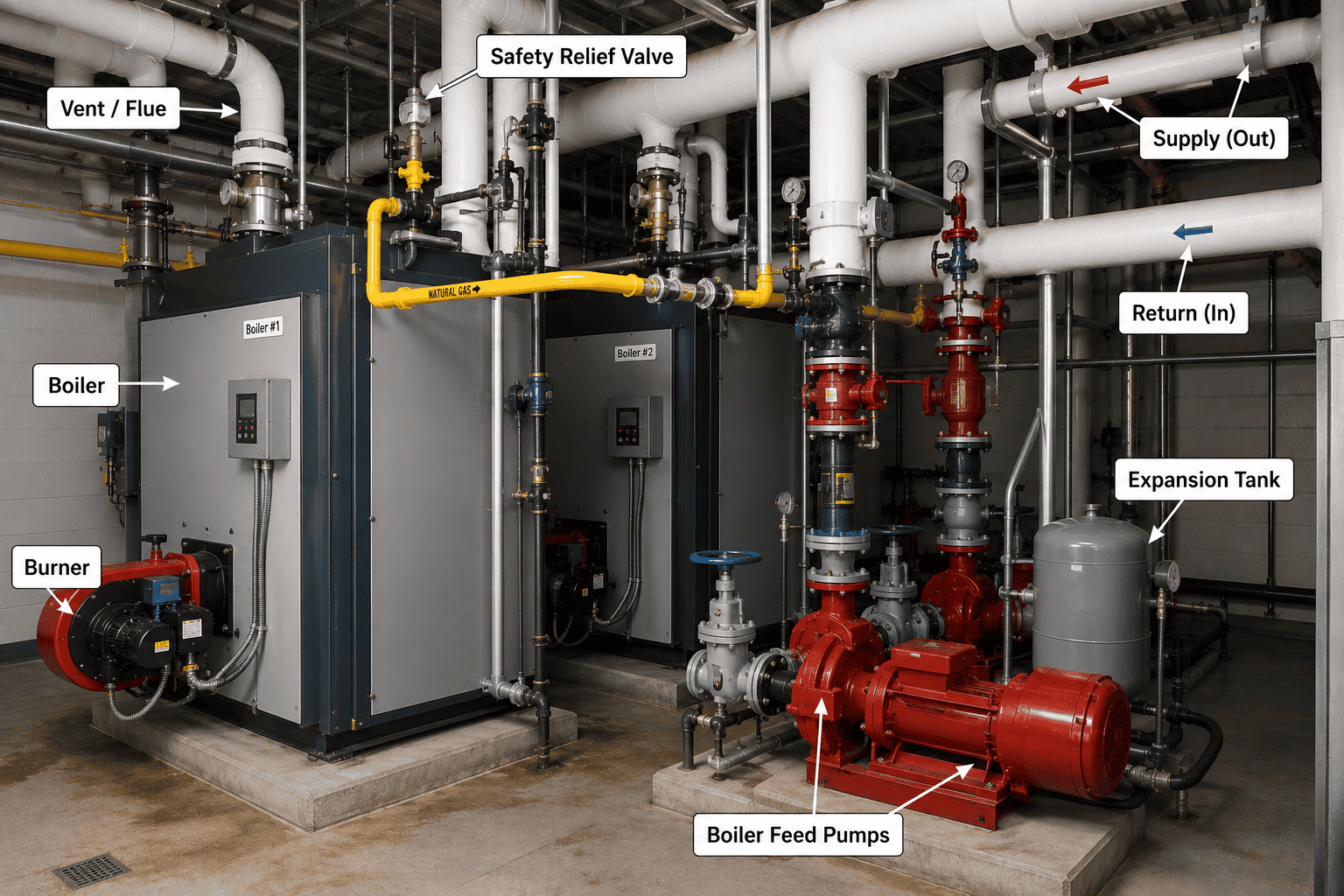
Major Components
Boiler Vessel
The pressure vessel contains the water being heated.
It is built to withstand years of thermal expansion and internal pressure.
Failure is extremely rare but potentially catastrophic.
Burner Assembly
The burner mixes:
- Fuel
- Air
- Ignition
Proper combustion requires the correct fuel-to-air ratio.
Poor combustion leads to:
- Soot
- Carbon buildup
- Higher fuel costs
- Reduced efficiency
- Unsafe operation
Heat Exchanger
The heat exchanger transfers combustion heat into the circulating water.
This is where energy actually enters the heating system.
Over time:
- Scale
- Corrosion
- Deposits
reduce heat transfer efficiency.
Circulation Pumps
Boilers do not move water.
Pumps do.
Without circulation:
- Boilers overheat
- Water stratifies
- Safety shutdowns occur
- Buildings lose heating
Expansion Tank
Water expands as it heats.
Without somewhere for that expansion to go:
Pressure rises rapidly.
Expansion tanks absorb this extra volume and stabilize system pressure.
Air Separator
Every closed-loop heating system contains dissolved air.
Air separators remove bubbles before they reach:
- Pumps
- Heat exchangers
- Control valves
Air causes:
- Noise
- Corrosion
- Cavitation
- Reduced heat transfer
Isolation Valves
Valves allow sections of piping or equipment to be removed from service without shutting down the entire plant.
Good valve placement can save hours—or even days—during repairs.
Pressure Relief Valve
One of the most important safety devices.
If system pressure exceeds design limits, the relief valve opens automatically to protect the boiler.
Never plug or isolate a relief valve.
Controls & Sensors
Modern boilers monitor:
- Water temperature
- Pressure
- Flame presence
- Gas pressure
- Oxygen levels
- Flow
- Safety interlocks
Today’s boiler operator often spends as much time monitoring controls as mechanical equipment.
Thermal Expansion
One of the most overlooked forces inside a boiler system is thermal expansion.
Steel, copper, brass, rubber, and gasket materials all expand when heated and contract as they cool.
This movement occurs every single heating cycle.
Over years of operation, components experience thousands of expansion and contraction cycles.
Eventually fatigue develops.
Common failures include:
- Gaskets hardening
- Union seals shrinking
- Threaded joints loosening
- Flange leaks
- Valve stem leakage
- Weld fatigue
- Pipe movement
The failure isn’t usually caused by one heating cycle.
It’s caused by tens of thousands.
Real-World Example: When Cooling Causes Leaks
One of the less obvious consequences of a boiler outage occurs after the system cools.
In one central plant, the boilers went down over a holiday weekend while no operators were on site.
As the hot water system gradually cooled, the piping contracted throughout the campus. Many of the union seals that had remained leak-free while the system was hot retracted just enough to lose their seal.
By the time operators returned, water was leaking throughout multiple penthouses and substations.
The repair effort required replacing more than 70 union seals over the next two days.
The boiler failure itself wasn’t what caused the leaks. The sudden loss of heat exposed years of aging seals that had been relying on thermal expansion to maintain a tight fit. Once the piping contracted, those weakened seals could no longer hold.
This illustrates an important lesson in central plant operations: equipment failures often trigger secondary failures elsewhere in the system. Understanding how thermal expansion affects piping, joints, gaskets, and seals helps operators anticipate problems before they become widespread leaks.
Common Boiler Problems
Scale Buildup
Minerals reduce heat transfer.
Results:
- Higher fuel costs
- Hot spots
- Tube damage
Corrosion
Water chemistry is critical.
Poor chemistry causes:
- Rust
- Pitting
- Leaks
- Tube failures
Air in the System
Air creates:
- Pump cavitation
- Cold spots
- Corrosion
- Noise
Pump Failures
Failed bearings
Seal leaks
Motor failures
Coupling failures
Loss of circulation.
Expansion Tank Problems
Failed bladder
Waterlogged tank
Pressure swings
Relief valve discharge
Control Failures
Bad sensors
Faulty temperature probes
Pressure transmitter failures
Communication problems
Incorrect BAS readings
Fuel Supply Problems
Gas pressure
Blocked regulators
Fuel contamination
Valve failures
Flame Failures
Dirty flame rods
Ignition failures
Poor combustion
Improper air mixture
Why Preventive Maintenance Matters
Most catastrophic failures begin as small ones.
A tiny drip today becomes:
- Corrosion
- Pipe damage
- Electrical damage
- Ceiling leaks
- Flooded mechanical rooms
Regular inspections often identify problems months before failure.
Experienced operators routinely look for:
- Water stains
- Rust streaks
- Vibration
- Temperature changes
- Pressure changes
- Unusual sounds
- Valve packing leaks
- Pump seal leakage
Small observations prevent large repairs.
Boiler Safety
Boilers contain stored energy.
That energy deserves respect.
Operators should never ignore:
- Relief valve discharge
- Fuel odors
- Flame instability
- Pressure spikes
- Low-water alarms
- High-temperature alarms
- Unusual noises
- Excessive vibration
Every alarm tells a story.
Understanding why it occurred is often more important than simply resetting it.
Final Thoughts
Boilers are far more than machines that heat water. They are dynamic systems where combustion, hydraulics, metallurgy, chemistry, controls, and thermal expansion all interact continuously. Every heating cycle expands metal, compresses seals, and places stress on joints and equipment. Over months and years, those repeated cycles slowly wear components until a seemingly minor event; a shutdown, a temperature swing, or a pressure change, reveals hidden weaknesses.
Successful central plant operators understand that maintaining a boiler system isn’t just about keeping the burners lit. It’s about monitoring trends, recognizing early warning signs, and understanding how one failure can cascade into many others.
In the world of central plant operations, the best repairs are often the ones that never become necessary because the warning signs were recognized in time.