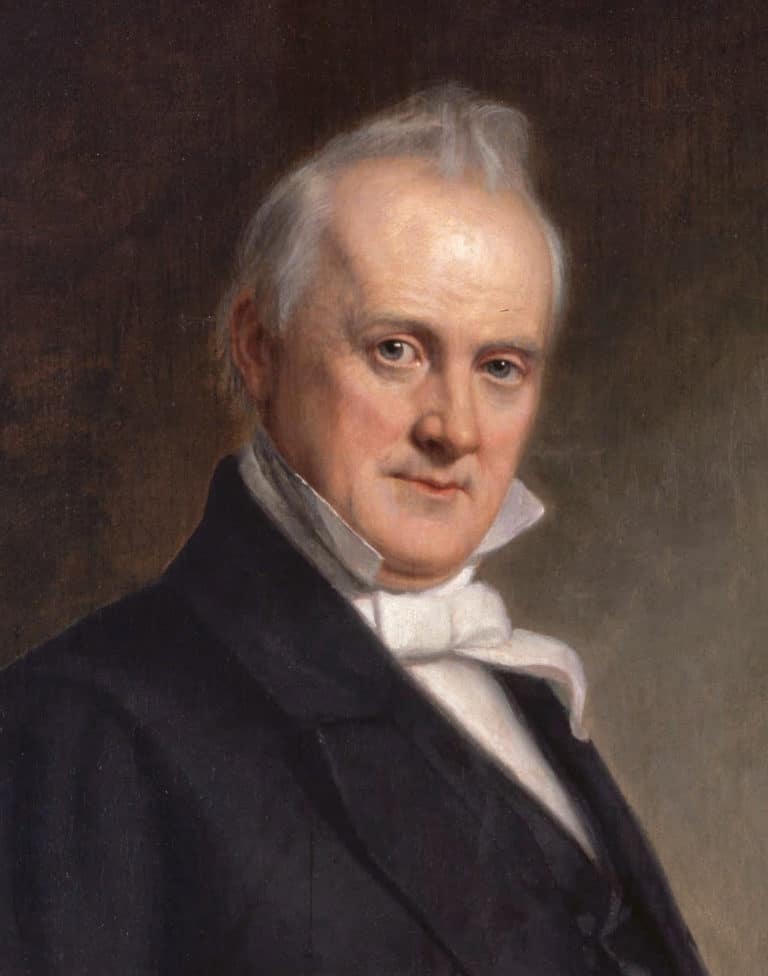
#40 Ronald Reagan- the Great Communicator

2/6/1911 – 6/5/2004
Party: Republican
Timeline; 1981-1989
#40 Ronald Reagan- the Great Communicator
Reagan was a movie star before enlisting in the U.S. Army as a reserve (1937), still starring in roles while serving and even signed a seven year contract with Warner Brothers before he was ordered to active duty (1942-1945).
When he was out he went back to the entertainment life serving on the Screen Actors Guild, eventually becoming President (1959-1960). During that time he started his political career as well where the Goldwater campaign and his fame led him to a visible political status which helped him win the position of governor of California (1967-1975).
After his terms as Governor he went on to run for President, losing his first campaign in 1976 before finally being elected in 1980.
1981;
- Reagan becomes the 40th President of the United States, at the age of 69. George H.W. Bush is his V.P.
- Fifty-two American hostages held in Iran since November 1979 are released.
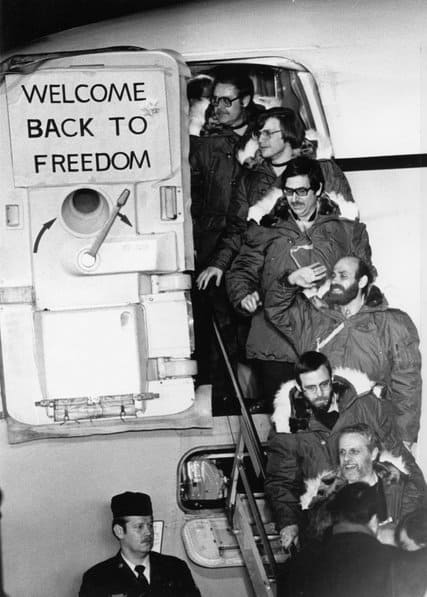
AMERICAN HOSTAGES ARE FREED FROM IRAN AFTER ALMOST 2 YEARS
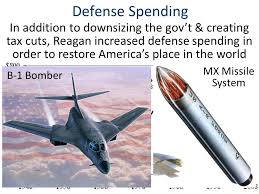
- He proposes increased defense spending, and decreased taxes and domestic spending in speech to Congress.
- The President was shot by John W. Hinkley, Jr., while leaving the Washington Hilton Hotel after giving a speech
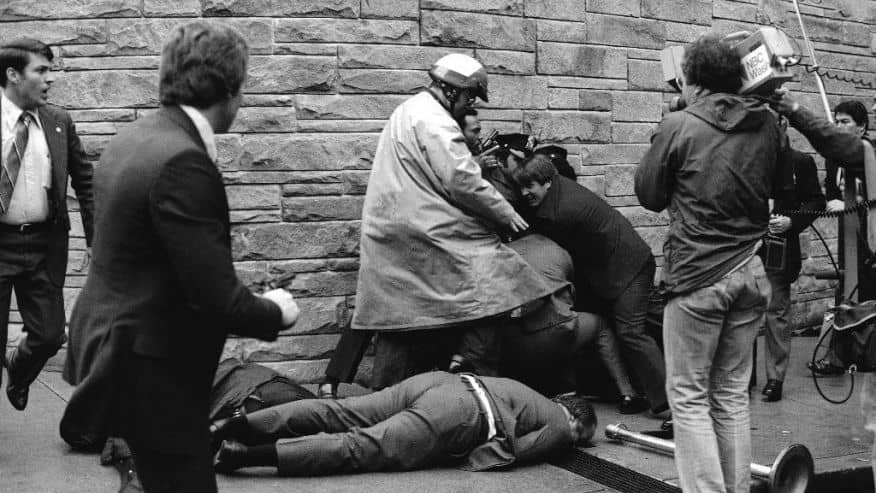
ATTEMPTED ASSASSINATION OF REAGAN
- Reagan lifts a grain embargo imposed on Soviet Union by President Carter.
- He nominates Sandra Day O’Connor to fill the seat of retiring Supreme Court justice Potter Stewart, making O’Connor the first woman to sit on the Supreme Court
- His administration orders the dismissal of 13,000 PATCO air traffic controllers out on strike, citing their violation of a federal law against industry strikes.
- He declares that the United States will produce the B-1 bomber and MX missiles as part of military buildup
- Reagan states that he will not deploy intermediate-range nuclear missiles in Europe if the Soviet Union agrees to dismantle similar weapons already in place.
- He imposes economic sanctions on Poland following that government’s imposition of martial law in the Poland Crisis.
1982;
- Reagan calls for “New Federalism” in his State of the Union address, advocating less federal spending and more state initiative to solve social and economic problems.
- He becomes the first U.S. President to address the combined Houses of Parliament, taking Britain’s side in the Falkland Islands conflict with Argentina.
- The President establishes the President’s Private Sector Survey on Cost Control through Executive Order
- He signs the Tax Equity & Fiscal Responsibility Act
1983;
- In his State of the Union address, Reagan calls for a freeze on domestic spending and increases in military outlays.
- Reagan sends forces to Lebanon to help reduce tensions from the Lebanese Civil War
- His administration urges development of the Strategic Defense Initiative (SDI), an attempt to create a high-technology anti-ballistic missile shield to protect the United States from nuclear attack.
- President Reagan signs the Social Security Reform Bill into law.
- The U.S. GNP shows dramatic growth for the first quarter of 1983, signaling the end of the recession.
- Suicide bombers crashed a truck bearing more than 2,000 pounds of explosives through protective barricades at U.S. Marine barracks in Lebanon, Beirut
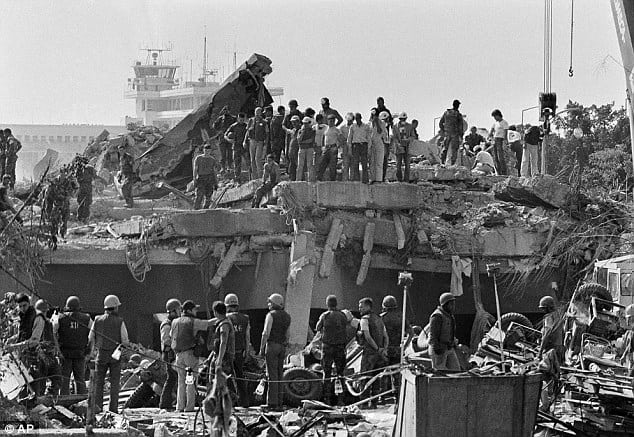
AFTERMATH OF THE BEIRUT SUICIDE BOMBING ON MARINE BARRACKS
1984;
- The President delivers State of the Union message, calling on Congress to cooperate to reduce the deficit.
- He signs scientific and cultural exchange accords with the Beijing leadership while on six-day visit to China.
- Congress and the President work out a compromise on the MX missile
1985;
- Reagan wins a second term
- The Reagan administration announces trade embargo against Nicaragua.
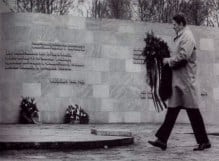
- He attends a wreath-laying ceremony at Bitburg military cemetery in West Germany, the gravesite of 200 German soldiers including 49 members of Adolf Hitler’s SS. Responding to criticism of the visit, Reagan visits and lays a wreath at a nearby concentration camp earlier in the day
- Reagan has a malignant polyp removed from his colon; Vice President Bush serves as acting President for eight hours.
- His administration announces limited economic sanctions against South Africa after the South African government declares martial law.
- Reagan and Soviet premier Mikhail Gorbachev hold a summit meeting in Geneva, Switzerland. It is the first such meeting between U.S and Soviet heads of state since 1979
- He signs the Gramm-Rudman deficit reduction bill.
1986;
- Reagan and Gorbachev meet in Reykjavik, Iceland.
- The Challenger space shuttle explodes just over a minute into its flight

CHALLENGER AT LIFT OFF

CHALLENGER EXPLOSION SHORTLY AFTER LIFT OFF
- Reagan signs a revision of the tax code into law.
- The White House informs Congress that the United States secretly sold arms to Iran in violation of federal laws prohibiting arms deals with Iran. The administration denies that the sales were part of an attempt to secure the release of American hostages held by Iranian-backed forces
- The administration admits that between $10 and $30 million had been diverted from Iranian arms sales and funneled to the Nicaraguan contras
- The Tower Commission is appointed to investigate the Iran-Contra affair. The President forgoes any claim of executive privilege and orders his administration to cooperate fully with the investigation. Lawrence Walsh is appointed special prosecutor to investigate criminal wrongdoing.
1987;
- Congress overrides Reagan’s veto of the Water Quality Control Act
- The Tower Commission releases its report, finding no criminal wrongdoing on the part of the White House but remaining critical of the administration nonetheless
- In televised address, Reagan accepts responsibility for actions in Iran-Contra affair that occurred without his knowledge.
- Reagan visits Berlin Wall asking Gorbachev to tear down the wall for peace talks
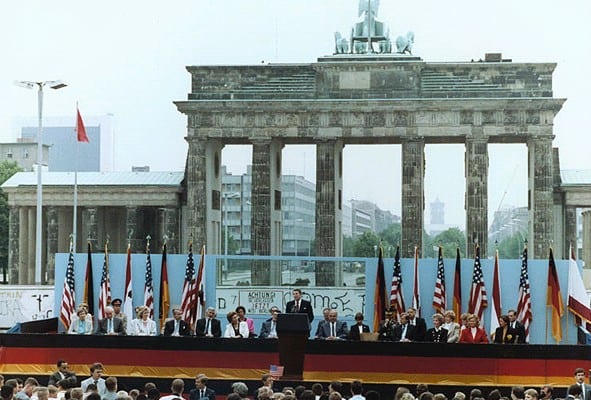
REAGAN SPEAKS AT BERLIN WALL
- Congress issues its Iran-Contra report, declaring that Regan must assume “ultimate responsibility” for the affair.
- Gorbachev and Reagan meet in Washington, D.C., and sign the Intermediate Range Nuclear Forces Treaty, ending the Cold War
1988;
- The administration prohibits federally funded family-planning centers from providing assistance to women seeking abortions.
- Reagan visits the Soviet Union for the Moscow Summit
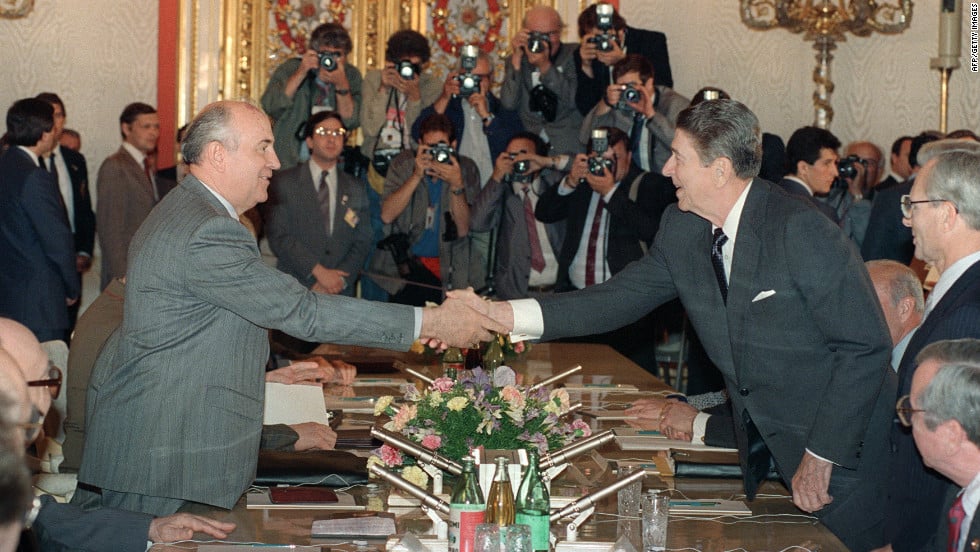
GORBACHEV AND REAGAN
1989;
- Reagan delivers his farewell address.
- Reagan leaves office with public opinion casting him as the nation’s most popular President since Franklin D. Roosevelt.
Reagan is credited with reviving national pride after the turmoil of the 1960s and 1970s. He enjoyed great popularity, though his conservative policies were controversial. He is the only President to survive after being wounded by a would-be assassin. Reagan retired to California occasionally making appearances on behalf of the Republican Party. He was diagnosed with Alzheimer’s disease in 1994.
Famous Quotes
“If we lose freedom here, there is no place to escape to. This is the last stand on Earth.”
“Government is not the solution to our problem, government is our problem”
“There is no limit to the amount of good you can do if you don’t care who gets the credit”