Project Management: Coordinating People, Systems, and Success
Every building, bridge, hospital expansion, manufacturing shutdown, software deployment, and equipment replacement began as a project.
Some finish ahead of schedule. Others finish years late. Many exceed their budgets. Some fail completely.
The difference is rarely luck.
Successful projects are the result of planning, communication, leadership, documentation, and disciplined execution.
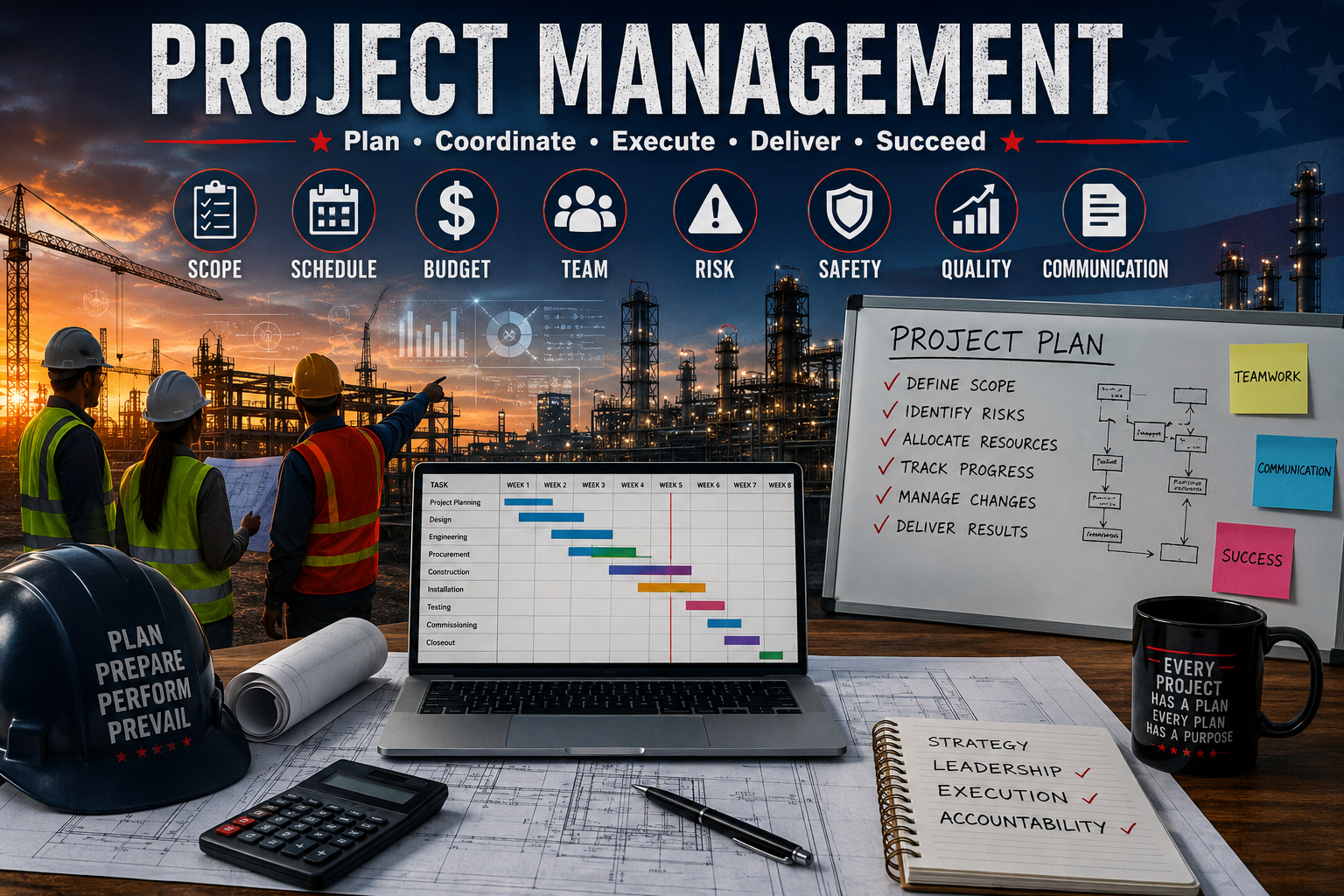
Project management is the process of organizing people, resources, schedules, budgets, and risks to accomplish a specific objective safely and efficiently.
Whether you’re replacing a rooftop HVAC unit, building a refinery, renovating a hospital, or installing a new computer network, the principles remain remarkably similar.
Good project management doesn’t eliminate problems.
It prepares for them before they happen.
Every Project Has Three Primary Goals
Every project attempts to balance three competing objectives.
Complete the work safely.
Finish on time.
Stay within budget.
Improving one often affects the others. Finishing faster may require additional labor. Reducing costs may increase project duration. Ignoring safety to save time can create catastrophic consequences.
Experienced project managers understand that success comes from balancing all three rather than maximizing only one.
Every Successful Project Begins With Scope
Before work begins, everyone must understand exactly what is being built.
This is known as the project scope.
Poorly defined scope creates confusion. Confusion creates change orders. Change orders create delays. Delays increase costs.
One unclear sentence during planning can become thousands of dollars during construction.
Good scope answers questions before they become expensive.
What work is included? What work is excluded? Who is responsible? What standards must be met?
When everyone understands the destination, reaching it becomes much easier.
Planning Prevents Chaos
Projects rarely fail because workers forget how to perform their jobs.
They fail because the work wasn’t organized properly.
Planning includes
- Scheduling
- Material procurement
- Permits
- Equipment availability
- Labor requirements
- Safety planning
- Shutdown coordination
- Vendor scheduling
- Quality inspections
- Documentation
Every hour spent planning often saves several hours during execution.
Planning is not delaying work.
Planning is reducing uncertainty.
The Importance of Scheduling
Time is one of the few project resources that cannot be replaced.
Once a day is lost, it cannot be recovered.
Good schedules identify
- Critical activities
- Dependencies
- Material delivery dates
- Inspection requirements
- Trade coordination
- Equipment outages
- Weather considerations
- Testing
- Commissioning
- Final turnover
One delayed activity often affects dozens of others.
This is why experienced project managers focus heavily on identifying the critical path.
Critical path activities determine the earliest possible completion date for the entire project.
Protecting these activities protects the project.
Communication Is the Real Job
Many people believe project managers spend most of their time creating schedules.
In reality, they spend most of their time communicating.
They communicate with
- Owners
- Engineers
- Architects
- Contractors
- Maintenance departments
- Operations
- Safety personnel
- Suppliers
- Inspectors
- Executives
Everyone sees the project differently.
The project manager ensures everyone continues moving toward the same objective.
Poor communication causes duplicate work, missed deadlines, material shortages, conflicting priorities, and expensive mistakes.
Most project failures begin with information that wasn’t shared.
Documentation Protects Everyone
If work wasn’t documented, it becomes difficult to prove it happened.
Documentation includes
- Meeting notes
- Inspection reports
- Change orders
- Material receipts
- Equipment manuals
- Maintenance records
- Commissioning reports
- Safety documentation
- Punch lists
- As-built drawings
Documentation protects owners, contractors, technicians, and future maintenance personnel.
It also preserves valuable knowledge long after the project ends.
Safety Is Never Separate From Production
Some organizations mistakenly believe safety slows projects.
In reality, unsafe projects create the greatest delays.
An injury can stop work for hours or even days. Investigations consume resources. Equipment may be taken out of service.
Schedules collapse. Costs increase.
Good project management integrates safety into every phase instead of treating it as a separate requirement.
Safety meetings. Lockout procedures. Permit systems. Hazard assessments. Proper PPE.
These are investments in successful execution.
Maintenance Projects Are Unique
Unlike new construction, maintenance projects often occur while facilities remain operational.
Hospitals cannot simply stop treating patients.
Factories cannot always stop producing products.
Data centers cannot lose power.
Maintenance project managers constantly balance operational needs with repair requirements.
Many maintenance projects require
- Temporary shutdowns
- Equipment redundancy
- Bypasses
- Night work
- Weekend work
- Emergency response planning
- Commissioning
- Startup verification
This makes communication even more important than construction alone.
Preventive Maintenance Saves More Than Repairs
Emergency work always feels urgent.
Preventive maintenance rarely does.
Yet preventive maintenance consistently reduces downtime, lowers repair costs, improves equipment reliability, and extends asset life.
Replacing bearings during scheduled downtime is far less expensive than replacing an entire motor after catastrophic failure.
The best maintenance organizations schedule repairs before equipment decides for them.
Contractors Must Work as One Team
Large projects often involve multiple contractors.
- Electrical.
- Mechanical
- Controls.
- Plumbing.
- Structural.
- Civil.
- Fire protection.
Each contractor has different priorities.
Without coordination they compete for space, equipment access, permits, and schedule time.
Successful project managers create cooperation instead of competition.
Everyone succeeds when trades work together.
Commissioning Confirms the Project Actually Works
Finishing construction does not necessarily mean the project is complete.
Equipment must be tested. Controls verified. Safety systems confirmed. Operators trained. Documentation completed. Problems corrected.
Commissioning ensures the installed system performs as designed before ownership is transferred.
Skipping commissioning simply delays discovering problems until after the project is finished.
Root Cause Analysis Creates Long Term Improvement
Replacing the same failed component every few months is not maintenance.
It is repetition.
Good project managers ask
- Why did it fail?
- What changed?
- What operating conditions exist?
- Was installation correct?
- Was the design appropriate?
- Was maintenance performed properly?
Solving the root cause prevents future failures instead of simply repeating repairs.
Scenario One
A hospital schedules a major pump replacement.
The crane contractor arrives late.
Electricians finish disconnecting power.
Operations is waiting to restore service.
The mechanical crew cannot begin until the crane arrives.
Instead of blaming one contractor, the project manager immediately reorganizes available work, updates every trade, communicates revised expectations, and minimizes downtime.
Good project managers adapt without losing control.
Scenario Two
A manufacturing facility experiences the same motor failure every six months.
Each repair replaces bearings and couplings.
Nothing changes.
Eventually an engineer discovers severe shaft misalignment that was never corrected.
The repairs were successful.
The problem was never solved.
Project management is about solving systems, not symptoms.
Scenario Three
A contractor requests additional work halfway through a project.
The owner verbally approves it.
No documentation is completed.
Weeks later both sides disagree about cost and schedule.
Proper change management protects everyone involved.
Every change should be documented before work begins whenever possible.
Scenario Four
A maintenance shutdown is scheduled months in advance.
Every contractor arrives on time.
Materials are staged.
Permits are approved.
Equipment is isolated.
Safety briefings are complete.
The shutdown finishes ahead of schedule because planning eliminated uncertainty before work started.
Preparation often determines success long before the first wrench is turned.
Scenario Five
A facility repeatedly replaces failed equipment but never reviews operating conditions.
The equipment is not defective.
The process is.
Without understanding why failures occur, repairs become an endless cycle.
The best organizations improve systems rather than simply replacing parts.
Questions Every Project Manager Should Ask
Before every project ask
- Is the scope clearly defined?
- Does everyone understand their responsibilities?
- Have materials been ordered?
- Are permits approved?
- Are risks identified?
- Is the schedule realistic?
- Have shutdowns been coordinated?
- Is safety integrated into the work plan?
- Are contingency plans available?
- How will changes be documented?
- Who approves decisions?
- How will success be measured?
The Eagleye Perspective
Project management is far more than timelines and meetings.
It is the discipline of coordinating complex systems where every decision affects people, equipment, budgets, safety, and future operations.
The best project managers are not simply organizers.
They are systems thinkers.
They recognize dependencies before others see them.
They communicate constantly. They document thoroughly. They prepare for uncertainty.
They solve root causes instead of temporary symptoms.
Whether managing a multimillion dollar industrial shutdown, replacing an air handler in a hospital, coordinating contractors during a campus renovation, or leading a small maintenance team, the principles remain the same.
Projects succeed when people work together, information flows freely, risks are managed early, and execution follows thoughtful planning.
In the end, project management is not about completing tasks.
It is about bringing people, resources, and systems together to accomplish something that no individual could achieve alone.