
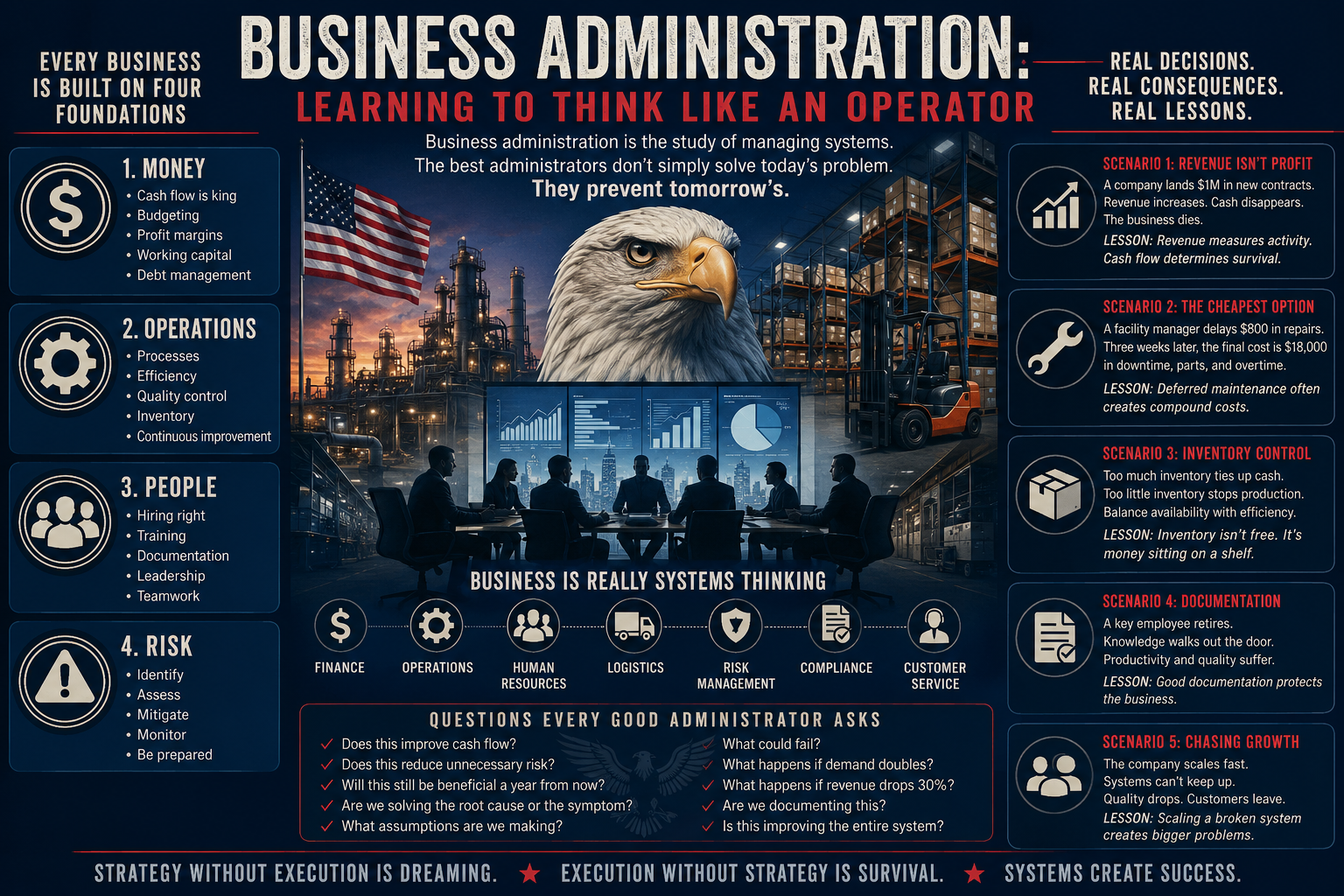
Business Administration: Learning to Think Like an Operator
Running a business isn’t about memorizing accounting terms or reading management books.
It’s about making thousands of small decisions that determine whether an organization grows, survives, or slowly destroys itself.
Every invoice…
Every hire…
Every purchase…
Every maintenance delay…
Every inventory order…
Every budget meeting…
…creates ripple effects throughout an organization.
Business administration is really the study of managing systems.
The best administrators don’t simply solve today’s problem.
They prevent tomorrow’s.
Whether you’re running a multinational corporation, a local HVAC company, a hospital maintenance department, or even your own household budget, the same principles apply.
Every Business Is Built on Four Foundations
1. Money
Without cash flow, nothing else matters.
A profitable business can still fail if it cannot pay its bills this month.
Understanding cash flow, budgeting, profit margins, working capital, and debt is often more important than simply increasing sales.
A growing company can actually go bankrupt faster than a stable one if growth isn’t properly financed.
2. Operations
Operations are the engine.
Processes should make work easier, safer, faster, and more repeatable.
Poor operations create:
- wasted labor
- inventory shortages
- customer complaints
- expensive overtime
- safety incidents
- equipment failures
The best organizations eliminate problems before employees ever experience them.
3. People
Employees are investments, not expenses.
Hiring the wrong person costs far more than taking extra time during recruitment.
Training should increase capability.
Documentation should reduce confusion.
Leadership should remove obstacles instead of creating them.
Strong teams multiply productivity.
Weak leadership multiplies mistakes.
4. Risk
Every decision has consequences.
Good administrators constantly ask:
“What happens if this fails?”
Risk management includes:
- insurance
- documentation
- compliance
- internal controls
- preventive maintenance
- cybersecurity
- emergency planning
- financial reserves
Businesses rarely collapse because of one catastrophic event.
They usually collapse because dozens of small risks were ignored until they combined into one large failure.
Business Is Really Systems Thinking
Imagine a leaking roof.
The maintenance department wants repairs.
Accounting wants to delay spending.
Operations wants production to continue.
Customers expect uninterrupted service.
Leadership wants lower costs.
Every department is technically correct.
The administrator’s job is balancing all of them.
Business administration is less about choosing sides…
…and more about optimizing the entire system.
Scenario 1: Revenue Isn’t Profit
An HVAC company lands $1 million in new contracts.
Everyone celebrates.
Six months later the company files bankruptcy.
How?
The company:
- underpriced every project
- purchased too much equipment
- hired too quickly
- financed everything through debt
- waited 90 days to receive payment
Revenue increased.
Cash disappeared.
The business died.
Lesson: Revenue measures activity.
Cash flow determines survival.
Scenario 2: The Cheapest Option
A facility manager delays replacing worn bearings to save $800.
Three weeks later:
- motor fails
- production stops
- overtime is required
- replacement parts must be overnight shipped
- customers receive delayed orders
Final cost:
$18,000
The cheapest decision became the most expensive.
Lesson: Deferred maintenance often creates compound costs.
Scenario 3: Inventory Control
A warehouse manager orders extra parts “just in case.”
After a year:
- shelves are full
- parts become obsolete
- money sits unused
- technicians still can’t find what they need
Inventory isn’t free.
Every unused part represents money that could have been invested elsewhere.
Good inventory balances availability with efficiency.
Everything has a shelf life, so too many extra parts may go to waste.
Scenario 4: Documentation
A senior technician retires.
He knew every shortcut.
Nothing was written down.
The new technician spends weeks figuring everything out.
Production slows.
Mistakes increase.
Customers complain.
The company didn’t just lose one employee.
It lost decades of undocumented knowledge.
Lesson: Good documentation protects the business, not just today’s workers.
Scenario 5: Chasing Growth
A small construction company doubles its workforce in one year.
Unfortunately:
- supervisors stay the same
- training disappears
- quality declines
- callbacks increase
- customers leave
Growth exposed weaknesses that already existed.
Scaling a broken system only creates larger problems.
Questions Every Good Administrator Asks
Before making a decision, ask:
- Does this improve cash flow?
- Does this reduce unnecessary risk?
- Will this still be beneficial a year from now?
- Are we solving the root cause or the symptom?
- What assumptions are we making?
- What could fail?
- What happens if demand doubles?
- What happens if revenue drops 30%?
- Are we documenting this?
- Is this improving the entire system or only one department?
These questions often matter more than finding the “perfect” answer.
The Eagleye Perspective
Business administration isn’t just about making money.
It’s about building systems that continue working long after today’s problems disappear.
Every successful organization depends on interconnected systems:
- Finance
- Leadership
- Procurement
- Inventory
- Maintenance
- Information Technology
- Human Resources
- Logistics
- Risk Management
- Compliance
- Customer Service
When one system weakens, the others eventually feel the strain.
Understanding those relationships is what separates managers from operators—and operators from leaders.
