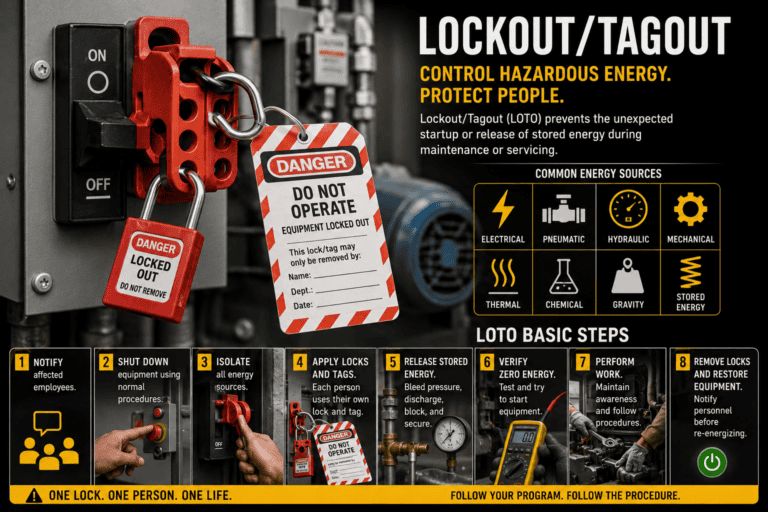
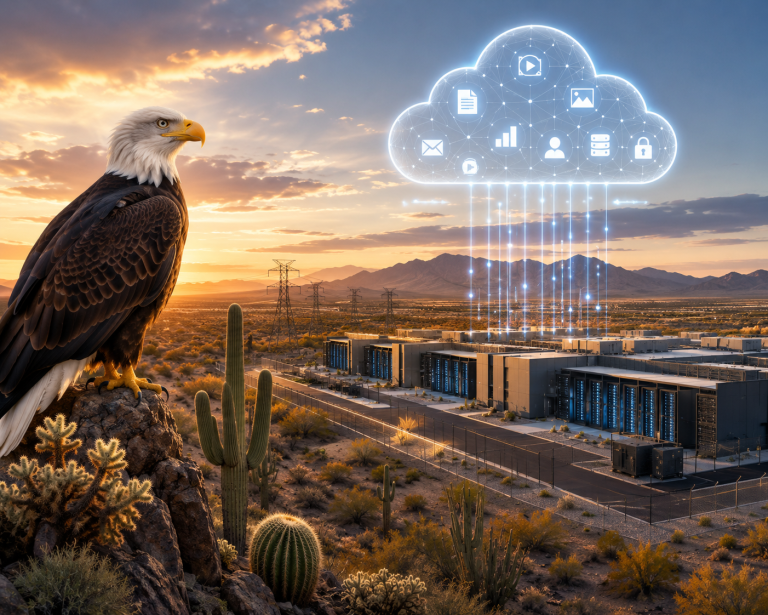
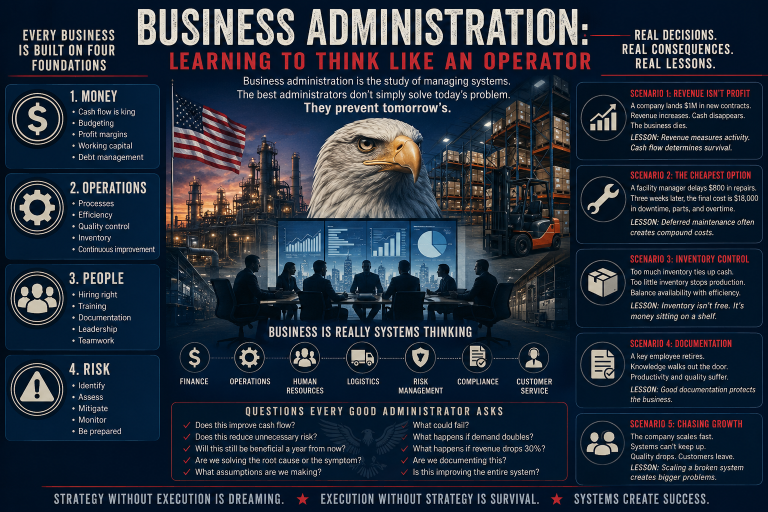
Why Facility Operations Matters
The Hidden Systems That Keep Society Running
Most people walk into a building and only notice the obvious things: the lights are on, the air conditioning works, the internet connects, the elevators move, and the bathrooms function. What they rarely see is the massive interconnected system operating behind the scenes to make all of that happen.
That system is Facility Operations.
Facility Operations is not just maintenance. It is the coordination of infrastructure, technology, logistics, planning, leadership, and human problem-solving that keeps buildings, campuses, factories, hospitals, schools, data centers, and cities functioning every single day.
When Facility Operations works properly, nobody notices it.
When it fails, everything stops.
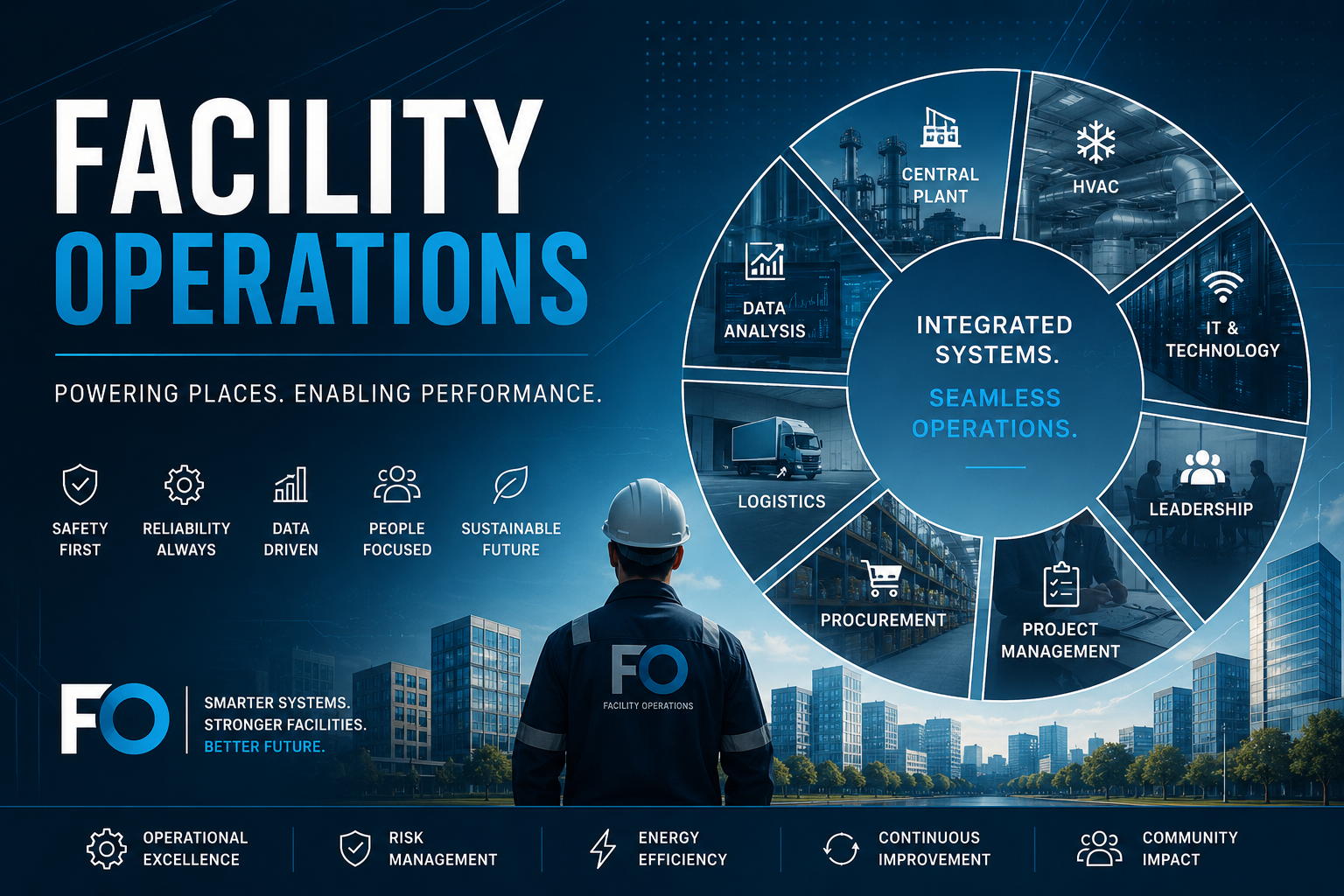
The Foundation of Modern Infrastructure
Every modern facility depends on layers of systems working together simultaneously:
- Electrical distribution
- HVAC and climate control
- Water and wastewater systems
- Fire protection
- Security systems
- IT and network infrastructure
- Mechanical equipment
- Logistics and supply chains
- Data analysis and automation
- Personnel coordination
- Financial planning and procurement
Facility Operations acts as the central nervous system connecting all of them together.
A hospital cannot function without stable HVAC pressure relationships and emergency power.
A data center cannot operate without cooling redundancy and network uptime.
A school cannot educate effectively if classrooms are unsafe or systems are failing.
A manufacturing plant loses money every minute equipment goes down.
The public often sees buildings.
Facility Operations sees systems.
Central Plant Operations: The Heart of Large Facilities
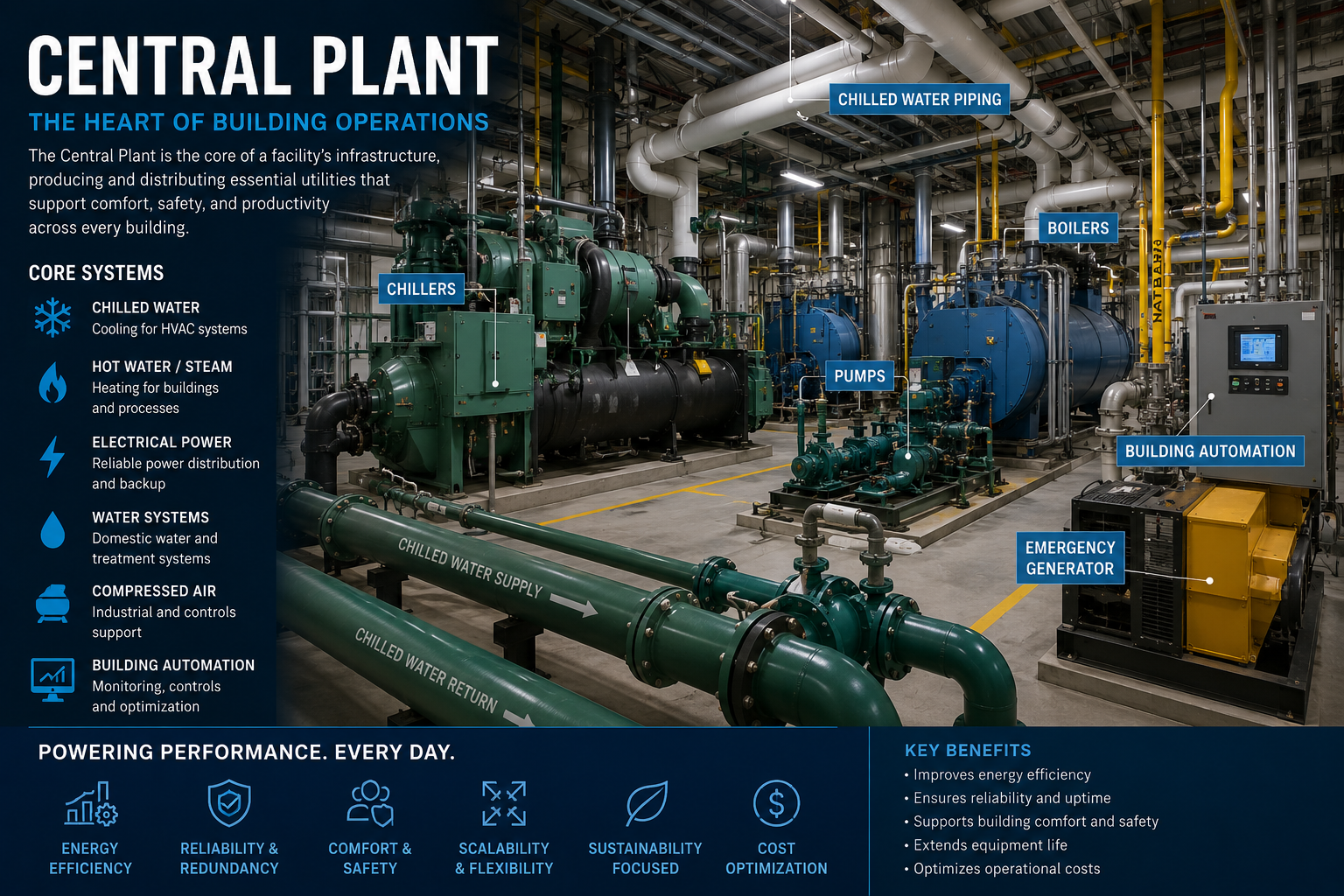
In many large campuses and industrial environments, the backbone of operations is the Central Plant.
A central plant is essentially the utility hub of a facility or campus. It produces and distributes critical services such as:
- Chilled water for cooling
- Steam or hot water for heating
- Electrical distribution
- Domestic water systems
- Backup power generation
- Compressed air
- Process utilities
These systems support hospitals, universities, casinos, airports, manufacturing plants, and government facilities.
A central plant may contain:
- Chillers
- Boilers
- Cooling towers
- Pumps
- Heat exchangers
- Air compressors
- Emergency generators
- Water treatment systems
- Automation controls
- SCADA/BAS systems
If the central plant fails, entire facilities can lose cooling, heating, water circulation, or electrical support within minutes.
This is why Facility Operations requires both technical expertise and strategic thinking. Operators and technicians are constantly balancing efficiency, reliability, safety, redundancy, and cost.
HVAC: The Environmental Control System
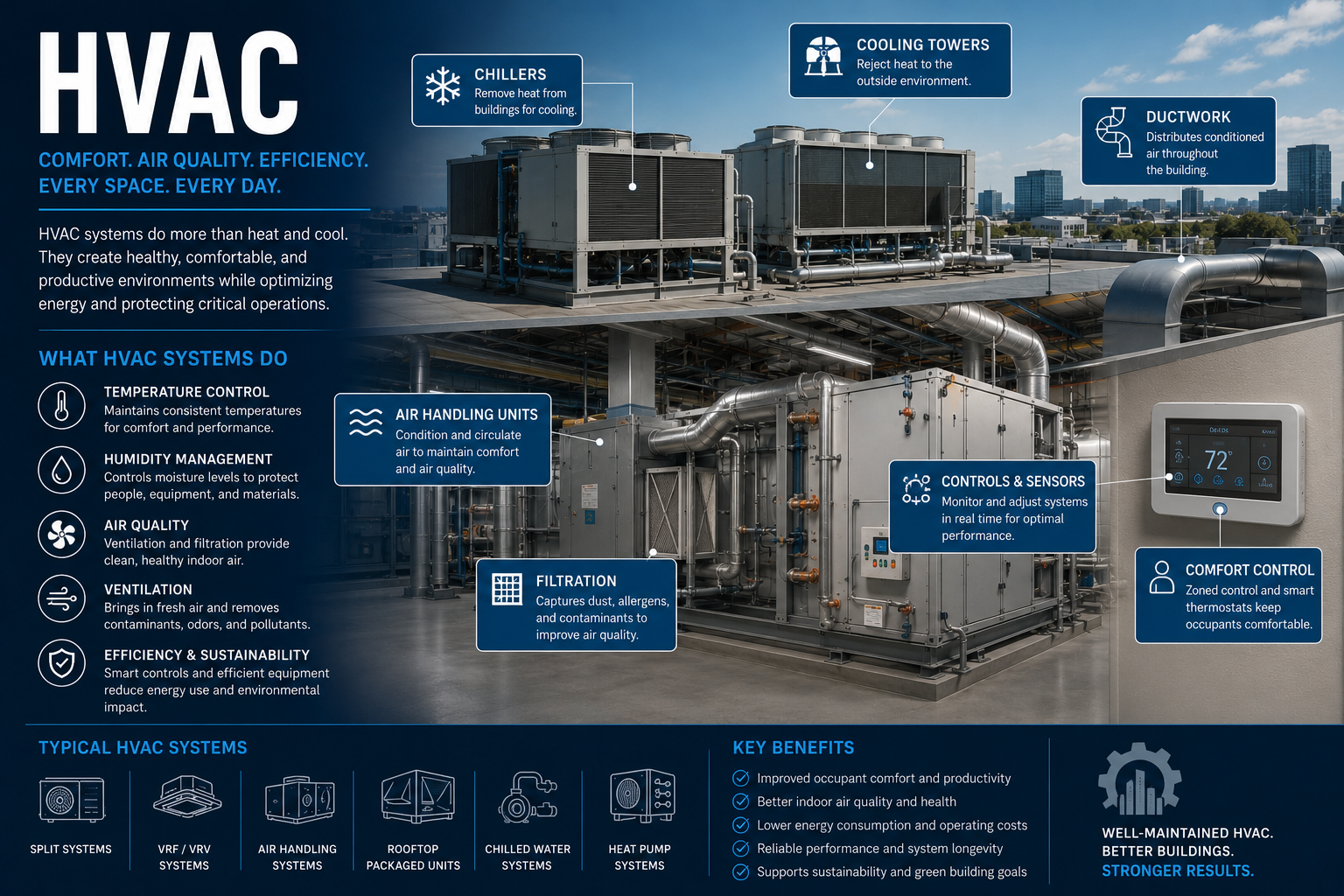
HVAC (Heating, Ventilation, and Air Conditioning) is one of the most visible and critical parts of Facility Operations.
Most people think HVAC simply means “air conditioning,” but modern HVAC systems regulate:
- Temperature
- Humidity
- Air quality
- Pressure relationships
- Ventilation rates
- Filtration
- Energy efficiency
In certain facilities, HVAC becomes mission critical:
Hospitals
Proper pressure relationships help prevent contamination and airborne infection spread.
Data Centers
Cooling systems protect servers from overheating and catastrophic downtime.
Laboratories
Ventilation systems protect workers from hazardous chemicals and maintain controlled environments.
Industrial Facilities
Process cooling and ventilation protect both equipment and workers.
Modern HVAC systems are deeply integrated with controls, sensors, automation, and data analytics. Technicians today often work as much with computers and controls as they do with tools.
IT and Digital Infrastructure
Modern Facility Operations is no longer purely mechanical.
It is increasingly digital.
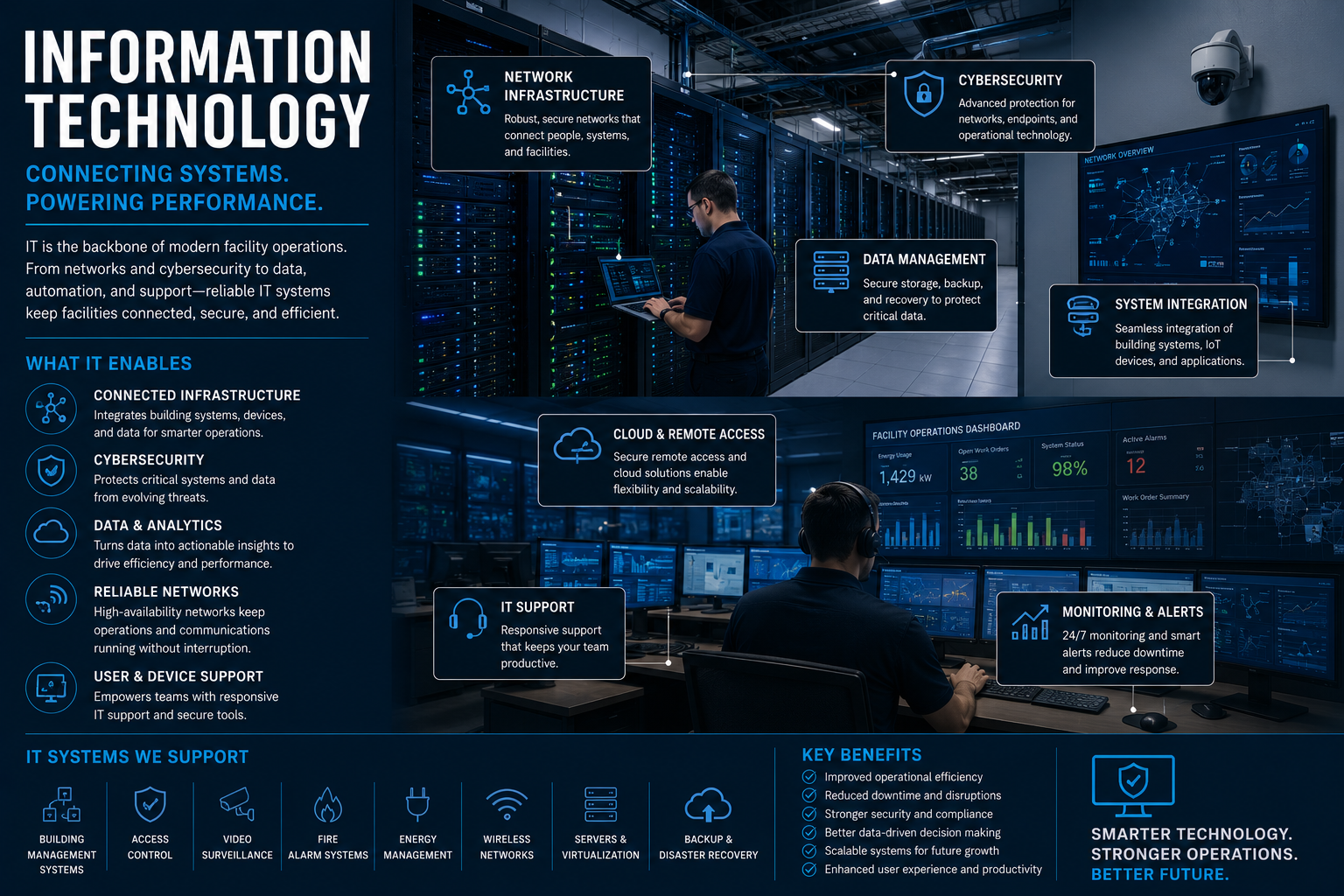
Most facilities now rely on:
- Network infrastructure
- Building Automation Systems (BAS)
- SCADA systems
- Remote monitoring
- Cybersecurity
- Cloud-based analytics
- Smart sensors
- IoT devices
A building today may contain thousands of live data points tracking:
- Temperatures
- Pressures
- Flow rates
- Energy usage
- Occupancy
- Alarm conditions
- Equipment runtimes
IT infrastructure has become deeply intertwined with physical infrastructure.
A failed network switch can disable an automation system.
A cybersecurity breach can affect building controls.
A failed sensor can trigger massive operational problems.
Facility Operations increasingly requires professionals who understand both physical systems and digital systems.
Leadership and Team Coordination
One of the biggest misconceptions about Facility Operations is that it only involves technical work.
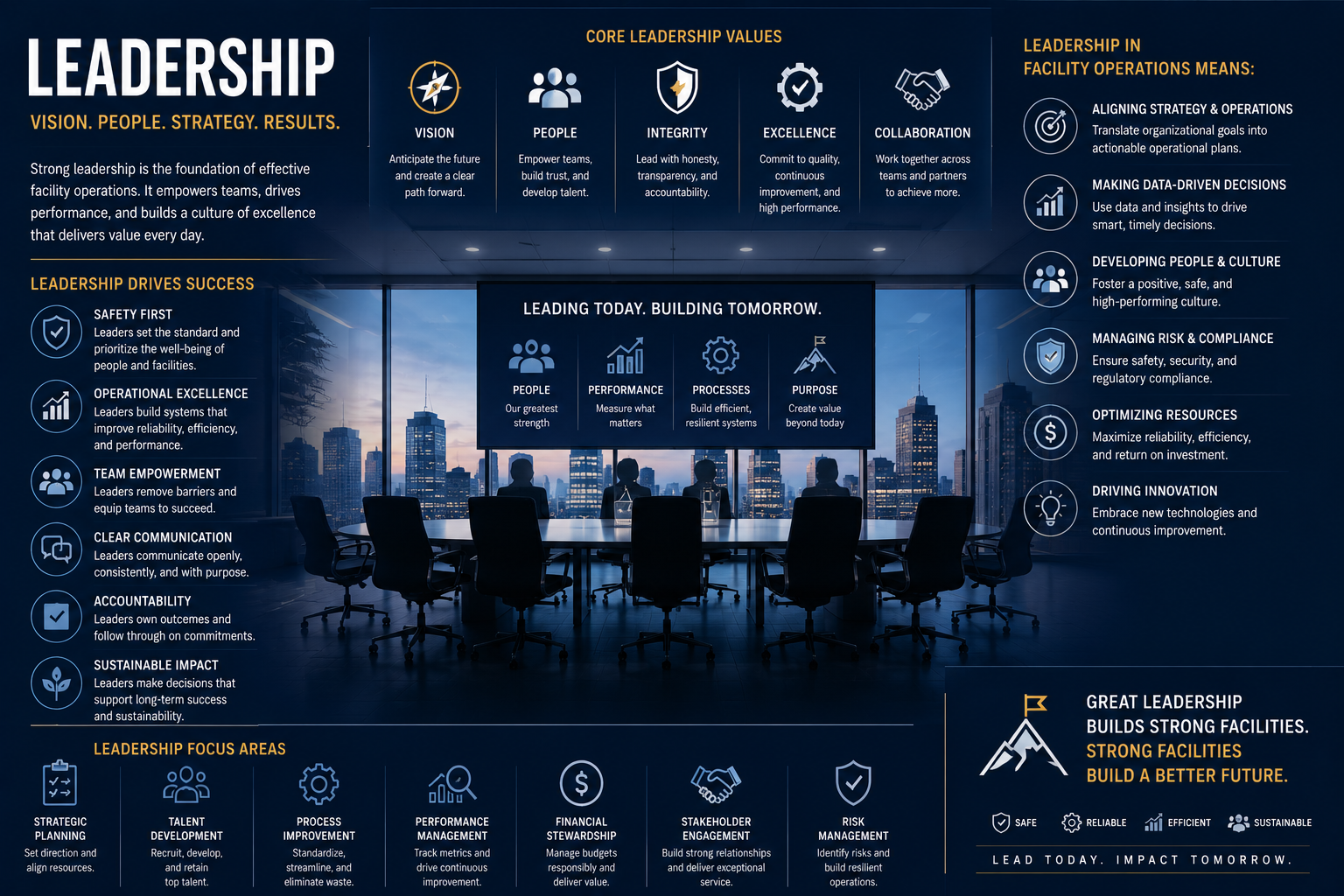
In reality, leadership is one of the most important components.
Facilities depend on coordination between:
- Operators
- Technicians
- Engineers
- Contractors
- Vendors
- IT staff
- Management
- Safety personnel
- Procurement teams
- Project managers
Strong leadership keeps systems functioning under pressure.
Facility leaders must constantly balance:
- Safety
- Budgets
- Staffing
- Emergency response
- Long-term planning
- Compliance
- Downtime prevention
A good facility leader understands both people and systems.
Technical knowledge matters.
Communication matters just as much.
Project Management and Continuous Improvement
Facilities are constantly evolving.
Equipment ages.
Codes change.
Technology advances.
Energy standards increase.
Operational demands grow.
Project management becomes essential for handling:
- Equipment upgrades
- Renovations
- Shutdowns
- Energy projects
- Automation integration
- Infrastructure expansion
- Preventive maintenance programs
A poorly planned project can disrupt operations for months.
A well-managed project can improve reliability, efficiency, and long-term costs for years.
Facility Operations is often about solving problems before they become disasters.
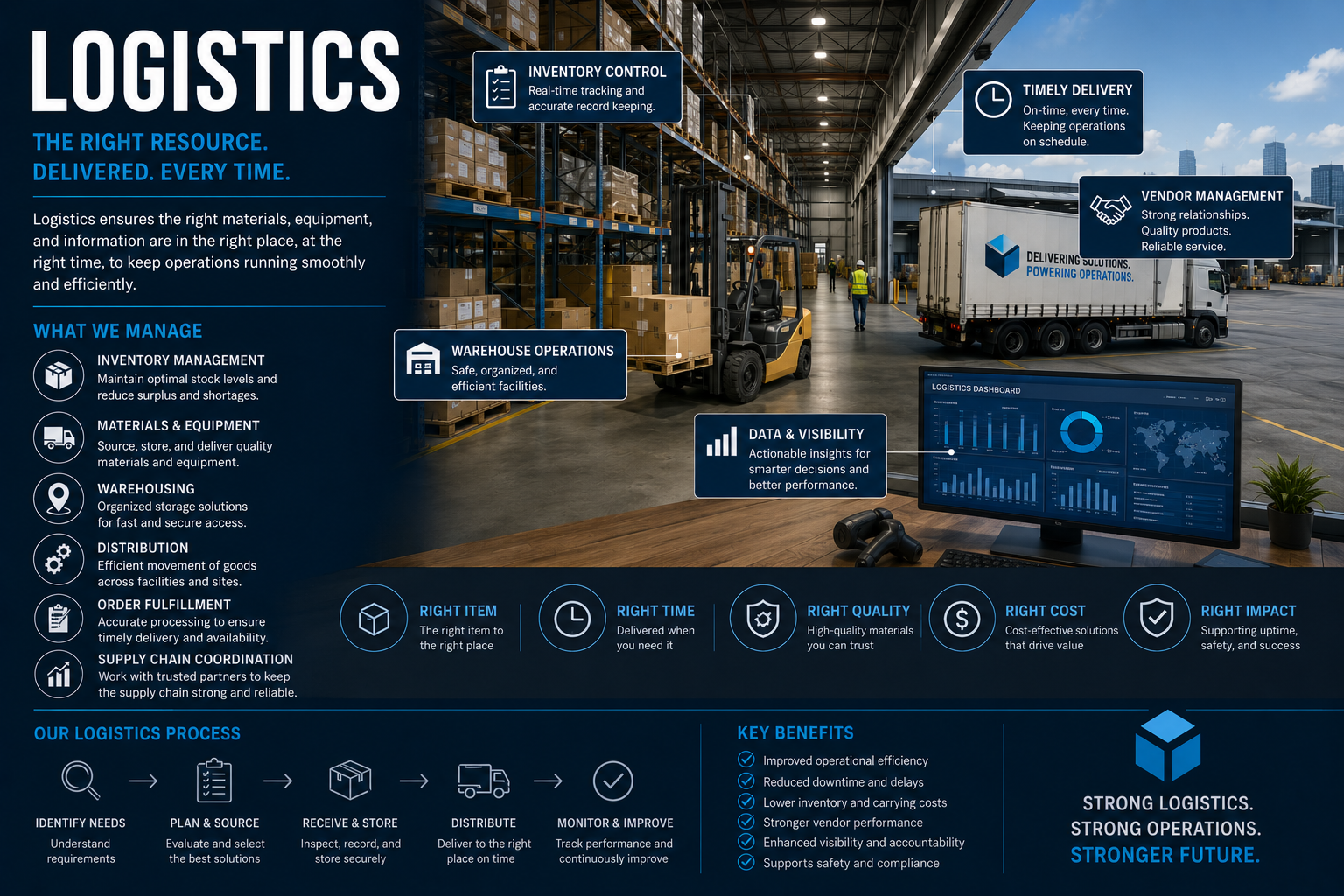
Logistics and Procurement
Even the best technicians cannot operate without proper materials, tools, and planning.
Logistics and procurement are critical but often overlooked components of Facility Operations.
Facilities require constant coordination of:
- Replacement parts
- Filters
- Chemicals
- Motors
- Electrical components
- Safety equipment
- Vendor contracts
- Specialized tools
- Emergency supplies
Poor procurement creates delays.
Delays create downtime.
Downtime creates operational and financial losses.
Supply chain awareness has become increasingly important in modern infrastructure management.
Data Analysis and Predictive Operations
Modern Facility Operations is becoming increasingly data-driven.
Facilities now use analytics to monitor:
- Energy consumption
- Equipment efficiency
- Runtime trends
- Failure patterns
- Predictive maintenance indicators
- Water usage
- Occupancy trends
This allows teams to move from reactive maintenance to predictive maintenance.
Instead of waiting for a motor to fail, systems can identify warning signs early through vibration analysis, temperature trends, pressure changes, or runtime abnormalities.
Data transforms operations from guesswork into informed decision-making.
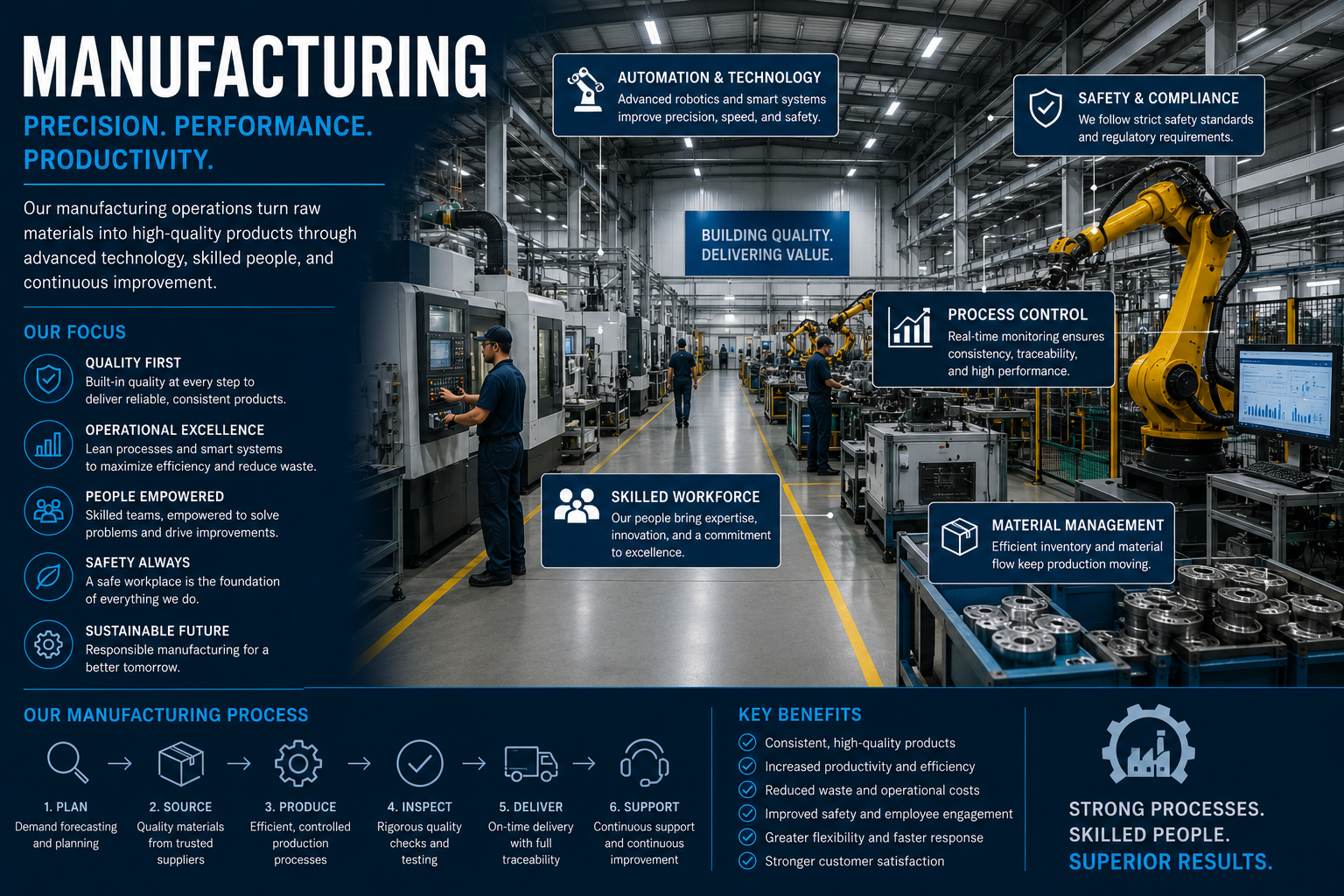
Facility Operations Is Systems Thinking
At its core, Facility Operations is about understanding interconnected systems.
A single issue can ripple across an entire facility:
- An HVAC failure can overheat IT systems.
- A network outage can disable controls.
- A procurement delay can shut down repairs.
- A staffing shortage can increase safety risks.
- A poor project decision can affect operations for years.
Facility professionals learn to think beyond isolated problems.
They learn to ask:
- What systems are connected?
- What are the downstream effects?
- Where are the vulnerabilities?
- What happens if this fails?
- How do we build redundancy?
This is why Facility Operations is one of the most important — and often underappreciated — fields in modern society.
The Invisible Backbone of Civilization
Facility Operations rarely receives public attention because success is measured by stability.
No headlines appear when:
- hospitals remain operational,
- water keeps flowing,
- data centers stay online,
- schools stay comfortable,
- factories remain productive,
- or infrastructure quietly performs as designed.
But behind every functioning building is a network of skilled professionals managing systems most people never think about.
Facility Operations is not just maintenance.
It is infrastructure management.
It is systems thinking.
It is logistics, engineering, technology, leadership, and problem-solving combined into one discipline.
And in a world increasingly dependent on complex infrastructure, Facility Operations matters more than ever.