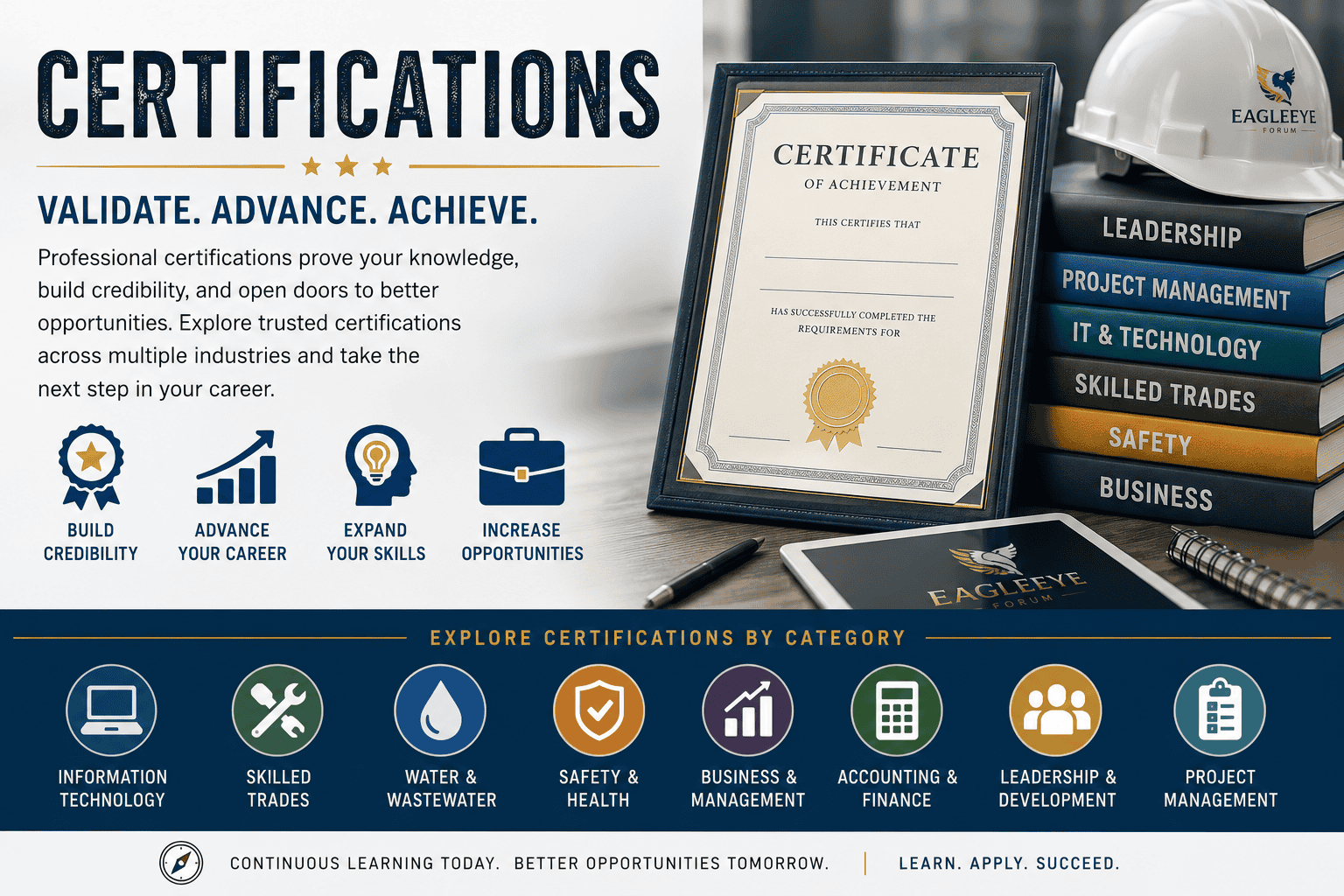
Professional Certifications: Investing in Your Career
Comparing Professional Certifications
Professional certifications vary considerably in cost, experience requirements, and career value. Some demonstrate foundational knowledge, while others validate advanced technical or leadership skills. Before investing in a credential, consider its relevance to your career goals, employer expectations, and ongoing renewal requirements.
The comparison below provides a starting point for evaluating credentials across multiple industries.
Professional Certifications Compared: Costs, Requirements & Renewal
| Certification | Career Field | Exam / Training Cost | Requirements | Renewal |
|---|---|---|---|---|
| EPA 608 | HVAC/R | Varies by provider | Pass approved exam | Lifetime |
| CMRT | Maintenance Technician | $195–$300 | Pass exam | 3 years |
| CMRP | Maintenance Management | $250–$470 | Pass exam | 3 years |
| CompTIA A+ | Information Technology | Approx. $500+ for two exams | Pass both exams | 3 years |
| CompTIA Network+ | IT / Networking | Approx. $390–$420 | Pass exam | 3 years |
| CompTIA Security+ | Cybersecurity | Approx. $400–$430 | Pass exam | 3 years |
| PMP | Project Management | $405–$655 | Project experience and training | 3 years |
| OSHA 10/30 | Workplace Safety | Varies by trainer | Complete authorized training | No federal expiration* |
| NATE | HVAC Technician | Varies by exams/provider | Required exams | Typically 2 years |
| ASHRAE Certifications | HVAC / Building Systems | Varies by credential | Experience and exam | Typically 3 years |
| Water / Wastewater Operator | Water Utilities | Varies by state and grade | State-specific exams and qualifications | State-spec |
- Note: OSHA 10/30 are training completion cards, not professional certifications. Employers may impose refresher requirements.
In today’s workforce, knowledge alone isn’t always enough. Employers want evidence that you possess the skills, experience, and commitment needed to perform at a high level. One of the best ways to demonstrate that commitment is through professional credentials.
A certification is more than a certificate hanging on the wall. It represents time spent learning, testing your knowledge, and proving your competency against an industry-recognized standard. While experience will always be one of the most valuable assets you can have, these credentials often open doors to interviews, promotions, leadership opportunities, and higher salaries.
Whether you’re interested in the skilled trades, information technology, business management, healthcare, finance, or engineering, there are numerous avenues designed to help you advance your career.
Why Certifications Matter
Professional certifications can provide several benefits throughout your career:
- Increase your credibility with employers.
- Demonstrate current industry knowledge.
- Improve promotion opportunities.
- Increase earning potential.
- Help you transition into a new career field.
- Meet regulatory or licensing requirements.
- Keep your skills current as technology evolves.
Many employers even reimburse employees for these trainings because a more knowledgeable workforce benefits the organization as much as the individual.
Information Technology Certifications
The IT industry changes rapidly, making certifications especially valuable. Many hiring managers use these credentials as a baseline when evaluating candidates.
Entry-Level
- CompTIA A+ – Computer hardware, operating systems, mobile devices, and troubleshooting.
- CompTIA Network+ – Networking fundamentals, routing, switching, and network security.
- CompTIA Security+ – Cybersecurity fundamentals and one of the most respected entry-level security certifications.
Intermediate
- Microsoft
- Cisco Certified Network Associate (CCNA)
- AWS Certified Cloud Practitioner
- Google Cloud Digital Leader
Advanced
- Certified Information Systems Security Professional (CISSP)
- Certified Ethical Hacker (CEH)
- AWS Solutions Architect
- Microsoft Azure Administrator
These can lead to careers in help desk support, systems administration, networking, cloud computing, cybersecurity, and IT management.
Skilled Trades Certifications
While experience remains the most important qualification in the trades, certifications demonstrate specialized knowledge and often satisfy employer or regulatory requirements.
HVAC/R
- EPA Section 608 (required in the U.S. for handling regulated refrigerants)
- NATE (North American Technician Excellence)
- HVAC Excellence
Electrical
- State Electrical Apprentice and Journeyman Licenses
- Master Electrician License
- NFPA 70E Electrical Safety Training
- Arc Flash Safety Training
Maintenance & Reliability
- Certified Maintenance & Reliability Technician (CMRT)
- Certified Maintenance & Reliability Professional (CMRP)
- Vibration Analysis
- Infrared Thermography
- Ultrasound Inspection
These credentials are highly valued in manufacturing, industrial maintenance, utilities, and facility operations.
Operator and Administrative Certifications
Water & Wastewater Certifications
Water and wastewater treatment are among the most regulated industries in the world. Operators are often required by law to hold credentials appropriate for the systems they operate.
Common certifications include:
- Water Treatment Operator
- Distribution Operator
- Wastewater Treatment Operator
- Wastewater Collections Operator
- Laboratory Analyst
- Backflow Prevention Tester
- Cross-Connection Control Specialist
Most states issue multiple levels that increase with experience and education.
Looking to get started? Go to the EPA Operator Certification page.
Safety Certifications
Safety credentials help protect employees while demonstrating a commitment to workplace safety and regulatory compliance.
Popular certifications include:
- OSHA 10-Hour
- OSHA 30-Hour
- HAZWOPER
- Certified Safety Professional (CSP)
- Associate Safety Professional (ASP)
- Certified Industrial Hygienist (CIH)
- CPR/AED & First Aid
These are valuable across nearly every industry.
Project Management Certifications
Project management skills are useful far beyond construction or engineering. Every organization manages projects.
Popular certifications include:
- Certified Associate in Project Management (CAPM)
- Project Management Professional (PMP)
- Agile Certified Practitioner (PMI-ACP)
- Certified ScrumMaster (CSM)
These credentials are respected in business, healthcare, manufacturing, government, and technology.
Business & Leadership Certifications
Strong technical skills can get you hired, but leadership skills often determine how far you advance.
Common certifications include:
- Lean Six Sigma Yellow Belt
- Lean Six Sigma Green Belt
- Lean Six Sigma Black Belt
- Certified Manager (CM)
- SHRM Certified Professional (SHRM-CP)
- Society for Human Resource Management
- Organizational Leadership Programs
Leadership development is often just as valuable as technical expertise for supervisors and managers.
Accounting & Finance Certifications
Financial professionals often pursue certifications that demonstrate expertise in accounting, auditing, taxation, and financial analysis.
Some of the most recognized include:
- Certified Public Accountant (CPA)
- Certified Management Accountant (CMA)
- Chartered Financial Analyst (CFA)
- Enrolled Agent (EA)
These certifications are widely respected in public accounting, corporate finance, government, and consulting.
Manufacturing & Quality Certifications
Organizations focused on quality and continuous improvement value certifications in process optimization and operational excellence.
Examples include:
- Lean Practitioner
- Six Sigma Green Belt
- Six Sigma Black Belt
- Certified Quality Inspector (CQI)
- Certified Quality Engineer (CQE)
- Certified Quality Auditor (CQA)
These credentials are especially valuable in manufacturing, aerospace, automotive, pharmaceuticals, and industrial operations.
Cloud, Data & Artificial Intelligence
As businesses continue adopting cloud services and AI-powered tools, training in these areas are becoming increasingly valuable.
Examples include:
- AWS
- Microsoft Azure
- Google Cloud
- Microsoft Power BI Data Analyst
- AI Fundamentals
- Data Analytics
These skills are becoming important across nearly every industry—not just traditional IT roles.
Don’t Chase Every Cert
One mistake many professionals make is collecting these credentials without a plan.
Instead, ask yourself:
- Does this help me perform my current job better?
- Will it qualify me for the next position I want?
- Is it recognized by employers in my industry?
- Will I actually use the knowledge I gain?
A few well-chosen certs are often more valuable than dozens of unrelated credentials.
Remember: Some Expire
Many professional credentials require periodic renewal to ensure certificate holders stay current with changing technologies, regulations, and best practices. Renewal requirements vary by organization and may include continuing education credits, documented work experience, refresher training, examinations, or renewal fees.
Always verify the renewal requirements with the organization that issues them. Maintaining an active credential demonstrates ongoing professional development and a commitment to staying current in your field.
Experience Still Matters Most
While these credentials can open doors, they don’t replace hands-on experience.
The strongest professionals combine:
- Practical experience
- Continuous learning
- Professional certifications
- Critical thinking
- Strong communication skills
- A willingness to adapt
When these qualities come together, they create someone who isn’t just qualified on paper—they’re capable of solving real-world problems and continuing to grow throughout their career.
The most successful careers are built one skill at a time. Certifications are simply milestones along that journey, providing structure, credibility, and confidence as you continue developing your knowledge and expertise. Treat them as tools for growth rather than trophies to collect, and they’ll serve you well throughout your professional life.