Critical Thinking Level 2: Challenging Assumptions, Not Reality
We live in a world that often rewards memorization over understanding.
Schools teach formulas. Agencies teach procedures. Organizations teach compliance. None of those are inherently bad—they provide structure, consistency, and a common language.
But critical thinking begins when you ask a simple question:
“Does this actually make sense?”
That’s Level 1.
Level 2 goes a step further.
It’s realizing that every model, every process, every policy, and every framework has limitations. They are designed to simplify reality—not replace it.
The mistake isn’t creating simplified models.
The mistake is forgetting they’re simplified.
Case Study: “The Breaker Tripped”
Imagine an apprentice reporting,
“The breaker failed.”
An experienced technician hears something different.
The breaker didn’t fail.
It protected the circuit exactly as it was designed to.
Now the questions begin.
Why did the circuit draw excessive current?
Was the motor overloaded?
Was there a short circuit?
Did a bearing seize?
Was a wire damaged?
Was the breaker undersized?
One person sees the event.
The other investigates the cause.
That’s the difference between memorization and critical thinking.
The statement wasn’t entirely wrong—but it wasn’t complete either.
And incomplete understanding often leads to incomplete solutions.
Teaching Models vs. Reality
Every profession uses simplified models.
Engineers use diagrams.
Scientists use theories.
Doctors use treatment protocols.
Mechanics use troubleshooting flowcharts.
Firefighters use the Fire Triangle.
None of these are perfect representations of reality.
They’re teaching tools.
They exist to make incredibly complex systems easier to understand.
Problems begin when people mistake the model for the entire truth.
Reality is almost always more complicated.
That’s why experienced professionals don’t stop at the diagram.
They use it as a starting point.
The Bureaucracy Problem
Large organizations naturally seek consistency.
Consistency creates standards.
Standards improve communication.
Training becomes easier.
Safety improves.
But there is a tradeoff.
Over time, people can become more loyal to the procedure than to the purpose behind it.
Processes that once solved problems slowly become checklists completed out of habit.
Policies become followed without understanding.
People begin protecting the process instead of questioning whether the process still serves the mission.
That’s how the status quo forms.
Not through bad intentions.
Through comfort.
Operations Teach Better Questions
The best operators don’t simply react.
They investigate.
A maintenance technician doesn’t ask,
“How do I reset the alarm?”
They ask,
“Why did the alarm occur?”
A wastewater operator doesn’t stop at,
“The pH is low.”
They ask,
“What changed upstream?”
A project manager doesn’t immediately conclude,
“The team failed.”
They ask,
“Did we define expectations clearly? Were resources available? Was the process realistic?”
A leader doesn’t assume,
“The employee doesn’t care.”
They ask,
“Have we given this person the tools, training, and clarity needed to succeed?”
The surface observation is rarely the whole story.
What Level 2 Thinking Looks Like
Challenge Assumptions
Don’t just question conclusions.
Question the assumptions that created them.
Differentiate Concepts
Words matter.
Define your terminology before debating ideas.
Many disagreements exist simply because people are using the same words differently.
Observe Before Concluding
Data comes before opinion.
Reality comes before theory.
If observations consistently contradict expectations, investigate why.
Look for Root Causes
Symptoms point toward problems.
They are rarely the problem itself.
Treating symptoms without understanding causes creates recurring failures.
Improve the Model
Finding limitations doesn’t mean throwing everything away.
It means refining what already works.
That’s how science advances.
That’s how industries improve.
That’s how people grow.
Challenge Yourself First
Critical thinking isn’t about proving everyone else wrong.
It’s about holding your own ideas to the same standard you expect from everyone else.
Ask yourself:
“What evidence would change my mind?”
If the answer is “nothing,” you’re no longer thinking critically.
You’re defending an identity.
Real critical thinkers welcome being corrected because every correction makes their understanding stronger.
The goal isn’t to win arguments.
The goal is to become more accurate.
The Eagleye Mindset
Questioning assumptions isn’t rebellion.
It’s responsibility.
The people who improve industries aren’t usually the loudest voices in the room.
They’re the ones willing to ask uncomfortable questions when everyone else has stopped asking them.
They understand that procedures are tools.
Models are guides.
Policies are frameworks.
None of them should ever replace observation, experience, or reason.
Progress doesn’t come from blindly accepting every established idea.
Nor does it come from rejecting everything that’s established.
It comes from testing ideas against reality, keeping what works, improving what doesn’t, and remaining humble enough to know that today’s best understanding may become tomorrow’s starting point.
So here’s the challenge.
The next time someone tells you,
“That’s just how it’s done.”
Pause.
Ask, “Why?”
Observe. Test. Think.
If the answer holds up, you’ve strengthened your understanding.
If it doesn’t, you’ve discovered an opportunity to improve.
That’s how understanding replaces repetition.
That’s how systems evolve.
And that’s how critical thinking becomes more than a skill, it becomes a way of seeing the world.
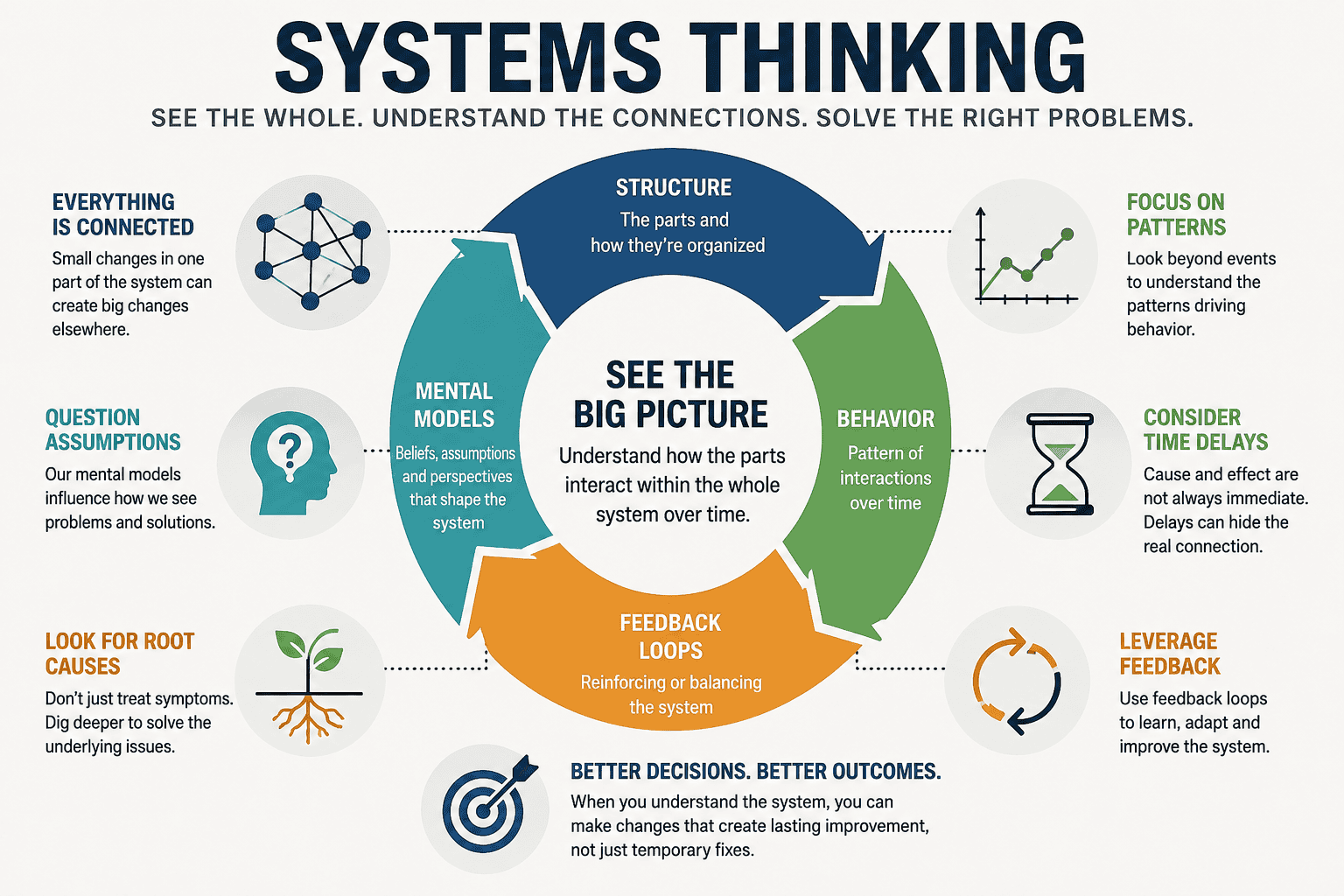
If you’re interested in learning more about systems thinking and how complex systems behave, MIT has published excellent resources on the subject.