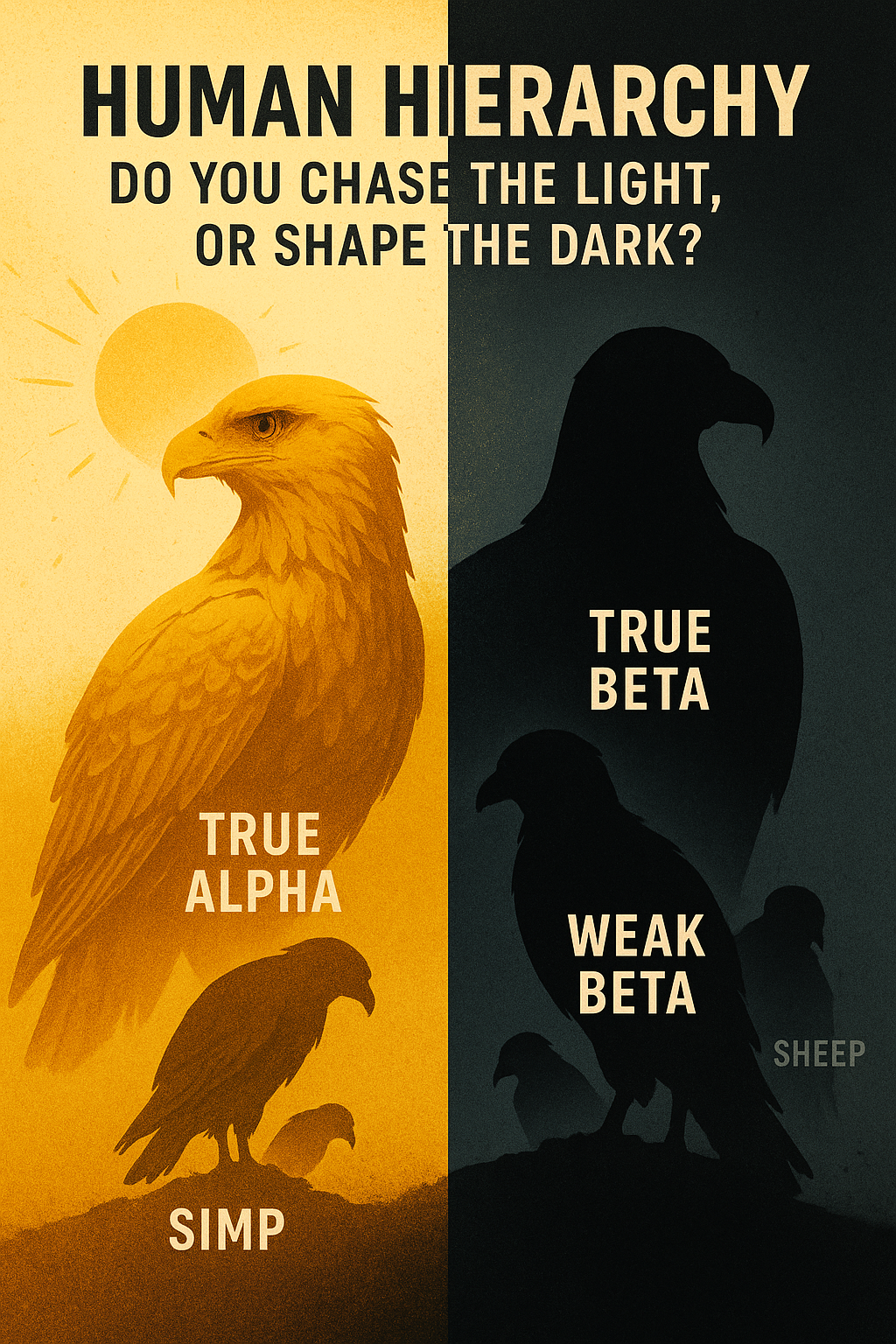
Alpha, Beta, and the Myth of the Hierarchy: Chasing Light, Shaping Shadows
In the previous piece on ego, we examined what happens when insecurity occupies a leadership role and how the need for validation gradually reshapes an institution around protecting the person at the top rather than serving the mission. That piece ended with a question: how do the people working beneath that ego respond? What does it do to a team, a facility, an organization, when the person holding authority is using it to protect themselves?
The answer depends almost entirely on who else is in the room.
The internet has spent years trying to answer that question with a hierarchy; alpha, beta, sigma, and a cascade of labels beneath them, each assigned a status and a set of traits. The conversation is louder than it is useful. Most of what gets said is either a performance of dominance or a reaction against one.
But underneath the noise, there’s a real distinction worth making. Not a ranking. A difference in orientation, toward the light, or toward the work.
The Problem With the Labels
Before going further, it’s worth naming the problem with the existing framework directly.
The alpha/beta vocabulary, as it circulates online, carries a set of assumptions borrowed from outdated animal behavior research, specifically, the idea of a dominance hierarchy where one individual controls access to resources and others defer. Later research, including work by the scientist who originally popularized the “alpha wolf” concept, largely retracted the framework. Wolf packs, it turns out, function more like families than dominance competitions. The alpha is usually just the parent.
The labels persisted not because they were accurate but because they were useful for a particular kind of social performance, a way of claiming status by naming it. Which is, itself, the behavior the labels were supposedly critiquing.
This is the same paradox we’ve traced throughout this series: the anti-authoritarian who becomes authoritarian, the gatekeeper who becomes the gate, the ego-driven leader who reorganizes the institution around themselves while claiming to serve it. The person performing alpha status to compensate for insecurity is the clearest possible demonstration that they don’t have it.
So rather than ranking, what follows is a description of two genuine orientations, toward visibility and toward function, and what each produces in the institutions and teams that depend on them.
Chasing the Light
The first orientation is toward visibility; toward being seen as competent, decisive, and in charge. In moderate amounts, this is healthy. Leadership requires presence. Presence requires some willingness to be visible.
The pathology begins when visibility becomes the goal rather than the byproduct. When the leader optimizes for how things look rather than how they function. When credit matters more than outcomes, and the appearance of decisiveness substitutes for the substance of good decisions.
This is the leader who dominates meetings but delegates the follow-through. Who announces initiatives but doesn’t track results. Who is loudest in the room when things are going well and hardest to find when they aren’t. Their authority is real, they hold the position, control the approvals, set the agenda. But their contribution to actual outcomes is thinner than the room’s perception of them.
The light-chaser isn’t always a villain. Often they’re genuinely convinced they’re contributing because the feedback they receive is calibrated to their preferences, and the people around them have learned that honest feedback is costly. The ego dynamic from the previous piece feeds directly into this one: the leader who can’t tolerate challenge creates a team that stops providing it, and then mistakes the resulting silence for consensus.
What makes this orientation genuinely damaging isn’t the individual. It’s what it does to the people around them. High performers who could shape the work instead spend energy managing upward, translating good ideas into language the ego can accept, timing feedback for when it’s least threatening, covering for decisions that were made for visibility rather than function. The cost is invisible in any single interaction and enormous across a career.
Shaping the Shadows
The second orientation is toward function, toward the work itself, the outcome, the thing that needs to be built or maintained or fixed. Recognition is welcome but not required, because the work itself provides the feedback loop. Did it run? Did it hold? Did the system perform?
This orientation is quieter, more durable, and systematically undervalued by institutions that measure visibility rather than contribution.
The person shaping the shadows isn’t passive. They’re not deferential by nature or conflict-avoidant by default. What they don’t do is perform. They don’t need the room to know they made the call, because they already know whether the call was right. Their confidence doesn’t require an audience because it isn’t constructed from one.
This is the technician who diagnoses the problem nobody else could find and fixes it before the building notices anything was wrong. The project coordinator who resolves three conflicts before the morning meeting without anyone knowing there were conflicts. The senior engineer whose institutional knowledge keeps a system running that, on paper, should have failed years ago. None of them are in the spotlight. All of them are load-bearing.
The paradox, and it connects directly to the oxymoron thread that runs through this entire series, is that the person most capable of leading is often the least interested in performing leadership. The genuine competence doesn’t need the signal. Which means institutions that select for the signal systematically pass over the competence.
What Each Orientation Produces in a Team
These two orientations don’t just describe individuals. They shape the cultures they inhabit.
A team organized around the light-chaser becomes a performance, meetings that are really status displays, reports that are really reputation management, processes that exist to document accountability rather than produce results. The best people in that environment face a choice: adapt to the performance culture, route around it, or leave. Most who can leave, do.
A team organized around the shadow-shaper becomes a function, problems get named honestly because the goal is solving them, not assigning blame. Credit moves toward the work rather than the person claiming it. New people develop faster because the senior members share what they know rather than protecting it as leverage. The institution compounds rather than calcifies.
Neither team is purely one or the other. Most real organizations contain both orientations, in tension. The question is which one the institution’s incentives reward, because over time, what gets rewarded is what gets selected for, and what gets selected for is what survives.
Alpha, Beta, and the Gatekeeping Connection
There’s a direct line from this piece back to the gatekeeping article.
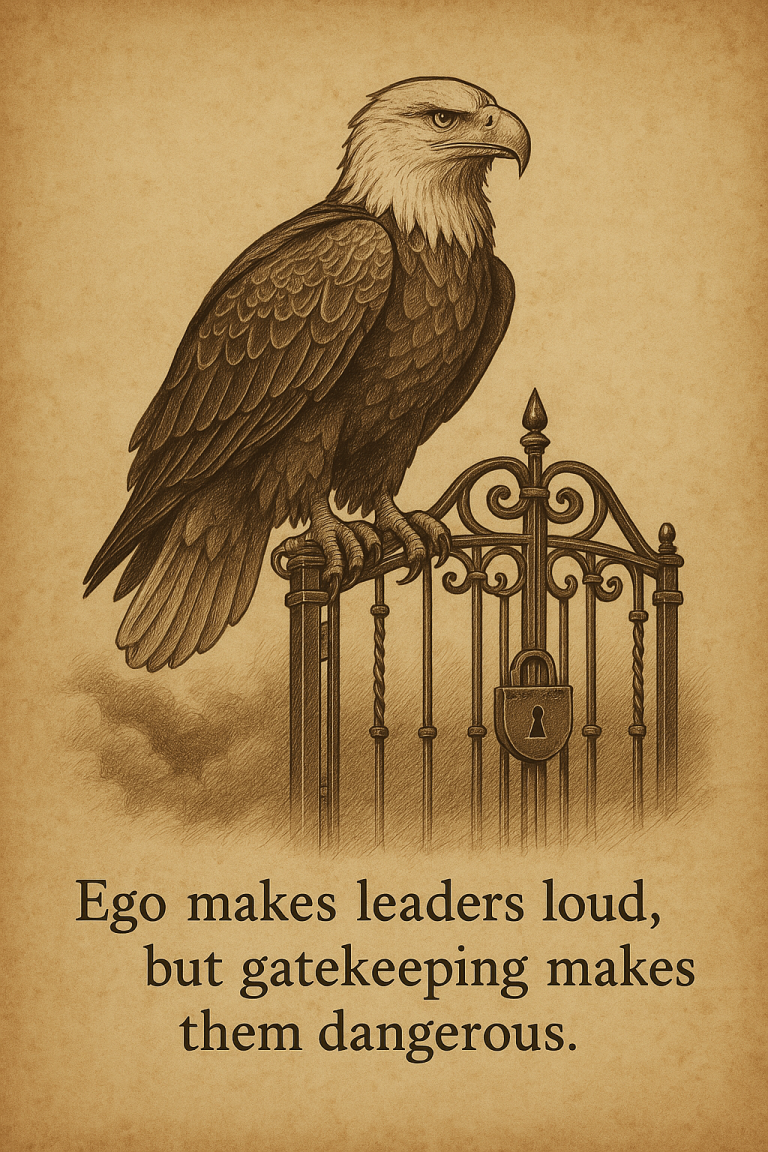
The light-chaser and the bad gatekeeper are often the same person, or at minimum, the same orientation. Both are protecting access. Both are using a position of authority to manage what gets through and what doesn’t, based on what serves them rather than what serves the mission. The gatekeeper who blocks the strong candidate because they feel threatening is the light-chaser who can’t let competence into the room without it reflecting badly on their own.
The shadow-shaper and the good gatekeeper are similarly aligned. Both are interested in the outcome. Both are willing to elevate people whose competence exceeds their own because the goal is the mission, not the credit. The shadow-shaper who mentors a successor, documents their knowledge, and builds a team that functions without them is practicing the same orientation as the gatekeeper who opens the door to the best candidate regardless of relationship or threat.
The orientation, consistently applied, produces the institution.
Alpha and Beta in Facility Operations
Nowhere is the light/shadow distinction more concrete, or more consequential, than in facilities management.
The light-chaser in a facility shows up in the budget presentation and the ribbon cutting. They’re vocal in planning meetings, fluent in the language of initiatives and upgrades, and visibly present when the building commissioner visits. They make the decisions that are visible: the renovation scope, the vendor selection, the system upgrade. What they often don’t do is understand the building deeply enough to know whether those decisions are good ones.
The shadow-shaper is the chief engineer who has been in the mechanical room at 2 AM more times than they can count. The lead technician who knows that the east wing chiller has a harmonic vibration that shows up every summer and that it needs to be addressed before July, not after. The operator who has developed a relationship with a piece of equipment over years and can hear when something is wrong before any sensor fires. They don’t announce what they know. They act on it.
The institutional failure happens when the light-chaser’s decisions override the shadow-shaper’s knowledge, when the renovation scope ignores the input of the people who will maintain the system afterward, when the vendor is selected for the relationship rather than the technical fit, when the upgrade is scheduled for visibility rather than operational timing.
In a facility, the building tells the truth. It doesn’t care about the meeting where the decision was made. It performs or it doesn’t. The pipes don’t know who got credit for the project. The chiller doesn’t care whose name is on the work order.
This is why the shadow-shaper tends to outlast the light-chaser in operations, not in title, necessarily, but in actual influence. The building learns who it can depend on. The team learns who actually knows what they’re doing. Over time, the real authority migrates toward competence whether or not the org chart reflects it.
The facility ops lesson from the alpha/beta framework is simple: hire for the shadow-shaper orientation, build incentive structures that reward function over appearance, document institutional knowledge so it doesn’t leave when the person does, and make sure the people who understand the building most deeply have a clear path to the decisions that affect it.
The Honest Self-Assessment
The framework only matters if it’s applied honestly, and most people apply it to others before themselves.
The light-chaser rarely identifies as one. They experience their visibility as earned, their credit as deserved, their presence as leadership. The feedback loop that would correct this honest challenge from people around them, has usually been filtered out by the same dynamic that produced the problem.
The shadow-shaper often undersells themselves, not out of false modesty but because the work is genuinely the point and the conversation about status feels beside it. This can be its own liability: in institutions that reward visibility, being consistently invisible is a choice with real career costs.
The useful question isn’t “am I an alpha?”, it’s simpler and harder:
When I make a decision, what am I actually optimizing for?
If the honest answer is outcomes, the orientation is toward function. If the honest answer is how the decision will be perceived, the orientation is toward performance. Most people will find, if they’re honest, that the answer varies by context and pressure. That’s not a failure, it’s an accurate reading of the situation. The goal isn’t purity. It’s awareness of which orientation is running in a given moment, and whether it’s serving the right thing.
Where the Series Lands Next
The alpha/beta dynamic doesn’t exist in the abstract. It plays out through specific people, in specific moments, over the course of a career. The final piece in this series examines exactly that — the people you meet, the patterns they represent, and what those encounters teach about the dynamics we’ve been mapping throughout.
Because the framework is only as useful as the recognition it produces. And recognition, in this context, means being able to see the light-chaser and the shadow-shaper not just in institutions and headlines, but in the specific people who shaped how you understand the way things work.
That’s where theory becomes experience. And experience is where all of this actually matters.