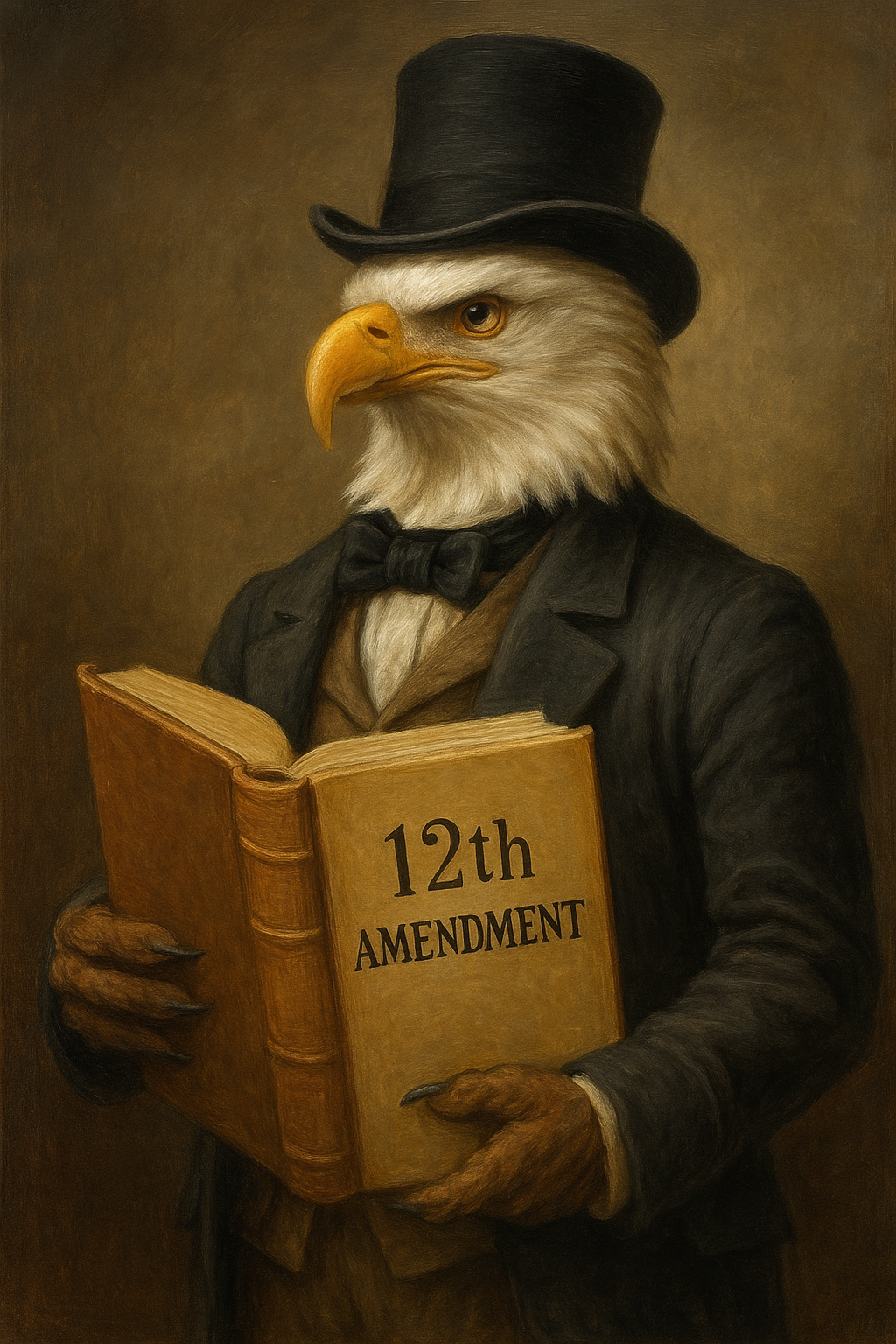
12th Amendment: Elections of the Executive Branch
12th Amendment: Elections of the Executive Branch
“The Electors shall meet in their respective states and vote by ballot for President and Vice-President, one of whom, at least, shall not be an inhabitant of the same state with themselves; they shall name in their ballots the person voted for as President, and in distinct ballots the person voted for as Vice-President…”
Historical Context
- Proposed: December 9, 1803
- Ratified: June 15, 1804
- Why It Happened:
- Originally, electors cast two votes for President. Whoever got the most became President, second place became VP.
- In 1796, John Adams (Federalist) became President, and his rival Thomas Jefferson (Democratic-Republican) became VP — creating a dysfunctional leadership team.
- In 1800, Jefferson and Aaron Burr tied in electoral votes, throwing the election to the House. It took 36 ballots to finally pick Jefferson.
- The Fix: The Twelfth required electors to cast separate votes for President and Vice President.
- Key Impact: Created the modern system of party tickets (President + VP running together).
The Twelfth closed loopholes that nearly tore the young Republic apart.
Simplified Breakdown
- Separate Ballots for President and VP
Translation: No more confusion, electors must clearly choose one for President and one for Vice President. - State Rules Still Apply
Translation: States run elections, but electors must follow this two-ballot process. - House Decides If No Majority
Translation: If no one gets a majority, the House picks the President, and the Senate picks the VP.
How It’s Treated Today
- Party Tickets: The amendment solidified political parties’ role; Presidents and VPs now always run as a team.
- Contingent Elections: The House has only decided twice since 1804 (1824 for John Quincy Adams; 1800 tie predates this amendment).
- Modern Concerns:
- Third-party candidates risk sending elections to the House.
- Critics argue the Electoral College still distorts representation, especially when popular vote winners lose.
- Disputes in 2000 (Bush v. Gore) and 2020 raised questions about whether the Twelfth is strong enough to prevent chaos.
How It Should Be Applied
- Maintain clarity: President and VP should always be distinct roles, not rivals forced together.
- Update processes for tie-breaks and contingent elections to ensure transparency and fairness in the House.
- Consider whether the Electoral College itself (which the Twelfth codifies further) still serves democracy, or if reforms are needed (ranked choice voting, proportional electors).
Core Idea
The Twelfth Amendment fixed early election chaos by separating the offices of President and Vice President. It also cemented the role of political parties in American elections, for better or worse.
Do you think the Electoral College, and by extension the Twelfth Amendment, still makes sense in today’s democracy, or should we move to a direct popular vote?