V-Belt Sizes, Types & Replacement Guide for HVAC
V-belts are simple components, but choosing, installing, and maintaining them correctly can prevent expensive equipment failures. In facility operations, belts commonly drive exhaust fans, air handlers, blowers, pumps, cooling towers, and other rotating equipment.
A belt may cost $20. The bearings, shaft, motor, labor, and downtime it protects can cost thousands.
Understanding Common V-Belts
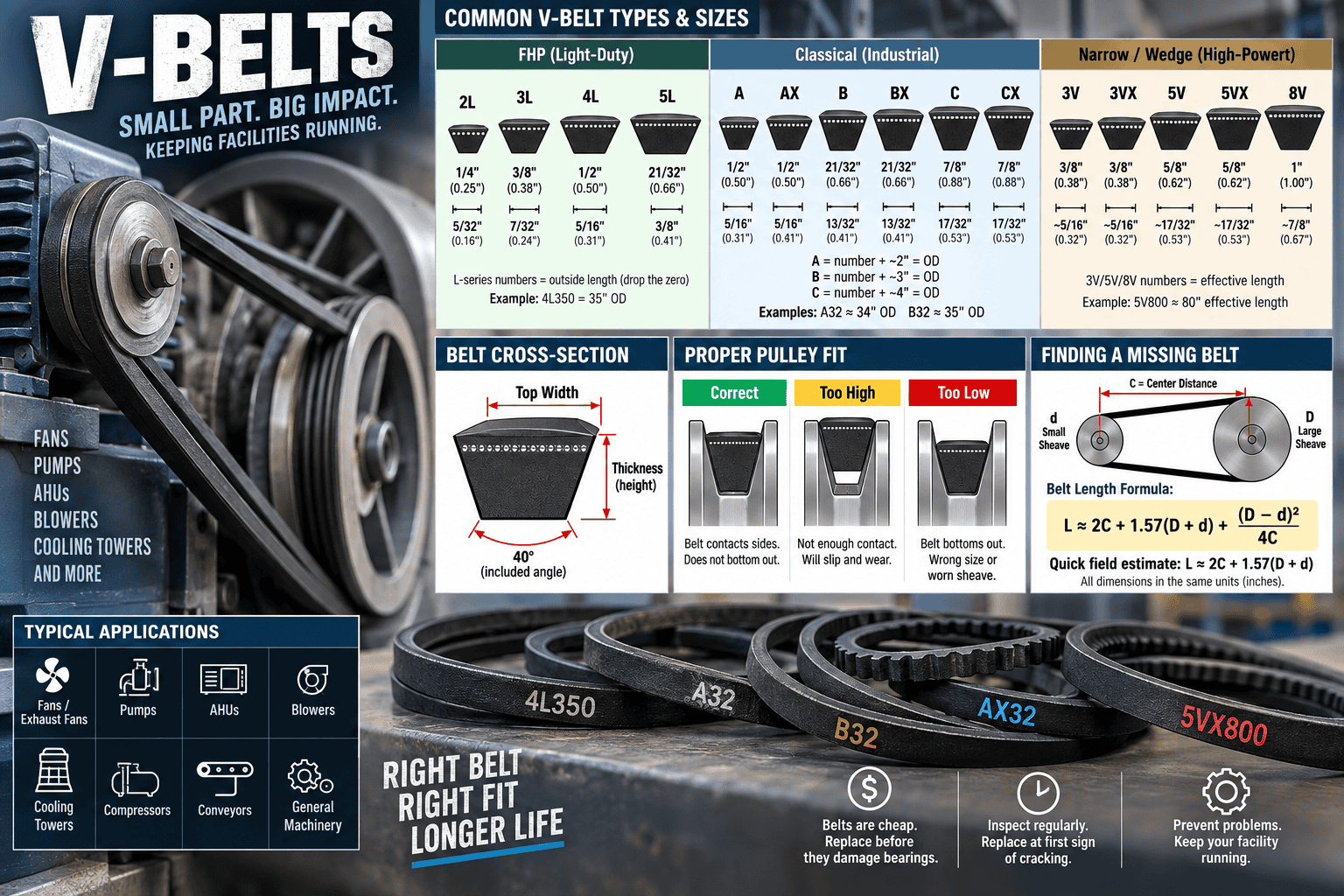
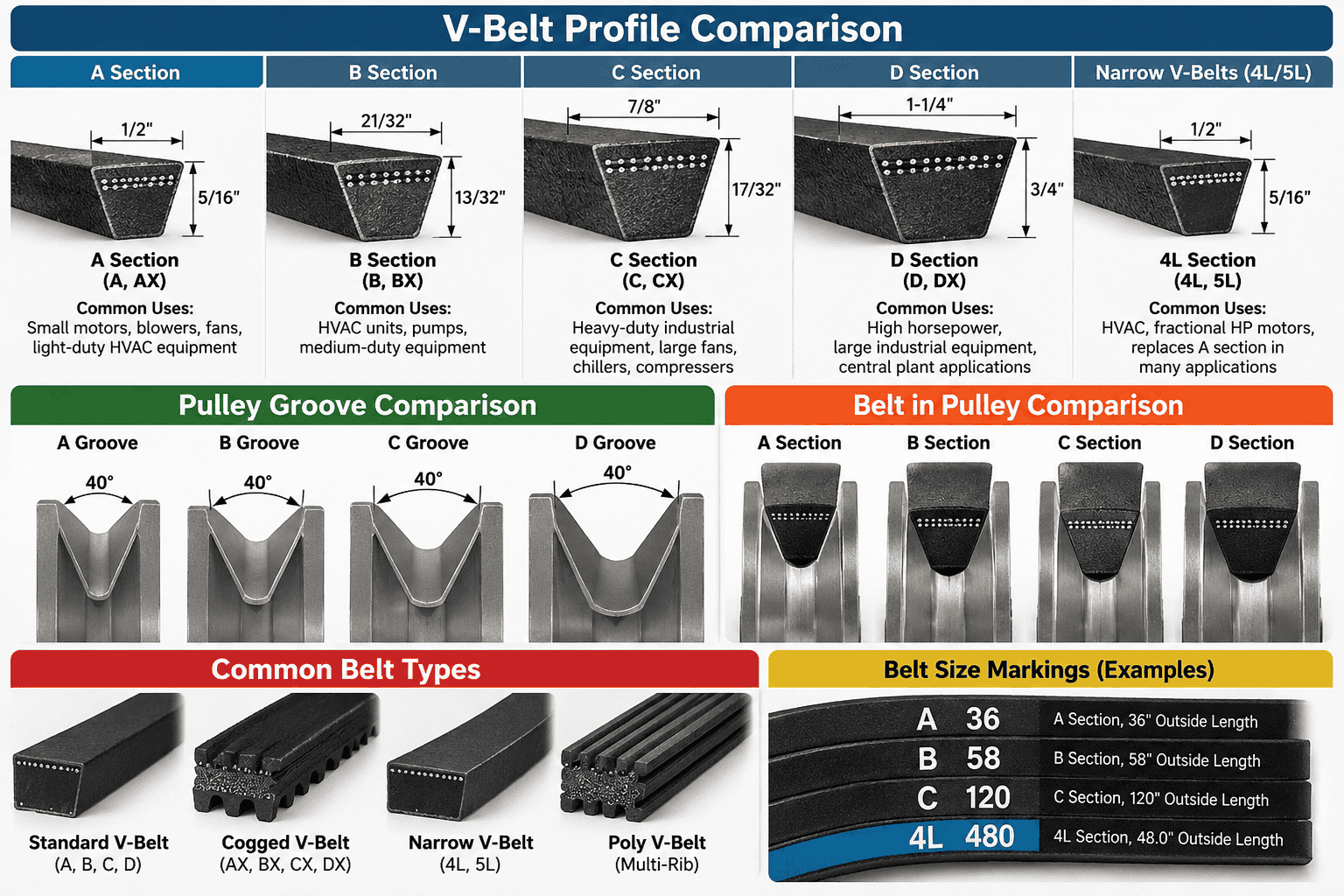
V-belts are identified by their cross-section and length. The most common facility types include:
| Type | Top Width | Approx. Depth | Typical Use |
|---|---|---|---|
| 2L | 1/4″ | 5/32″ | Very small equipment |
| 3L | 3/8″ | 7/32″ | Small exhaust fans |
| 4L | 1/2″ | 5/16″ | Exhaust fans, small blowers |
| 5L | 21/32″ | 3/8″ | Larger light-duty equipment |
| A / AX | 1/2″ | 5/16″ | AHUs, fans, pumps |
| B / BX | 21/32″ | 13/32″ | Large AHUs, pumps, blowers |
| C / CX | 7/8″ | 17/32″ | Heavy industrial equipment |
| 3V / 3VX | 3/8″ | ~5/16″ | Compact higher-power drives |
| 5V / 5VX | 5/8″ | ~17/32″ | High-HP fans and equipment |
| 8V | 1″ | ~7/8″ | Very heavy industrial drives |
The L-series belts are fractional-horsepower belts intended primarily for lighter loads. Classical A, B and C belts are industrial power-transmission belts.
The X, as in AX, BX or 5VX, indicates a cogged/notched construction. Cogged belts flex more easily around smaller sheaves and generally handle heat and demanding drives better.
Narrow 3V, 5V and 8V belts should not be confused with similarly sized L or classical belts. A 3L and 3V may both be roughly 3/8″ wide, but their cross sections and intended loads are very different.
Reading Belt Sizes Quickly
Knowing the numbering system can save considerable time in the field.
With fractional-horsepower belts, the number directly indicates approximate outside length:
4L320 = 32″ OD
4L350 = 35″ OD
5L500 = 50″ OD
Classical belts work differently. A useful field approximation is:
A belt: number + ~2″ = OD
B belt: number + ~3″ = OD
C belt: number + ~4″ = OD
Therefore:
A32 ≈ 34″ OD
B32 ≈ 35″ OD
This also explains why an A32 is closer dimensionally to a 4L340, not a 4L320.
For 3V, 5V and 8V belts, the number generally represents effective length in tenths of an inch. A 5V800, for example, is approximately an 80″ effective-length belt. Use manufacturer specifications when an exact cross-reference is required.
Choosing the Right Belt
As a general facility rule:
2L/3L/4L/5L: fractional and low-horsepower equipment
A/AX: general HVAC and industrial drives
B/BX: larger fans, AHUs, pumps and industrial equipment
C/CX: heavy and legacy equipment
3V/3VX: compact, higher-power drives
5V/5VX: heavy, high-power-density drives
8V: very heavy industrial applications
Horsepower alone does not determine belt size. Motor RPM, sheave diameter, load, belt speed, number of belts and equipment design all matter.
When substituting in an emergency, an industrial belt can sometimes replace a dimensionally equivalent FHP belt. For example, an A-section belt may replace an equivalent 4L in an appropriate sheave.
Going the opposite direction deserves much more caution. A 4L should not automatically replace an A belt on an industrial drive simply because it fits.
Never assume belts are interchangeable based solely on top width.
How a V-Belt Should Sit
A V-belt transmits power primarily through contact with the sides of the sheave groove.
The belt should wedge into the groove without bottoming out.
If a belt rides extremely low or touches the bottom of the groove, look for:
worn sheaves, worn belts, or an incorrect belt section.
If it rides excessively high, verify that the correct belt and sheave profiles are being used.
This is important because a slipping belt is sometimes mistakenly corrected by adding more tension.
That can create a bigger problem.
Excessive belt tension increases radial loading on motor and driven-equipment bearings. A technician can turn an inexpensive belt problem into an expensive bearing failure.
Finding a Missing Belt
Sometimes you arrive at equipment and the old belt is simply gone.
Measure:
D = large sheave diameter
d = small sheave diameter
C = center-to-center shaft distance
A useful field formula is:
Belt Length ≈ 2C + 1.57(D + d)
For greater accuracy:
L ≈ 2C + 1.57(D + d) + (D − d)² ÷ 4C
For example, with a 10″ driven sheave, 4″ motor sheave and 24″ center distance:
48 + 1.57(14) ≈ 70″
The correction term brings it to roughly 70.4″.
That immediately tells you which belt-length range to investigate.
When possible, position an adjustable motor somewhere within its adjustment range rather than at either extreme before determining the final belt.
Free V-Belt Length Calculator for HVAC and Facility Maintenance.
V-Belt Length Calculator
Enter pulley outside diameters and center-to-center distance, in inches.
For an open-belt drive. Uses the common approximate formula L ≈ 2C + 1.5708(D + d) + (D − d)²/(4C). Values are approximate and not suitable for crossed belts.
Find your belt on Amazon: Click Here
Belt Life and Arizona Heat
There is no universal lifespan for a V-belt.
Heat, runtime, alignment, tension, sheave condition, contamination, starts and stops, and equipment load all affect belt life.
Arizona equipment can be especially hard on belts. Rooftop equipment and hot mechanical spaces can accelerate rubber deterioration.
A practical rule is simple:
Once cracking begins, replace the belt.
Belts are consumable components. Bearings, motors, shafts and labor are expensive.
Replacing an inexpensive belt every six months on severe-service equipment may appear wasteful, but replacing several extra belts over the life of a bearing can be considerably cheaper than prematurely replacing the bearing.
A useful maintenance philosophy is:
Belts are consumables. Bearings are assets. Don't sacrifice an asset to maximize the life of a consumable.
Preventive, Predictive and Corrective Maintenance
Belts and bearings are excellent examples of the three major maintenance strategies.
Preventive maintenance occurs at planned intervals. Lubricating bearings, inspecting drives, checking alignment and replacing belts at established intervals are preventive actions.
Predictive maintenance uses equipment condition to determine when intervention is needed. Vibration analysis, temperature trends, ultrasound, belt condition and other measurements can indicate deterioration before failure.
Corrective maintenance occurs after a defect or failure has developed. A broken belt, seized bearing or failed fan requiring repair is corrective work.
A fourth concept is proactive maintenance: finding and eliminating the reason failures keep occurring.
If an AHU destroys belts every three months, don't simply become good at changing belts. Check alignment, sheaves, tension, loading, temperature and installation practices.
The goal of good facility maintenance is not to eliminate every failure. It is to catch deterioration early enough that planned maintenance replaces emergency maintenance whenever practical.
V-Belt Troubleshooting Guide
| Problem | Common Causes | Recommended Action |
|---|---|---|
| Belt Slipping | Loose tension, worn pulleys, excessive load | Check tension, inspect pulley grooves, and verify equipment load. |
| Belt Squealing | Belt slipping during startup, misalignment, improper tension | Adjust tension, align pulleys, and inspect for glazing. |
| Belt Cracking | Age, excessive heat, over-tensioning, environmental exposure | Replace belt, inspect operating temperatures, and verify tension. |
| Premature Belt Failure | Misalignment, incorrect belt size, excessive tension, worn bearings | Verify belt specifications, check alignment, inspect bearings, and correct tension. |
Maintenance Tip: Always inspect pulley alignment, groove wear, and bearing condition before installing a replacement belt. Excessive tension can damage bearings, while insufficient tension causes slipping and heat buildup.
Quick Rules to Remember
L-series = light/fractional horsepower.
A/B/C = classical industrial belts.
3V/5V/8V = narrow, high-power-density belts.
X = cogged/notched version.
4L350 = approximately 35" OD.
A32 ≈ 34" OD.
B32 ≈ 35" OD.
Missing belt? Start with 2C + 1.57(D+d).
Belts drive from the sides of the sheave—not the bottom.
Cracked, glazed, frayed or damaged belt? Replace it.
Never solve every slipping-belt problem by simply tightening the belt.
And above all:
A cheap belt is supposed to wear. Don't destroy expensive equipment trying to squeeze every last hour out of it.