3rd Amendment: Quartering
3rd Amendment: No Quartering
“No Soldier shall, in time of peace be quartered in any house, without the consent of the Owner, nor in time of war, but in a manner to be prescribed by law.”
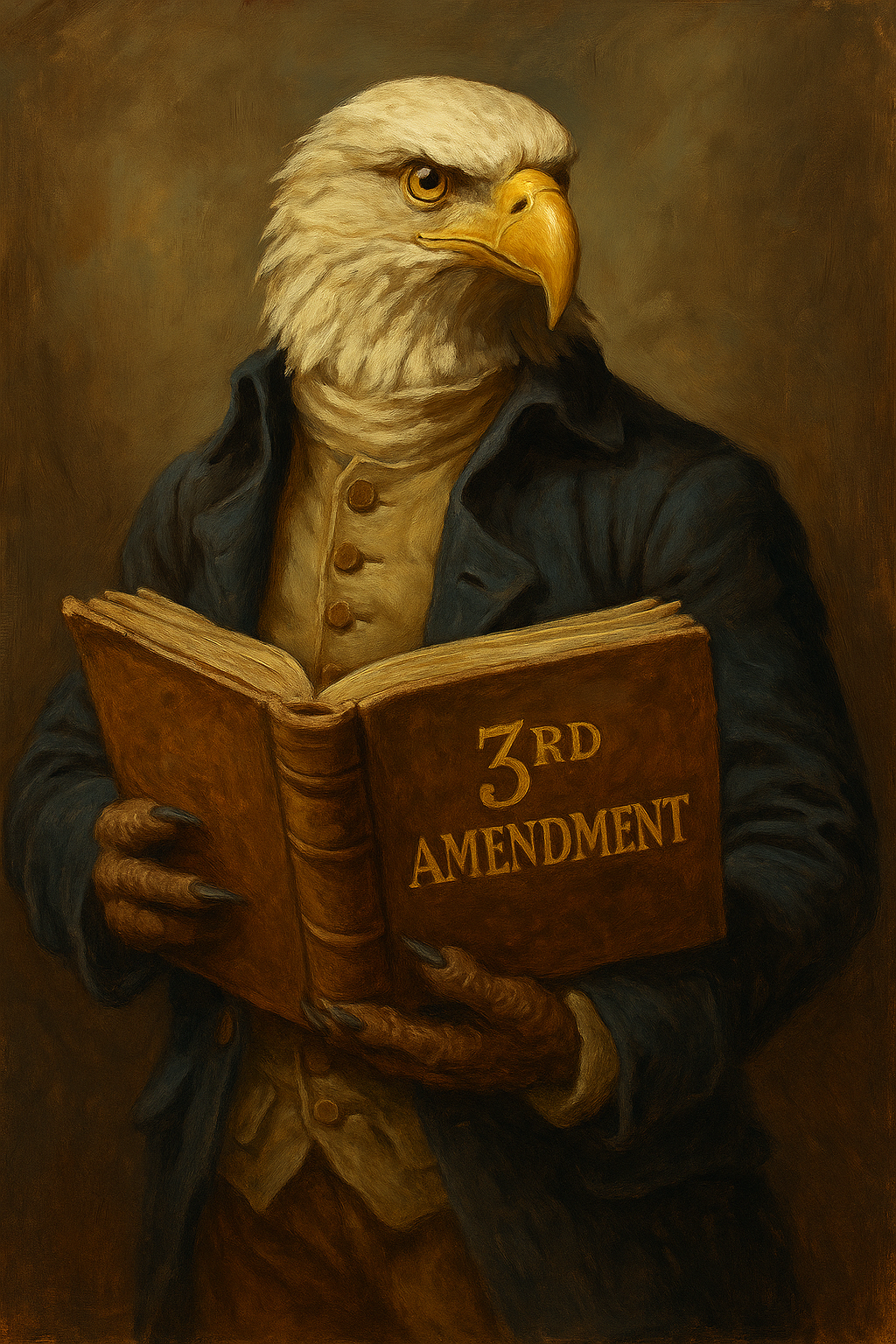
1. No Quartering of Soldiers in Peace
- In colonial times, British troops could be forced into private homes without consent.
Translation: In peacetime, the government cannot put soldiers in your house.
2. In War, Only by Law
- Even in war, Congress would have to pass a law first.
Translation: Military needs don’t override your property rights unless due process is followed.
How It’s Treated Today
- You’ll almost never see a court case directly about quartering soldiers. The U.S. military provides its own housing.
- But the principle still shows up in debates about privacy and government intrusion. Some courts have used it to reinforce the idea that homes are protected spaces.
- It’s also referenced in broader arguments about the limits of emergency powers — how much the government can demand from private citizens during crises.
How It Should Be Applied
- The Third Amendment is more than just “no soldiers in your guest room.” It’s a statement that:
- Your home is your private domain, not an extension of government property.
- Even in war or emergency, government power must remain limited and clearly defined.
- Modern parallels could include:
- Mass surveillance inside the home (smart devices, data collection).
- Emergency housing mandates (if government forced citizens to house refugees, migrants, or disaster evacuees against their will).
- National emergencies (where leaders might argue extraordinary circumstances justify overreach).
Translation: The core idea is timeless; your private space belongs to you. The government must never assume it can cross that line without permission or law.
Core Idea
The Third Amendment may feel outdated, but it’s really about boundaries. If the government can’t force soldiers into your home, it also shouldn’t assume it can invade your privacy, take your property, or commandeer your space in the name of “greater good.”
Do you think the Third Amendment still matters today, or is it only a relic of colonial history? Could modern issues like surveillance or emergency mandates be today’s version of “quartering”?