#17 Andrew Johnson- The Impeached President
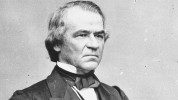
12/29/1808 – 7/31/1875
Party: National Union
Timeline; 1865-1869
Before running with Lincoln, Johnson served in the U.S. house of representatives (1843-1853), was the governor of Tennessee (1853-1857) and in the Tennessee Senate (1875). As Southern slave states, including Tennessee, seceded to form the Confederate States of America, Johnson remained firmly with the Union. He was the only sitting senator from a Confederate state who did not resign his seat upon learning of his state’s secession.
1865;
- At the age of 56, Johnson becomes the 17th President of the United States after Lincoln’s assassination.
- Johnson declares that terms agreed on between Union General Sherman and Confederate General Joseph E. Johnston were too lenient to the Confederates. Johnston surrenders to Sherman later, on harsher terms
- Johnson issues a proclamation offering rewards for the arrests of Confederate leaders Jefferson Davis, Jacob Thompson, and Clement C. Clay, Jr.
- After Lincoln’s funeral train departs D.C. for Illinois, D.C. celebrates the Civil War win as Johnson presides over a series of reviews from the Army of Potomac and Army of Tennessee
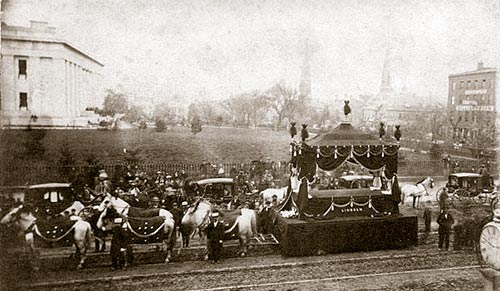
LINCOLN FUNERAL
- Johnson appoints provisional governors of the South to look over his reconstruction plans
- Lincoln is laid to rest in Springfield, IL
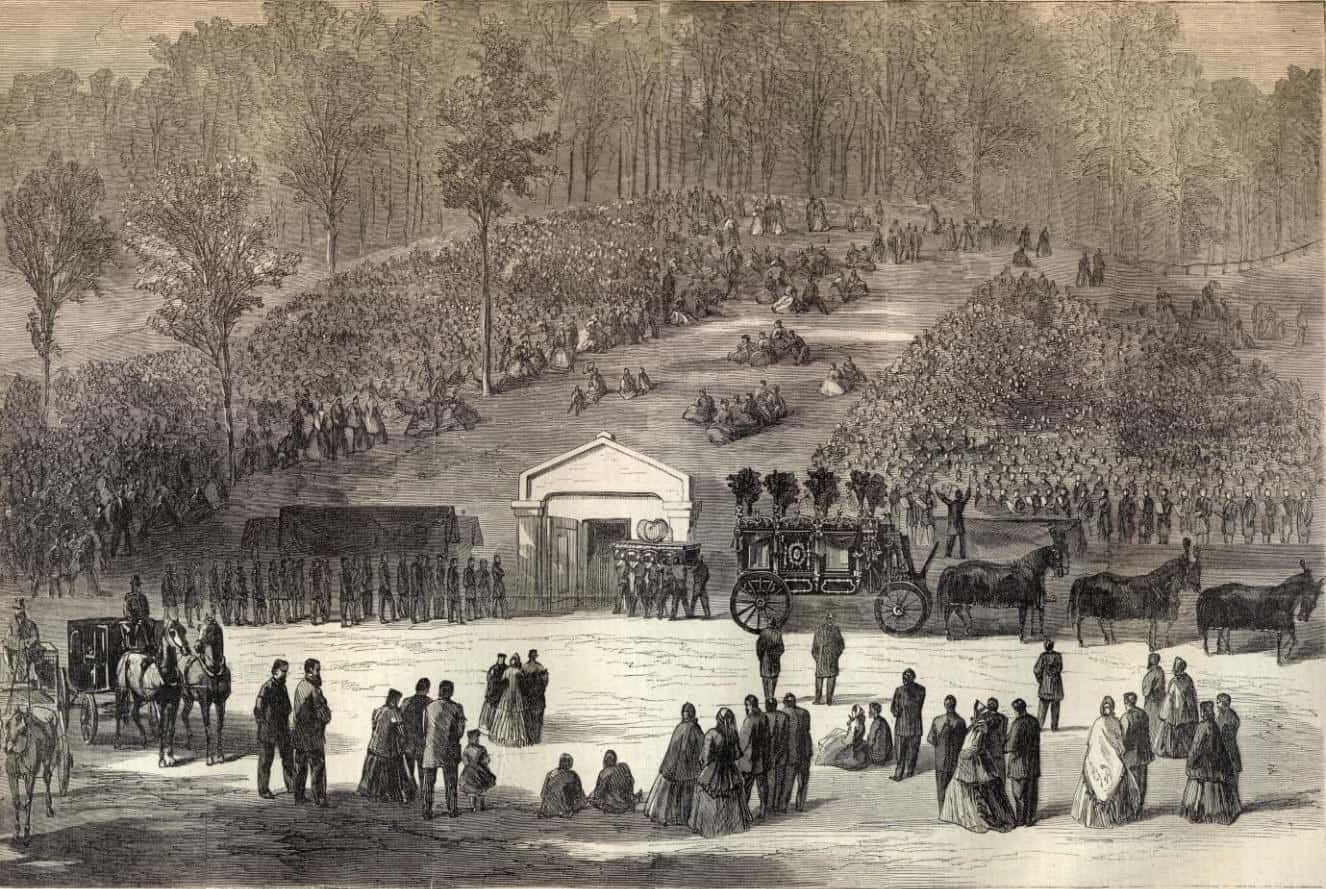
LINCOLN’S TOMB 1865
- Mississippi enacts a Black Code which restricts newly won rights of African Americans in attempts to still keep them inferior. Other ex-Confederate states do the same.
- Johnson orders provisional governors to hand over their positions to the elected successors. Newly elected government are filled with numerous ex-Confederate officials.
1866;
- Johnson vetoes a bill calling for the extension of the Freedmen’s Bureau. The bill is a response to the black codes of the South and would expand the power of the Bureau, the organization formed for the freedmen’s protection.
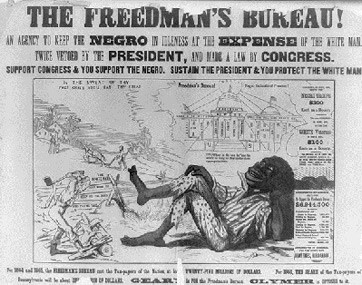
- Johnson vetoes the Civil Rights Act, a second attempt by Congress to provide freedmen with federal citizenship after the failed Freedmen’s Bureau bill, but The Senate overrides Johnson’s veto and three days later, the House of Representatives overrides it as well.
- The Fenian Raid and the Battle of Ridgeway in Canada takes place between Canadian militiamen and members of the Fenian Brotherhood, an Irish-American organization lobbying for a free Ireland. Many of the Fenian participants are Civil War veterans.

FENIAN RAID
- Congress passes and sends the Fourteenth Amendment to the Constitution, to the states for ratification. Not only does the amendment seek to prevent ex-Confederates from holding office, it also establishes the citizenship of African Americans, affirming that “all persons born or naturalized in the United States, and subject to the jurisdiction thereof, are citizens of the United States and of the State wherein they reside.” The amendment, when passed, will overturn the Dred Scott decision of 1857.
- Congress readmits Tennessee to the Union after the state ratifies the Fourteenth Amendment
1867;
- Nebraska becomes 37th state in the Union
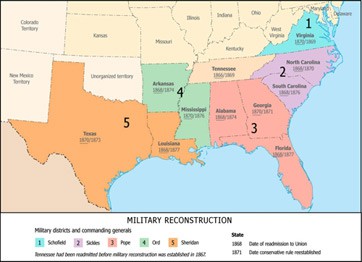
- Despite Johnson’s veto, Congress passes the First Reconstruction Act as well as the Army Appropriations Act. Congress also passes, over Johnson’s veto, the Tenure of Office Act, prohibiting Johnson from removing cabinet officers without the Senate’s consent.
- Johnson vetoes the Seconds Reconstruction Act but Congress overrides that too.
- Johnson vetoes the Third Reconstruction Act, but again, Congress overrides it.
- Johnson and Secretary of War Edwin Stanton disagree on Southern Reconstruction,
Stanton refuses to resign at Johnson’s request so Johnson suspends him and promotes Ulysses S. Grant as interim Secretary of War.
1868;
- Johnson submits his reasons for suspending Stanton to the Senate but the Senate refuses to concur
- Grant informs Johnson that he will vacate his spot for Stanton per the Senate
- Former President Buchanan is laid to rest in Lancaster, PA
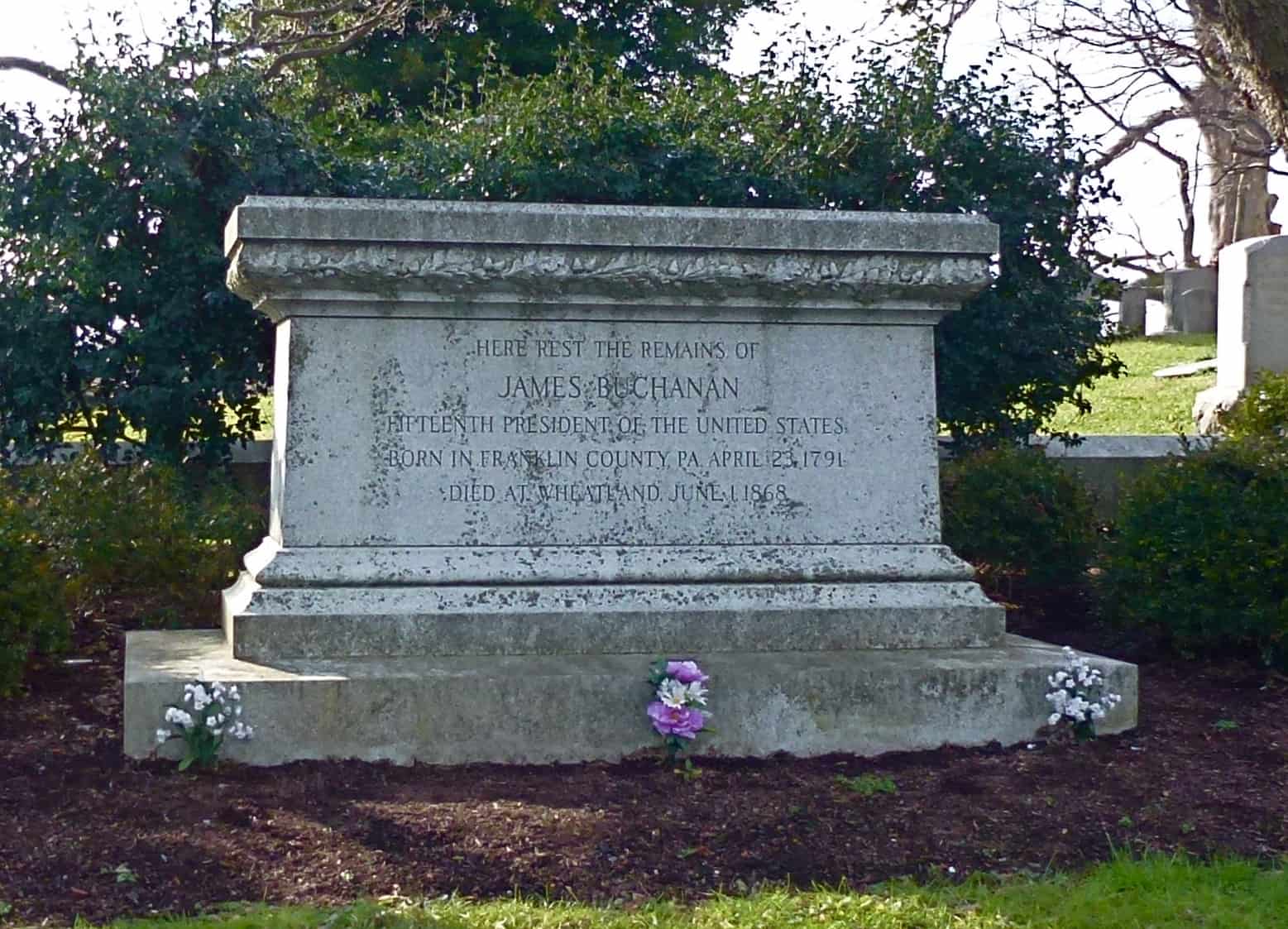
BUCHANAN’S TOMB
- Johnson removes Stanton and gives control of the War Department to General Lorenzo Thomas but Stanton barricades himself in his cabinet office for a couple months. Johnson’s actions violate the Tenure of Office Act and begin the impeachment crisis.
- The House appoints seven managers to go before the Senate with eleven articles of impeachment. Eight of these articles relate to the Tenure of Office Act and the removal of Secretary of War Stanton.
- Senate begins impeachment trials
- The Senate votes 35-19 to convict President Johnson, falling one vote short of the necessary two-third majority. Seven moderate Republicans vote against impeachment. The vote serves as a precedent for standard necessary to convict in impeachment hearings.
- The Senate votes to acquit President Johnson on impeachment charges two and three. The Senate then adjourns and fails to vote on the remaining eight articles of impeachment.
- President Johnson vetoes bills that would have readmitted several ex-Confederate states to the Union. Congress overrides these vetoes.
- Johnson submits the Burlingame Treaty between the United States and China
- President Johnson delivers his final annual message to Congress, again requesting the repeal of the Reconstruction Acts.
Succeeding Lincoln, Johnson found himself in bitter battles with Congress over Reconstruction. Congress tried to impeach him and he was tried by the Senate, but was acquitted by one vote. After Presidency he won another seat on the Senate in 1875 but died later that year due to complications of multiple strokes.
Famous quotes;
“Honest conviction is my courage; the Constitution is my guide”
“There are no good laws but such as repeal of other laws”
“I am sworn to uphold the Canstitution as Andy Johnson understands
it and interprets it”