

Electrical Systems & Skilled Trades
Understanding Power, Wiring, and Real-World Application
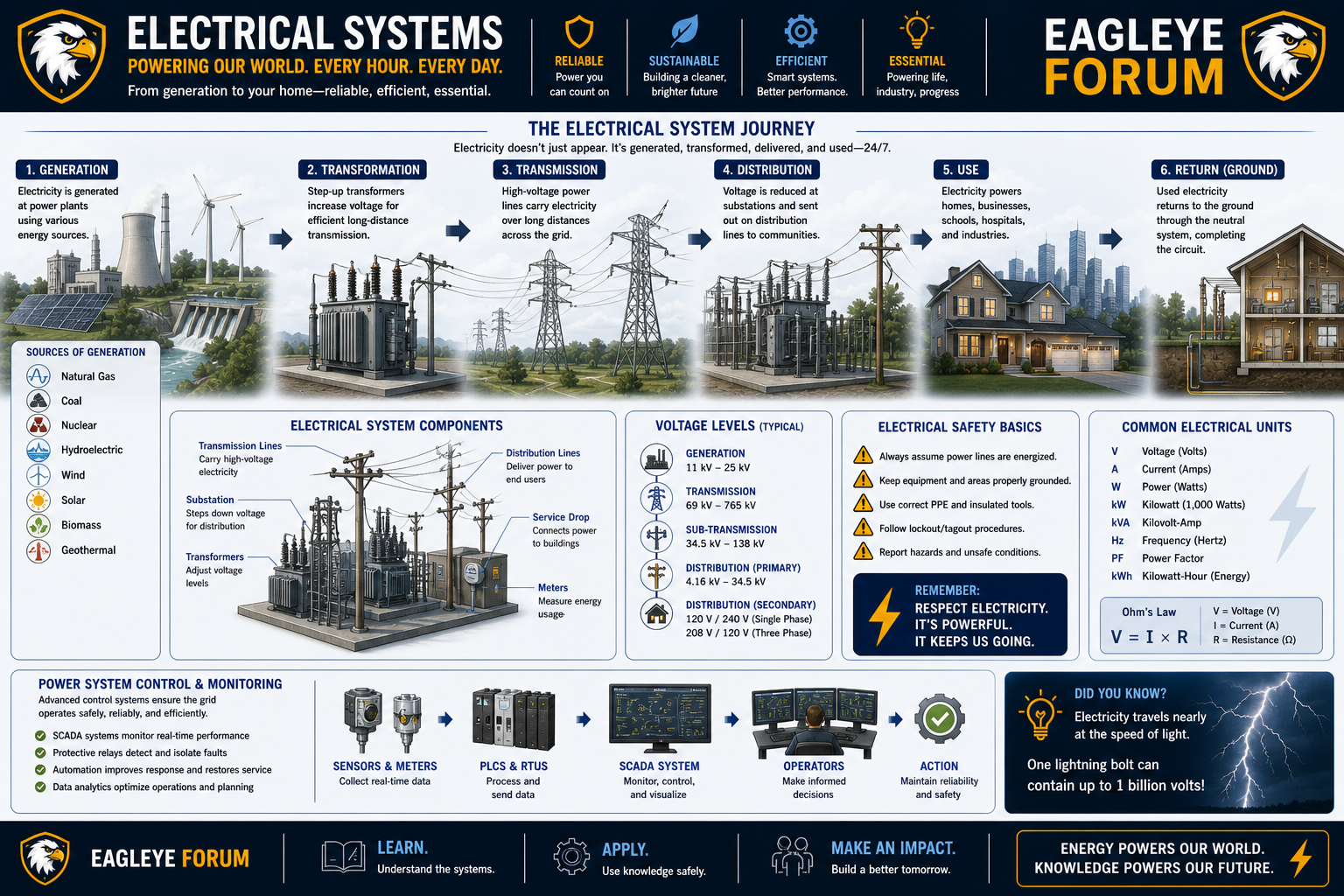
Electricity isn’t just theory—it’s a working system that powers homes, buildings, and entire industries. This page is designed to help you understand how electrical systems are wired, how to read them, how to test them, and how to work on them safely.
Understanding Circuits
Electricity flows in a closed circuit:
- Closed circuit → electricity flows
- Open circuit → flow stops
Example:
- Turning a light switch ON → closes the circuit
- Turning it OFF → opens the circuit
No complete path = no current flow.
Electrical Safety (Non-Negotiable)
Electricity is dangerous and must always be respected.
Key Safety Principles
- Always assume circuits are energized
- Verify with a meter before working
- De-energize whenever possible (LOTO when required)
- Avoid water and wet conditions
- Inspect tools and cords before use
- Never trust wire color alone
- Remove metal jewelry
- Avoid metal ladders near circuits
Important Reality
Electricity can shock, burn, or kill—even at low voltages.
Your body is mostly water, making it a strong conductor. Electrical current can cause:
- Muscle contraction (can’t let go)
- Internal burns
- Cardiac arrest
- Severe injury or death
Jobsite Awareness
Before starting work:
- Check for overhead lines
- Identify underground utilities (call before digging)
- Watch for hidden conductors
- Maintain safe distance from energized systems
Tools Every Electrical Worker Should Know
Basic Tools
- Multimeter (voltage, resistance, continuity)
- Clamp meter (amperage)
- Non-contact voltage tester
- Insulated screwdrivers
- Wire strippers / cutters
- Needle nose pliers
Advanced / Industrial
- Megger (insulation testing)
- Phase rotation meter
- Oscilloscope (controls/troubleshooting)
- Loop calibrator (4–20mA systems)
If you can’t test it, you can’t troubleshoot it.
Wire Color Basics
Color is a guide—not a guarantee. Always verify.
Ground
- Green
- Green-Yellow
- Bare
Alternating Current (AC) Systems
- Black / Red → Hot
- White / Gray → Neutral
Direct Current (DC) Systems
- Red → Positive
- Black → Negative
3-Phase (Typical 480V)
- L1 → Brown
- L2 → Orange
- L3 → Yellow
Control Systems (General)
- Power → Black / Red / White
- Signal → Blue / Violet
- Sensors → Orange / Yellow
- Coils → Brown / Red
Common Voltage Systems (What You’ll See in the Field)
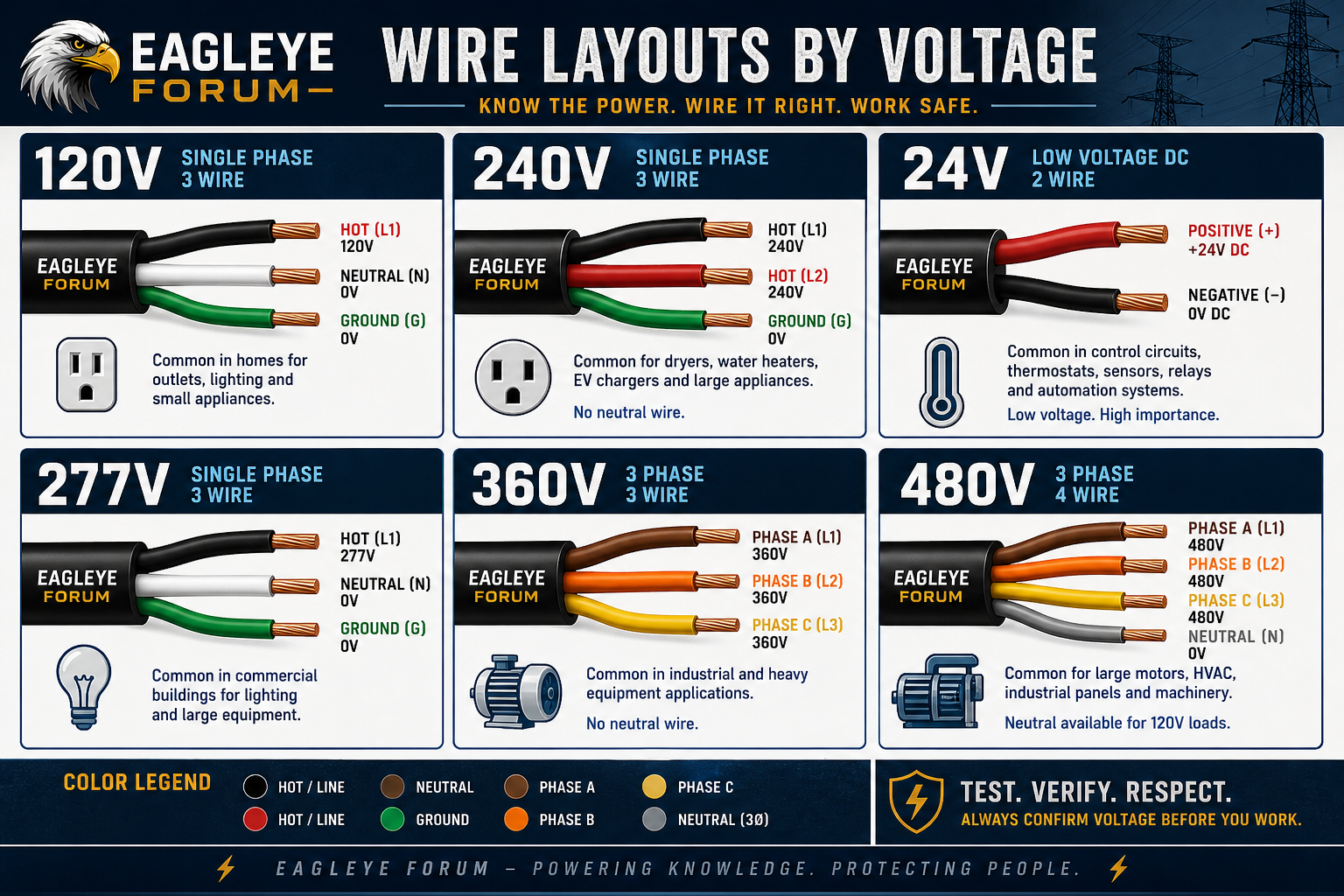
120V (Residential)
- 1 Hot + Neutral + Ground
- Used for outlets, lighting
Expected Readings:
- Hot → Neutral = 120V
- Hot → Ground = 120V
- Neutral → Ground ≈ 0V
🏠 240V (Residential Split Phase)
- 2 Hots + Ground (neutral optional)
Expected Readings:
- Hot → Hot = 240V
- Each Hot → Ground = 120V
🏢 208Y/120V (Commercial Wye)
- 3 Phase + Neutral
Expected Readings:
- Phase → Phase = 208V
- Phase → Neutral = 120V
🏢 480Y/277V (Commercial/Industrial Wye)
- 3 Phase + Neutral
Expected Readings:
- Phase → Phase = 480V
- Phase → Neutral = 277V
- Phase → Ground ≈ 277V
Common for lighting (277V) and equipment (480V)
480V Delta (Industrial)
- 3 Phase, typically no neutral
Expected Readings:
- Phase → Phase = 480V
- Phase → Ground = varies
Wye (Y) vs Delta (Δ) Systems
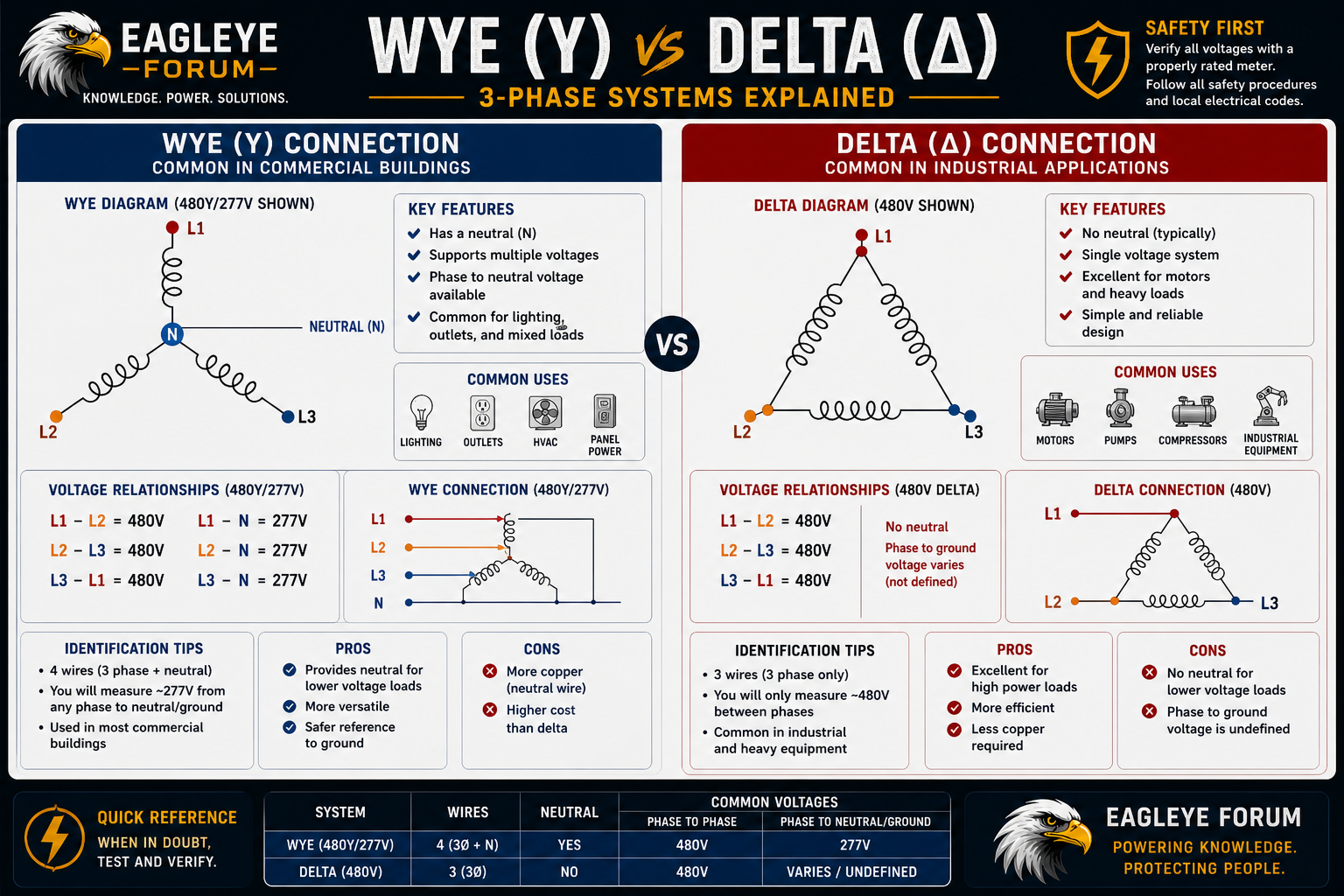
Wye System (Most Common in Buildings)
Features:
- Has a neutral
- Supports multiple voltages
- Safer and more flexible
Why It’s Used:
- Powers lighting + outlets + equipment
- Easy to step down voltage
- Stable reference to ground
Best for commercial buildings
Delta System (Most Common in Industry)
Features:
- No neutral (usually)
- Strong motor performance
- Simple design
Why It’s Used:
- Ideal for heavy loads
- Reliable for motors and machinery
- Can run in degraded conditions (open delta)
Best for industrial applications
Quick Comparison
| Feature | Wye | Delta |
|---|---|---|
| Neutral | Yes | No |
| Voltage Options | Multiple | Single |
| Use | Commercial | Industrial |
| Motor Performance | Good | Excellent |
How to Identify What System You’re On
Use your meter:
- ~120V or 277V to ground? → Wye
- Only phase-to-phase voltage? → Delta
- Weird fluctuating readings? → Possibly ungrounded delta
- One leg = 0V to ground? → Corner-grounded delta
How to Read Electrical Systems (Think Like a Tech)
When approaching a system:
Step 1: Identify Voltage
- Check panel labels
- Confirm with meter
Step 2: Identify System Type
- Wye or Delta?
Step 3: Check Relationships
- Phase-to-phase
- Phase-to-ground
- Neutral presence
Step 4: Confirm Load Type
- Lighting?
- Motors?
- Controls?
This process separates guessing from real troubleshooting.
Best Practices
- Turn power off and test before touching
- Use proper grounding and bonding
- Keep work areas dry
- Replace damaged cords immediately
- Use correctly rated tools and PPE
Why This Matters
Electricity is the backbone of:
- HVAC systems
- Water & wastewater plants
- Industrial automation
- PLC / SCADA / 4–20mA controls
- Homes and commercial buildings
Understanding electrical systems means:
Safer work
Faster troubleshooting
Higher skill value
Better career opportunities
Remember:
- Safety = everything
- Wye = versatility
- Delta = power
- Meters = truth
Want to dive further: